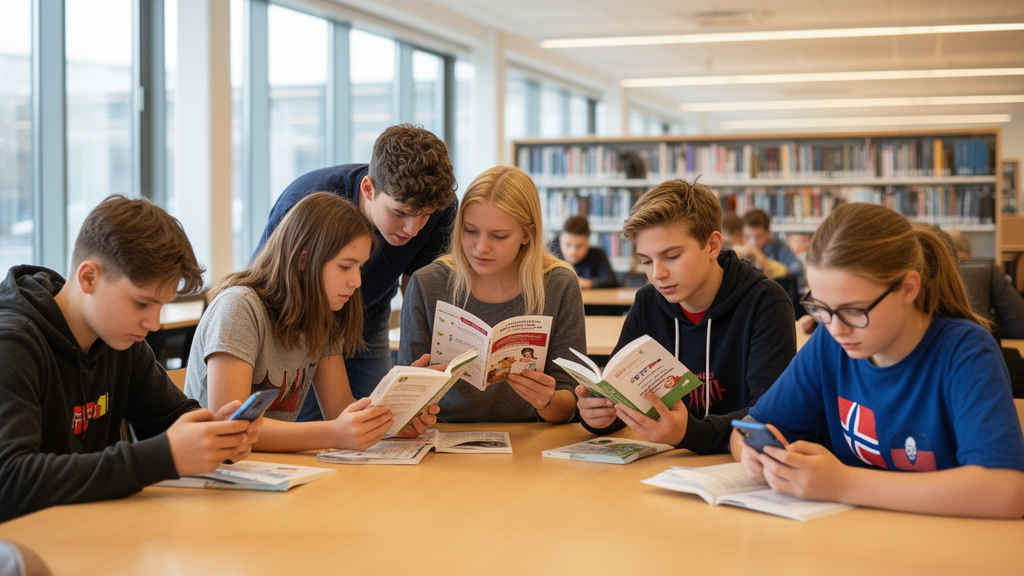
Nearly half of Norwegian teenagers aged 14 to 16 report living with persistent pain, yet a new study suggests that how well they understand and act on health information varies far more widely than a single average score can capture. Researchers at Oslo Metropolitan University and partner institutions surveyed 440 adolescents across six lower secondary schools in southern Norway and, using a data-driven clustering technique, found that the teenagers sorted into four distinct health literacy groups, ranging from a low-scoring group of 16 percent of the sample to a high-scoring group of 24 percent. The overall mean score on the Health Literacy for School-Aged Children instrument was 31.6 out of a possible 40, but that single figure concealed a graded landscape of competencies with clear social patterning.
The study, published in Frontiers in Public Health, is among the first to classify adolescents into health literacy clusters based on their scores across five theoretically defined components of the HLSAC framework: theoretical knowledge, practical knowledge, individual critical thinking, self-awareness, and citizenship. Rather than applying the instrument’s predefined cut-off values, which sort respondents into low, moderate, and high bands, the team applied Ward’s hierarchical clustering method, which minimizes within-group variance and reveals natural groupings in the data. The researchers argued that this exploratory approach captures the complexity of health literacy more faithfully than fixed thresholds, although they acknowledged that choosing the number of clusters involves an element of subjective judgment.
The four-cluster solution emerged after the researchers evaluated alternatives containing two to five groups. A two-cluster solution simply split participants into lower and higher literacy camps with little nuance, while a three-cluster solution produced an uneven distribution and limited additional insight. A five-cluster solution largely reproduced the four-cluster pattern but fragmented the lowest-scoring group into very small subgroups. The four-cluster solution, by contrast, captured the gradient across all five components while maintaining adequate group sizes. Three researchers collaboratively agreed on the solution they considered most clinically meaningful, and the authors note that no evidence-based guidelines exist for what constitutes a relevant difference between component scores.
The composition of the clusters tells a story about where adolescent health literacy is strongest and weakest. Cluster A, the lowest group with a mean total score of 25.3, scored lowest of all on the citizenship component, at 4.4 out of 8, reflecting limited capacity to consider how personal actions affect the health of others and society. Cluster B, the largest group at 31 percent of the sample, showed a relative strength in practical knowledge but its weakest score in individual critical thinking, the ability to evaluate the credibility of health information and seek deeper understanding. Cluster C scored highest on self-awareness, while Cluster D, the highest group with a mean total of 37.1, excelled in practical knowledge at 7.7, with its lowest scores still a respectable 7.2 in critical thinking and citizenship.
Across every cluster, the components measuring critical thinking and citizenship tended to receive the lowest scores. The authors suggest this may reflect how health literacy develops over time, with more advanced components potentially demanding greater cognitive effort or life experience, though they caution that the components are not strictly hierarchical and may overlap. Lower scores on the more advanced components may reflect variations in health literacy rather than inherent difficulty, underscoring the importance of considering individual and contextual factors in shaping adolescent competencies. At the item level, the questionnaire item with the lowest mean score in the whole sample asked adolescents to give ideas on how to improve health in their immediate surroundings, while the highest-scoring item measured their ability to follow instructions given by health personnel.
The regression analysis revealed a pronounced social gradient. Adolescents who aspired to complete a college or university degree had an 83 percent lower relative risk of belonging to the lowest literacy cluster compared with the highest, after adjustment for other factors, and a 59 percent lower relative risk of belonging to the second-lowest cluster. Having a father with a college or university education was associated with a 63 percent lower relative risk of membership in the lowest cluster. Gender mattered in a more limited way: boys had a 51 percent lower relative risk than girls of belonging to the second-lowest cluster rather than the highest, a finding the authors note runs counter to previous research showing girls generally achieve higher health literacy scores across several countries, possibly linked to stronger school engagement and academic performance.
Persistent pain, reported by 48 percent of the sample, did not reach statistical significance as a predictor of cluster membership, although the lowest-literacy cluster contained the largest share of adolescents with pain, at 56 percent, compared with 43 percent in the highest cluster. The authors frame this cautiously: research on the relationship between health literacy and pain in adolescents remains sparse, and adult studies have reported small to large associations between literacy and pain intensity, possibly because people with higher literacy manage pain more effectively. Adolescent pain, they note, is shaped by a complex interplay of individual and environmental factors, and any relationship with literacy may be mediated by variables the analysis did not capture.
The study’s methods were designed with care. Data were collected between March and September 2023 through an encrypted web-based questionnaire completed in classrooms, with school health service staff and the first author present to answer questions. The questionnaire was pilot-tested by six adolescents, whose feedback prompted layout corrections and spelling fixes. Participation was voluntary with written parental consent, and no adolescent with consent declined to take part. Of 940 eligible students, 472 completed the survey, a response rate of 50 percent that varied between 42 and 66 percent across schools, and 440 had complete outcome data. The HLSAC instrument showed good internal consistency in this sample, with a Cronbach’s alpha of 0.87.
The authors are candid about the limitations. The HLSAC instrument, originally developed and tested among Finnish adolescents aged 13 and 15, has not been validated in Norwegian for the 13-to-15 age group, and no Norwegian reference studies exist. Although the instrument is built on five theoretical components, psychometric testing established it as a one-factor measure, so the clusters should be interpreted as reflecting theoretically informed components rather than empirically established subscales. Self-reported measures may introduce reporting bias, particularly for sociodemographic background, and school-level clustering of participants was not accounted for in the analyses. Lower participation in some schools may also limit generalizability to the broader adolescent population.
Even with those caveats, the findings carry weight for anyone concerned with adolescent health. Health literacy is increasingly recognized as a determinant of health in its own right, equipping people to access, comprehend, and act on health information in an environment saturated with sources ranging from peers and parents to social media and commercial enterprises. In this sample, 71 percent of adolescents turned to digital sources, including internet, social media, and ChatGPT, when seeking information about pain or injuries, while 80 percent relied on parents, family, or friends. The observation that critical appraisal skills lag behind other components across all four clusters suggests that helping teenagers question and verify what they read about health may be one of the most valuable investments schools and health services can make, particularly for the one in six adolescents whose overall literacy profile places them at the low end of the spectrum.
Subject of Research: Health literacy clusters and their social determinants among Norwegian adolescents aged 14-16
Article Title: Health literacy among adolescents: a cluster analysis
Article References: Veshovda, S., Richardsen, K. R., Andersen, M. H., Øiestad, B. E., Eik, H., & Riiser, K. (2026). Health literacy among adolescents: a cluster analysis. Frontiers in Public Health, 14, Article 1853107. https://doi.org/10.3389/fpubh.2026.1853107
Image Credits: AI Generated
DOI: 10.3389/fpubh.2026.1853107
Keywords: health literacy, adolescents, cluster analysis, Norway, HLSAC instrument, persistent pain, parental education, academic ambition, critical thinking, public health, cross-sectional study, gender differences
News Source: Ophelia Keating. (October 26, 2026). Norwegian Teenagers Fall Into Four Distinct Health Literacy Groups, Study Finds. Scienmag.