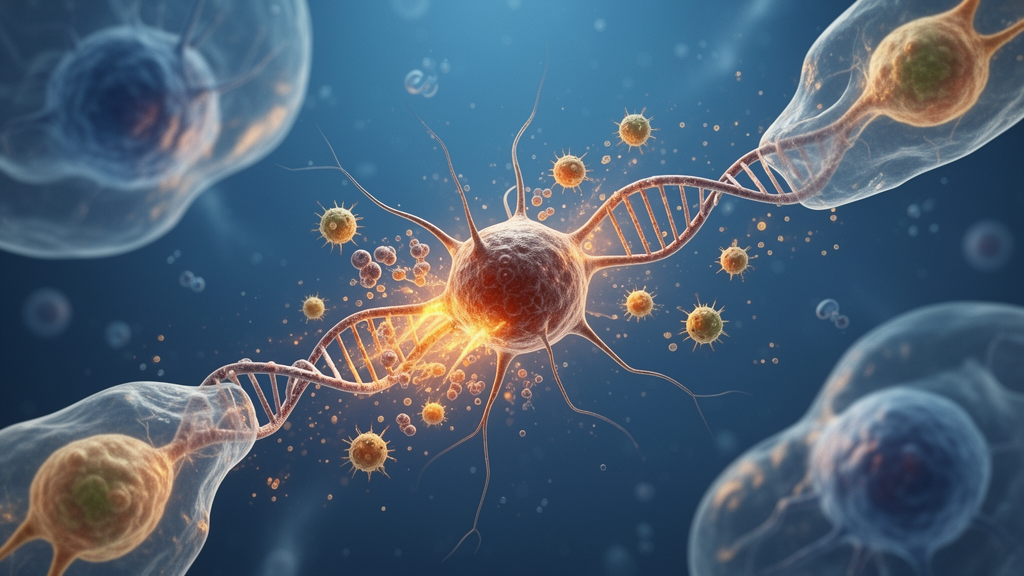
A peer-reviewed review concludes that aging may sustain brain inflammation when damaged nuclear or mitochondrial DNA escapes into the cytoplasm and keeps the cGAS–STING immune-signaling pathway active. The authors at Huashan Hospital, Fudan University, describe this pathway not as the sole cause of neurological disease, but as a shared immune hub that can translate several forms of cellular injury into chronic neuroinflammation. Their synthesis connects age-related genomic and mitochondrial damage with persistent signaling across microglia, astrocytes, neurons and brain endothelial cells.
The central mechanism begins with misplaced self-DNA. During aging, oxidative stress, tissue injury, genomic instability and mitochondrial damage can release nuclear DNA or mitochondrial DNA, or mtDNA, from its normal compartment. Cytosolic double-stranded DNA is detected by the sensor cGAS, which produces cGAMP. cGAMP then activates STING, promoting its movement from the endoplasmic reticulum to the Golgi apparatus and initiating type I interferon and inflammatory signaling. The same pathway is briefly useful during infection, but its biological effect depends on the DNA source and location, responding cell type, signaling duration and whether the response is properly terminated.
The review emphasizes that the transition from protection to pathology may depend less on activation itself than on its persistence. Short-lived cGAS–STING activity supports antimicrobial defense, cellular homeostasis and removal of damaged material. Earlier work cited by the authors also showed that the pathway can be linked to cellular senescence and can trigger autophagy to clear cytosolic DNA. With aging, however, genomic instability and mitochondrial damage may increase the supply of abnormal DNA while declining autophagy–lysosomal clearance makes it harder to remove. An acute response that should resolve can therefore become chronic, low-grade inflammation, a loss of reversibility the authors identify as a key feature of inflammaging.
Mitochondrial DNA is presented as especially important because mitochondria contain many copies of mtDNA, generate reactive oxygen species and are vulnerable to oxidative damage. Mitochondrial stress can release mtDNA into the cytoplasm or extracellular space, where misplaced or oxidized DNA can activate cGAS–STING in several brain cell types. The resulting signals are associated in the reviewed evidence with glial activation, blood-brain barrier injury and neuronal damage. This provides a possible bridge between metabolic dysfunction and neuroinflammation, although the review does not establish that the pathway initiates any individual disorder or that inhibiting it would reverse an established disease.
Different neurological disorders may converge on the same signaling hub through distinct upstream stresses. Parkinson’s disease is discussed in relation to alpha-synuclein pathology, Alzheimer’s disease to amyloid-beta and Tau abnormalities, and amyotrophic lateral sclerosis/frontotemporal dementia to C9orf72- and TDP-43-associated organelle stress. Ischemic stroke can involve oxidized mtDNA released after ischemia–reperfusion injury. Across these conditions, nuclear DNA damage, mitochondrial dysfunction and mtDNA leakage may all feed into sustained cGAS–STING activity. The authors therefore portray the pathway as one possible amplifier of neuroinflammation rather than a universal cause, while proposing that future work distinguish disease-specific DNA sources, dominant responding cell types and stages of signaling.
The review also identifies several points at which experimental interventions might be tested in the future, but it does not report a clinical therapy or establish human treatment benefits. Candidate strategies include reducing the generation or leakage of inflammatory self-DNA, restoring mitochondrial or autophagic clearance, limiting intercellular cGAMP transmission, or selectively modulating cGAS–STING in particular cell types and disease stages. Such an approach would aim to restrain pathological signaling while preserving the pathway’s roles in antimicrobial defense and immune surveillance. Demonstrating that balance would require further evidence, including clearer identification of the relevant DNA sources, cell populations and therapeutic windows. The authors also call for research that integrates genome stability, mitochondrial homeostasis, metabolism, immune microenvironments and cell-to-cell communication to reveal more precise opportunities for studying or treating neuroinflammatory disease.
Subject of Research: A review of cGAS–STING signaling, DNA damage and persistent neuroinflammation during aging
Article Title: When DNA sounds a lasting alarm: cGAS-STING links aging to brain inflammation
Article References: When DNA sounds a lasting alarm: cGAS-STING links aging to brain inflammation. Original publication (Bibliographic details unavailable.)
Image Credits: AI Generated
DOI: Not provided
Keywords: cGAS–STING, brain inflammation, aging, self-DNA, mitochondrial DNA, microglia, cellular senescence, autophagy, neurodegeneration, sounds, lasting, alarm
News Source: Cassandra Pierce. (October 26, 2026). Aging DNA alarm links cellular stress to persistent brain inflammation. Scienmag.