A modeling study of more than 7,000 fossils and records representing over 400 living and extinct species suggests that crocodiles and their relatives may have survived the Chicxulub asteroid impact partly by following warm climates into equatorial and subtropical refuges. Led by University College London researchers and published in Science Advances, the study examined the environmental preferences of pseudosuchians across 245 million years and modeled how those preferences might have affected their chances of surviving the extinction event 66 million years ago. The results indicate a possible geographic advantage, not proof that climate preference alone caused the lineage to survive.
The researchers inferred the temperature and rainfall preferences of 400 pseudosuchian species by combining fossil records, evolutionary trees and detailed maps of where living crocodilian species occur today. They then mapped suitable habitats over time using reconstructions of Earth’s climate and geography. The analysis showed that crocodile relatives generally tracked warm climates: during the early Eocene hothouse, about 50 million years ago, when global temperatures were about 10°C higher than today and polar regions were ice-free, they occupied high latitudes in North America, Europe and Antarctica. As the planet cooled over the following millions of years, their range contracted toward the tropics. The pattern was not universal. During the Cretaceous Thermal Maximum, about 94 million years ago, when global temperatures were up to around 14°C higher than today, one branch of the crocodile family tree adapted to temperatures beyond the tolerance shown by the broader lineage at other times. Around 34 million years ago, an extinct group of Australian crocodiles adapted to drier, desert-like conditions as a prolonged cooling interval reduced rainfall and the continent dried out.
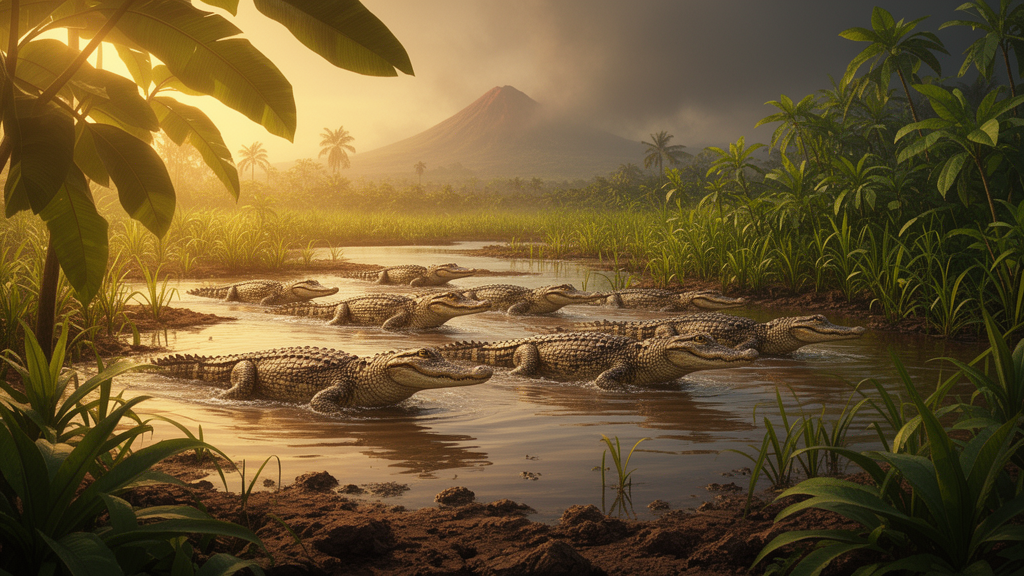
To examine conditions immediately after the asteroid impact, the team modeled changes in climate and geography across scenarios involving reduced sunlight from atmospheric ash and dust and increased atmospheric carbon dioxide associated with volcanic eruptions. Under assumptions of 5% and 10% reduced sunlight, warm regions around the equator remained suitable for crocodile relatives. At 15% less sunlight, those regions no longer met the modeled climate requirements, although the researchers described this more extreme scenario as currently considered unlikely. Scenarios involving increased carbon dioxide did not alter modeled climate suitability for the group. These simulations suggest that equatorial and subtropical refuges may have offered places where crocodile relatives could persist as widespread climatic disruption followed the impact. They do not directly establish the physiology, abundance or eventual recovery of populations at the time, and earlier modeling by members of the same team found that suitable climates for non-avian dinosaurs contracted much more sharply.
Pseudosuchians appeared around the same time as dinosaurs and have survived two of Earth’s five mass extinctions. Although living crocodilians appear similar to one another, their fossil relatives were highly varied, including heavily armored plant eaters, terrestrial predators and animals that could move on two legs as well as on four. The ancestors of the group included giants weighing more than a tonne. Well-known examples include Sarcosuchus, a giant predator that reached about 12 meters in length, and Postosuchus, a terrestrial hunter that could move on two legs or on all fours. Lead author Alfio Alessandro Chiarenza said the asteroid did not make the planet equally hostile to every group. The lineage’s long-standing preference for warm environments may have placed survivors where suitable conditions persisted, with equatorial refuges potentially sheltering populations that later recovered and radiated outward. The authors emphasized that climate did not fully explain survival: smaller body size, semi-aquatic lifestyles, flexible diets and the low energy needs of ectothermic animals probably also helped.
Because the study is retrospective, it combines fossils, evolutionary relationships, present-day distributions and reconstructed climates rather than observing the extinction directly. Its central result is that the crocodile lineage’s relationship with climate remained comparatively consistent even while its anatomy, ecology and diversity changed greatly. The findings also have implications for living species. If crocodilians have often coped with climate change by moving toward suitable habitats, current populations will need space for similar movements as the planet warms. Professor Philip Mannion said roads, farms and cities are making that room harder to find. The modeling therefore points to a possible role for climate tracking in crocodilian survival while leaving the relative contributions of habitat movement, biological traits and other ecological factors unresolved.
Subject of Research: Climate tracking as a possible factor in crocodilian survival across the Chicxulub mass extinction
Article Title: Keeping to warm climates helped crocodiles outlast the dinosaurs
Article References: Keeping to warm climates helped crocodiles outlast the dinosaurs. Original publication (Bibliographic details unavailable.)
Image Credits: AI Generated
DOI: Not provided
Keywords: crocodilian evolution, mass extinction, Chicxulub asteroid, climate modeling, pseudosuchians, fossil records, climate refuges, Cretaceous, Eocene, conservation, Keeping, warm
News Source: Gavin Prescott. (October 26, 2026). Warm-climate tracking may have helped crocodilian relatives survive the dinosaur extinction. Scienmag.