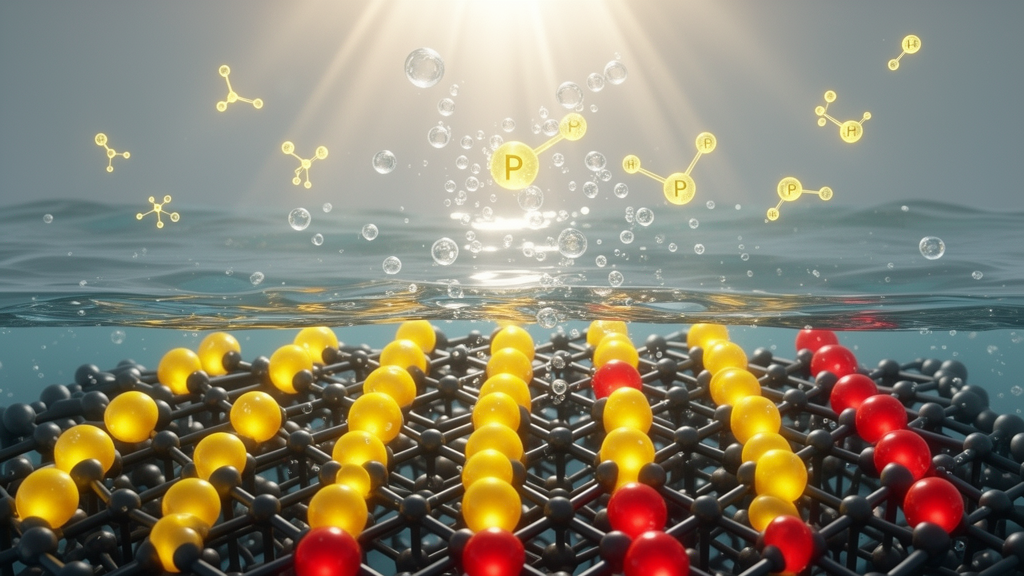
Hydrogen peroxide is one of the most useful chemicals on the planet, quietly underpinning everything from water disinfection to green chemical synthesis and energy storage. Yet the way we make it has barely changed in decades. More than 95 percent of global hydrogen peroxide still comes from the anthraquinone process, an industrial route that demands sprawling infrastructure, consumes enormous amounts of energy, and generates considerable chemical waste. Now, a research team has reported a strikingly different approach: a metal-free photocatalyst that produces hydrogen peroxide directly from water and molecular oxygen using nothing but sunlight. The key, according to the study, lies not simply in adding two different dopants to a catalyst, but in making sure those dopants are chemically bonded to each other at the atomic scale.
The material at the heart of the work is graphitic carbon nitride, a polymeric semiconductor built from heptazine units that has long fascinated photocatalysis researchers. It absorbs visible light, resists chemical degradation, and offers a tunable electronic structure, all without containing a single metal atom. But pristine carbon nitride has a stubborn flaw: photogenerated electrons and holes recombine almost as fast as they are created, and charge transfer across its surface is sluggish. Researchers have tried doping it with phosphorus, sulfur, or boron to fix this, and while such strategies can narrow the band gap and create reactive surface sites, single-heteroatom doping often introduces highly localized electronic states that act as charge-trapping centers, accelerating recombination rather than suppressing it. The result has been only modest performance gains.
Co-doping with two heteroatoms has been widely explored as a next step, but the new study raises an uncomfortable question about much of that literature: are the two dopants actually cooperating, or are they merely coexisting? In most reported co-doped systems, the spatial correlation between dopants within the carbon nitride framework is rarely verified. The dopants may sit independently in the lattice, and the observed improvement may arise primarily from increased dopant concentration and independent electronic perturbations rather than genuine cooperative interactions. The research team set out to resolve this ambiguity by engineering phosphorus and sulfur dopants that are directly coordinated within the same heptazine unit, forming a covalent P–S linkage embedded in a conjugated N–P–S–C motif. Phosphorus and sulfur were chosen because their differences in electronegativity and compatible p-orbital symmetry create cooperative donor–acceptor interactions within the lattice.
Density functional theory calculations provided the first evidence that this correlated configuration is more than a theoretical curiosity. Among all screened models, the co-doped configuration with phosphorus at a carbon site and sulfur at an adjacent nitrogen site in direct atomic correlation is the most stable, with a formation energy of −1.04 eV. That value is substantially lower than the minimum of −0.29 eV for all isolated phosphorus and sulfur configurations, confirming that the directly bonded P–S motif is thermodynamically preferred over spatially separated substitution. Structural relaxation revealed measurable local geometric distortion, with P–N and S–C bond lengths elongated relative to the standard C–N bond length of 1.35 Å, reflecting the larger atomic radii of phosphorus and sulfur, and an out-of-plane displacement of the sulfur atom accommodated by the intrinsic layer buckling of carbon nitride.
The electronic consequences of this correlation are profound. Band structure calculations showed that singly phosphorus-doped carbon nitride, while narrowing the band gap, develops nearly flat defect-derived bands close to the Fermi level, with a strong contribution from P 3p states indicating highly localized trap-like states. The atomically correlated P–S model, by contrast, preserves the beneficial bandgap modulation while markedly suppressing those deep localized features. The band dispersion near the frontier states becomes more continuous, and the projected density of states shows stronger hybridization among the C 2p, N 2p, P 3p, and S 3p orbitals, indicating long-range electronic connectivity. Charge density difference analysis reinforced the picture: in singly doped material, pronounced charge depletion occurs at the phosphorus center with a Bader charge of +1.73 |e|, whereas the correlated system shows a more spatially distributed charge redistribution with values of +1.09 |e| for phosphorus and +0.19 |e| for sulfur, indicating cooperative charge sharing rather than excessive carrier trapping.
Proving that the synthesized material actually contains bonded P–S pairs, rather than independent dopants, required an arsenal of spectroscopic techniques. X-ray photoelectron spectroscopy showed a P 2p doublet at 132.4 and 133.3 eV, shifted toward lower binding energies compared with singly doped samples and consistent with phosphorus coordinated to neighboring nitrogen and sulfur atoms. The S 2p spectrum displayed a doublet at 161.3 and 162.8 eV, characteristic of sulfide-type sulfur in a low-oxidation-state bonding environment, with the low value consistent with P–S bonding and no features above 166 eV that would indicate surface oxide species. Synchrotron X-ray absorption spectroscopy delivered perhaps the most diagnostic evidence: the S K-edge spectrum of the co-doped catalyst exhibits an additional shoulder at approximately 2471.5 eV, absent in singly sulfur-doped material, indicating sulfur atoms directly coordinated to phosphorus.
Pair distribution function analysis of synchrotron X-ray scattering data then resolved the local atomic environments directly. The PDF profile of the co-doped catalyst displays an additional feature at 1.74 Å, absent in pristine carbon nitride, and only structural models containing directly bonded P–S pairs at adjacent C1 and N2 sites reproduce this feature. Models with isolated phosphorus or sulfur substitutions fail to reproduce it, confirming that the peak arises from covalent P–S bonding rather than independent heteroatom incorporation. The best-fitting model, containing two pairs of atomically correlated P–S sites, yielded the lowest refinement residual at 14.12 percent. Correlated substitution also elongates the first-shell C–N distance from 1.35 to 1.39 Å and increases the N–N pair distance from 2.65 to 3.08 Å, reflecting dopant-induced reorganization of the heptazine network.
With the atomic structure established, the performance numbers are remarkable. Under visible-light irradiation at 420 nm in oxygen-saturated pure water at neutral pH, without any sacrificial agents, the co-doped catalyst delivers a hydrogen peroxide generation rate of 229 µmol g⁻¹ h⁻¹, an elevenfold enhancement over pristine bulk carbon nitride at 20.9 µmol g⁻¹ h⁻¹ and a 6.5-fold improvement over exfoliated nanosheets. Critically, a physical mixture of singly doped catalysts with identical dopant ratios produced only 101 µmol g⁻¹ h⁻¹, comparable to the singly doped systems, providing direct evidence that the superior activity originates from atomically correlated P–S sites rather than the cumulative effect of independent dopants. The catalyst achieved an apparent quantum yield of 13.01 percent at 380 nm and 6.80 percent at 420 nm, with a solar-to-chemical conversion efficiency of 0.89 percent in the first hour and 0.49 percent after three hours, placing it among the top-performing metal-free carbon nitride systems under sacrificial-agent-free conditions.
Selectivity is where the correlated sites truly earn their keep. Rotating ring-disk electrode measurements showed that the co-doped catalyst maintained an electron-transfer number close to 2 across the applied potential range, while pristine carbon nitride exhibited values exceeding 3.00, indicating competition from deeper oxygen reduction. The co-doped catalyst achieved a hydrogen peroxide selectivity of 92 percent at 0.5 V versus RHE, compared to only 50 percent for the pristine framework. Scavenger experiments identified superoxide radicals as the critical intermediate, since benzoquinone substantially suppressed production while tert-butanol had minimal impact. Temperature-programmed desorption revealed substantially higher oxygen surface uptake, and in-situ synchrotron-radiated FTIR spectroscopy captured the sequential formation of superoxide, hydroperoxyl, and adsorbed hydrogen peroxide intermediates, together with an O–O stretching band at 892 cm⁻¹ confirming a two-step, single-electron pathway that preserves the O–O bond throughout the reaction sequence.
The team went further, verifying the complete reaction balance with isotope-labeling and stoichiometric bookkeeping. Isotopic experiments in H₂¹⁸O under a ¹⁶O₂ atmosphere confirmed that the oxygen atoms in the produced hydrogen peroxide originate primarily from molecular oxygen rather than water, while steadily increasing gas-phase ¹⁸O₂ signals confirmed that evolved oxygen derives from water oxidation. Over 24 hours, the reaction yielded approximately 119 µmol of oxygen and 240 µmol of hydrogen peroxide, an O₂/H₂O₂ ratio of 0.49 consistent with the theoretical value of 0.5, confirming that photogenerated holes are consumed by four-electron water oxidation at the same rate as electrons are consumed by oxygen reduction. Stability testing showed the catalyst retained 89.4 percent of its initial rate over six consecutive cycles and 88.65 percent over a continuous 24-hour run, with cumulative hydrogen peroxide reaching 4816 µM. Post-reaction XRD, FTIR, and XPS analyses confirmed no phosphate or sulfate features and no oxidative decomposition of the P–S sites. The work establishes atomic-scale dopant correlation, rather than simple co-doping, as a governing design principle for regulating redox selectivity in metal-free photocatalysts, offering a general route toward efficient solar-to-chemical energy conversion.
Subject of Research: Atomically correlated phosphorus–sulfur co-doping in graphitic carbon nitride for photocatalytic hydrogen peroxide production
Article Title: Atomically Correlated Phosphorus–Sulfur Sites in Carbon Nitride for Efficient Hydrogen Peroxide Production
Article References: Ahmad, A., Abass, G. F., Naing, M. T., Yang, C., Gunawan, D., Huang, H., Zhai, Q., Lu, T., Cox, N., Dai, L., Amal, R., Frankcombe, T. J., & Liu, Y. (2026). Atomically Correlated Phosphorus–Sulfur Sites in Carbon Nitride for Efficient Hydrogen Peroxide Production. Advanced Science, 13(59), Article e76839. https://doi.org/10.1002/advs.76839
Image Credits: AI Generated
DOI: 10.1002/advs.76839
Keywords: photocatalysis, hydrogen peroxide, carbon nitride, co-doping, oxygen reduction, solar fuels, density functional theory, water oxidation, metal-free catalyst, synchrotron spectroscopy, Atomically, Correlated
News Source: Denise Maddox. (October 25, 2026). Correlated Phosphorus–Sulfur Sites Supercharge Solar Hydrogen Peroxide Production. Scienmag.