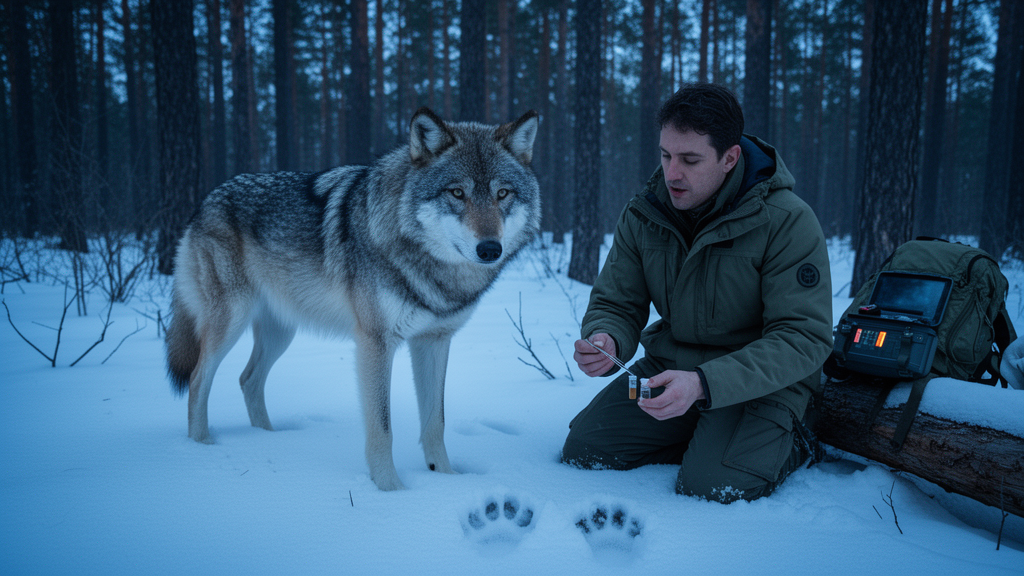
Genetic tests designed to catch wolves mating with domestic dogs can be badly misled by something far more mundane: the wolves' own family history. A new study from Czechia shows that when a wolf population is a mosaic of several distinct lineages, routine hybrid-detection methods can flag pure wolves as dog hybrids, misassign wolves to dog clusters, and inflate apparent admixture. Only after the researchers explicitly accounted for the population structure within the wolf dataset did the picture resolve: out of 380 genetically monitored wolves, a single recent wolf-dog hybrid was confirmed, and there was no evidence of ongoing dog introgression into the population.
The problem stems from a fundamental feature of wolf-dog genetics. Gray wolves and domestic dogs diverged only within the last thousands to tens of thousands of years, which is far too recent for most of the genome to have developed reciprocal monophyly, the state in which each species carries its own exclusive set of genetic variants. Instead, wolves and dogs still share vast stretches of ancestral polymorphism.
On top of that, the easily detected first-generation hybrids are rare in most natural systems, and introgression typically proceeds through repeated backcrossing that progressively dilutes dog ancestry. Routine monitoring compounds these difficulties because it usually relies on non-invasive samples such as scats, hair, and saliva, which yield little and often fragmented DNA, and classical monitoring still predominantly depends on short tandem repeat (STR) loci rather than genome-wide data. Together, these factors make hybrid detection exquisitely sensitive to analytical assumptions and marker choice.
Czechia offers an unusually demanding test case. The country lies at the crossroads of three genetically differentiated wolf populations: the Central European lowland population, the Carpathian population, and the Alpine population. Wolves from these lineages have dispersed into the country and admixed with one another, producing individuals with varying degrees of wild-wild population admixture.
Most hybridization studies, the authors note, have been performed on genetically rather homogeneous populations or have paid limited attention to structure within their datasets, even though admixture among wild populations can be misinterpreted as domestic introgression, generating false-positive hybrid assignments or masking true hybrids. The stakes are not merely academic: in Europe, hybrid classification can affect legal status, reporting under conservation frameworks, and management decisions, and in Slovakia alleged hybrids were among the main reasons for changing the protection status of wolves and re-establishing their hunting. The research team collected 2,413 samples over four wolf years.
Only 1,245 of them, 51.6 percent, met the quality threshold of at least 13 successfully amplified STR loci needed for an acceptable consensus genotype, with success rates ranging from 39.8 percent for kill swabs to 88.5 percent for tissues. Clustering analyses then removed 60 samples identified as foxes and 41 as dogs, and identity analysis consolidated the remaining genotypes into 380 individual wolves, the final monitoring dataset. The sensitivity analysis delivered the study's most striking warning.
When the researchers ran the full wolf dataset alongside comparative dogs without accounting for population structure, the Bayesian clustering program STRUCTURE found the strongest support for just two clusters, and a large proportion of the wolves clustered with dogs or showed varying degrees of wolf-dog admixture. NewHybrids, a program explicitly designed for hybrid classification, misclassified some pure wolves as pure dogs or assigned them to various hybrid categories. Only the principal component analysis clearly separated dogs and wolves.
In other words, the very methods routinely used in monitoring produced inconsistent and, in the clustering analyses, plainly erroneous assignments simply because the wolf dataset contained internally differentiated lineages that the algorithms tried to accommodate. STRUCTURE analysis of the wolf dataset itself showed the strongest support for two population clusters. Applying a 0.8 assignment threshold allocated 275 individuals to one cluster, 84 to the other, and left 21 with mixed ancestry between the two wolf lineages.
The researchers then built a conservative, monitoring-compatible workflow that screens each wolf cluster separately against comparative dogs and calibrates decision thresholds with simulations. Using HYBRIDLAB, they simulated genotypes of parental wolves and dogs and of F1, F2, and backcross hybrids, deriving thresholds from the most wolf-like hybrid class, the wolf-backcross BC1W, which is expected to be the hardest to detect. The resulting thresholds were 0.9150 for one cluster and 0.9108 for the other in STRUCTURE, and 0.9599 and 0.9484 in NewHybrids.
The calibration revealed the deliberate trade-off at the heart of the design. Ten to twenty percent of simulated pure wolves fell below the derived thresholds and would be incorrectly flagged as potential hybrids, but none of the simulated F1, F2, or BC1W individuals were misclassified as pure wolves, achieving a zero percent type II error rate. This conservatism is intentional: in early-warning monitoring, missing a true hybrid could have substantial conservation or regulatory consequences, so the screening step is expected to over-flag.
Applying the thresholds to the empirical data, 15 individuals failed the criteria for pure wolf status in the STRUCTURE analyses and 20 in NewHybrids, with all 15 STRUCTURE-flagged animals also below threshold in NewHybrids. Verification with independent marker systems told a very different story. Mitochondrial DNA, which traces maternal lineages, was successfully amplified in 19 of the 20 suspect animals and revealed six haplotypes previously described in European wolves, including w1, the most common haplotype in the Central European lowland population, and w6 and w14, typical of the Carpathian population.
These haplotypes imply local origin rather than atypical maternal ancestry. The decisive test came from a targeted SNP panel specifically designed for wolf-dog admixture detection in non-invasive samples, with markers showing strong allele-frequency differentiation between wolves and dogs. In the SNP analysis, 19 of the 20 individuals clustered with wolves with assignment probabilities of 0.945 or higher and showed a 1.0 posterior probability of belonging to the wolf category in NewHybrids.
They were confirmed as pure wolves. The remaining individual, CW24_212, showed intermediate values and was considered a hybrid. The confirmed hybrid was detected only once, in March 2024, from a scat sample in Krkonoše National Park in northern Czechia, and was never redetected despite continued intensive monitoring through fall 2025.
Its results were ambiguous across analyses: when compared with one wolf cluster it appeared more wolf-like, but when compared with the other it was assigned to the dog cluster with a probability of 0.9774, and NewHybrids gave its highest posterior probability, 0.9445, to the pure dog category. The SNP analysis assigned it to the dog cluster with a probability of 0.799 and a posterior probability of 0.99141 to the dog-backcross BC1D category, placing it outside both parental clusters but closer to dogs. It carried the mitochondrial haplotype w19, which occurs in wolves but is also commonly detected in domestic dogs, consistent with a dog-associated maternal lineage.
The researchers conclude the evidence points to an isolated, non-recurring event involving a dog-associated individual with wolf ancestry, not ongoing hybridization or the establishment of a free-ranging admixed lineage. The low prevalence fits the ecological context. High hybridization rates reported across Europe are commonly linked to large populations of free-ranging dogs, particularly in southern regions, whereas Czechia has few free-ranging dogs, which are controlled.
Wolf hunting can disrupt population dynamics and create a lack of conspecific mating partners, fostering wolf-dog mating, but the gray wolf is strictly protected in Czechia and its hunting is prohibited by national nature protection and hunting laws. The authors argue their findings support a tiered approach in which cost-effective STR genotyping retains high operational value for large-scale screening, rapid species verification, individual identification, and parentage testing, while standardized SNP assays provide robust confirmation for the limited subset of ambiguous cases. They also caution that assignment thresholds are marker- and dataset-specific and must be recalibrated if the marker set or comparative dog composition changes, and that late-generation backcrossing remains difficult to distinguish from background variation without genome-wide data.
As wolf populations expand and recolonization brings lineages into contact, the researchers say, reproducible pipelines that explicitly incorporate population structure and independent validation will be essential wherever hybrid classification carries management consequences.
Subject of Research: Wolf-dog hybridization detection confounded by wolf population structure in Czechia
Article Title: Wolf-dog hybridization: Population structure confounds genetic assignment and hybrid classification
Article References: Cetkovská, E., Eliášová, K., Šrutová, J., Tkáčová, N., Matějů, P., Jelínková, J., Kutal, M., Vorel, A., Nowak, C., Hulva, P., & Černá Bolfíková, B. (2026). Wolf-dog hybridization: Population structure confounds genetic assignment and hybrid classification. iScience, 29(11), Article 117980. https://doi.org/10.1016/j.isci.2026.117980
Image Credits: AI Generated
DOI: 10.1016/j.isci.2026.117980
Keywords: wolf-dog hybridization, population structure, conservation genetics, STR markers, SNP panel, Czechia, gray wolf, genetic monitoring, introgression, STRUCTURE, NewHybrids, backcrossing
News Source: Juliet Wilcox. (October 25, 2026). Hidden Wolf Population Structure Confounds Genetic Tests for Dog Hybrids. Scienmag.