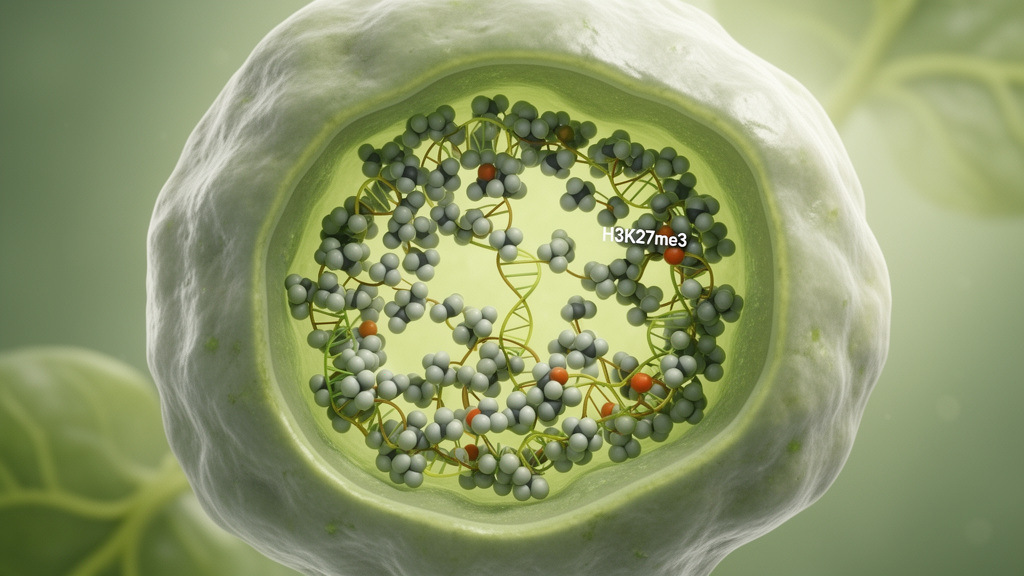
Perturbing the histone variant H2A.Z in the plant Arabidopsis thaliana altered the distribution and abundance of the transcriptional-repression mark H3K27me3 at specific genomic loci. Researchers examined hta9 hta11 double-mutant plants, which are defective in two of the three genes encoding H2A.Z. Using a quantitative siQ-ChIP pipeline, they found a twofold global reduction in H2A.Z abundance in the mutants. Mass spectrometry of chromatin proteins independently confirmed the overall reduction and also detected an altered relative abundance of H2A.Z variants. The corresponding changes in H3K27me3 were not uniform: its global abundance decreased slightly at non-expressed genes, while hundreds of individual loci showed reduced H3K27me3 enrichment.
The study directly tested whether H2A.Z contributes to the maintenance of H3K27me3 in plants. H2A.Z is a variant of the H2A histone protein, and H3K27me3 is a histone modification associated with transcriptional repression. Previous genome-wide studies had raised the possibility that H2A.Z contributes to H3K27me3 homeostasis in Arabidopsis, where the two features are often found together. The new research went beyond colocalization by genetically reducing H2A.Z and then measuring chromatin enrichment, protein abundance and gene expression. The siQ-ChIP analysis revealed both the twofold global decline in H2A.Z and an altered normalized distribution of H3K27me3 across the genome.
Genes carrying H3K27me3 were substantially overrepresented among those showing differential expression in the hta9 hta11 mutants, linking changes in the repressive chromatin state with altered transcriptional behavior. The pattern nevertheless varied among genomic regions rather than following a single proportional shift. The study did not characterize the locus-level reductions as a complete loss of H3K27me3, and it did not report their magnitude in the supplied evidence. Its results support the conclusion that perturbing H2A.Z enrichment and variant composition is sufficient to alter H3K27me3 distribution and abundance in a locus-specific fashion. They are also consistent with a functional relationship between these conserved chromatin features, although the experiments do not establish that H3K27me3 changes directly caused every observed difference in gene expression.
One possible contributor to the locus-specific effects was the transcriptional regulator FUS3. The researchers’ analyses raised the possibility that ectopic expression of FUS3 in hta9 hta11 seedlings contributed to altered H3K27me3 enrichment at its target genes, offering a possible route through which reduced H2A.Z could affect chromatin regulation. This remains a qualified interpretation rather than a demonstrated universal mechanism. The work was conducted in a specific Arabidopsis mutant background and combined genetic perturbation with chromatin profiling, protein-abundance measurements and gene-expression analysis. Its scope is therefore the relationship between H2A.Z and H3K27me3 in that experimental system, not evidence for equivalent effects across plant species, tissues or developmental conditions. The article was published as an early-access, peer-reviewed version in BMC Plant Biology and was identified as subject to further editorial revision.
Subject of Research: Effects of H2A.Z perturbation on H3K27me3 distribution and gene expression in Arabidopsis thaliana
Article Title: Perturbation of H2A.Z enrichment and variant composition in Arabidopsis thaliana is sufficient to alter H3K27me3 distribution and abundance in a locus-specific fashion
Article References: Long, J., Agreda, G., Sliger, S., Fawley, J. R., Pascuzzi, P. E., Dickson, B. M., Drown, B., & Ogas, J. (2026). Perturbation of H2A.Z enrichment and variant composition in Arabidopsis thaliana is sufficient to alter H3K27me3 distribution and abundance in a locus-specific fashion. BMC Plant Biology. https://doi.org/10.1186/s12870-026-09899-4
Image Credits: AI Generated
DOI: 10.1186/s12870-026-09899-4
Keywords: Arabidopsis thaliana, H2A.Z, H3K27me3, histone variants, chromatin regulation, plant epigenetics, gene expression, FUS3, siQ-ChIP, mass spectrometry, Perturbation, enrichment
News Source: Juliet Wilcox. (October 25, 2026). H2A.Z reduction reshapes H3K27me3 at specific Arabidopsis loci. Scienmag.