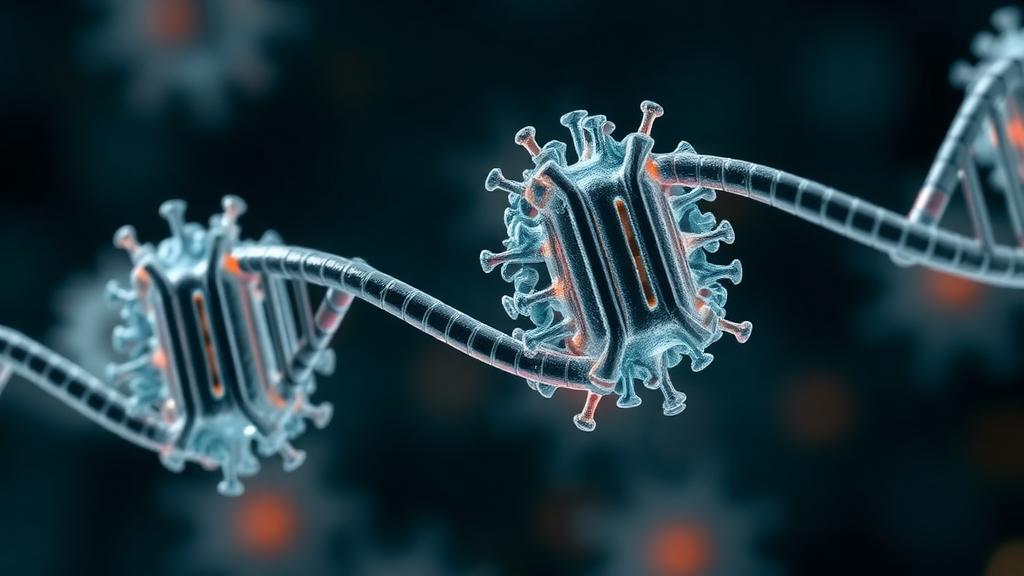
Some of the most aggressive tumors known to medicine carry a strange and dangerous cargo. Instead of housing all of their genes neatly packaged within chromosomes, rapidly growing, highly metastatic cancer cells often contain numerous small rings of DNA that float free of the chromosome set. These circular molecules, known as extrachromosomal DNA or ecDNA, frequently carry oncogenes — the very genes that drive uncontrolled cell growth. Because ecDNA can be copied in vast numbers and handed down to daughter cells in unpredictable ways, it allows tumors to boost their malignant programming far beyond what ordinary chromosomes permit. Now, an international team of researchers has uncovered a natural weakness in these DNA rings, one that could point the way toward entirely new cancer therapies. The findings, published in the journal Nature Genetics, come from a collaboration led by Dr. Anton Henssen of the Experimental and Clinical Research Center, a joint institution of Charité – Universitätsmedizin Berlin and the Max Delbrück Center, together with senior authors Dr. Howard Chang and Dr. Paul Mischel of Stanford University in California.
The central discovery of the study is deceptively simple: the DNA rings lose their power when they become trapped outside the cell nucleus in tiny compartments called micronuclei. Scientists have documented the existence of micronuclei for many years. These small, additional nuclei are visible under a light microscope and are commonly found in cancer cells, but their contents and consequences were far less well understood. The new work shows that when ecDNA ends up sequestered inside a micronucleus, its structure changes in a way that silences the genes it carries. The cell can no longer read those genes or translate them into proteins, which means the oncogenic payload of the rings effectively stops functioning. Cancer cells burdened with many micronuclei therefore suffer a significant survival disadvantage — a striking reversal for cells that usually hold every selective advantage.
To understand why this matters, it helps to consider how ecDNA behaves during cell division. When a healthy cell divides, its chromosomes are normally distributed evenly and reliably between the two daughter cells, thanks to specialized structures that attach them to the segregation machinery. ecDNA lacks these structures entirely. As Henssen explains, the rings instead attach themselves to chromosomes and essentially hitchhike into the new cells. This hitchhiking is a haphazard process: some rings succeed in reaching a daughter nucleus, while others do not. The less successful ones become trapped in micronuclei, small membrane-bound structures that sit outside the main nucleus and hold their genetic cargo in a kind of cellular quarantine. In effect, every cell division is a lottery for ecDNA, and the rings that lose the draw are locked away where they can no longer do harm.
Proving that micronuclei are primarily filled with ecDNA required a sophisticated technical approach. Working with Dr. Ana Pombo at the Max Delbrück Center, Henssen’s team developed a laser-assisted method that allowed them to isolate individual micronuclei and sequence their genetic material directly. The results were unambiguous. As Robin Xu, one of the study’s three first authors and a researcher in Henssen’s lab, notes, micronuclei are primarily filled with ecDNA. This has a practical consequence that extends beyond basic biology: because micronuclei are visible under a standard light microscope, clinicians and researchers can estimate how much ecDNA is present in cancer cells simply by counting or assessing the micronuclei they can already see. What once required advanced genomic sequencing to detect may now be readable through a microscope lens.
The structural changes that ecDNA undergoes inside micronuclei have profound implications for tumor behavior. Lotte Brückner, who shares first authorship with Xu, explains that once the rings are inside micronuclei, the cell can no longer read the genes they carry or convert them into proteins. Gene expression is a physical process that depends on the accessibility of DNA and the correct assembly of transcriptional machinery, and the altered configuration of the trapped rings disrupts that process entirely. For a tumor that depends on extra copies of oncogenes carried on ecDNA to fuel its growth, accumulating micronuclei is therefore a costly burden. Cells containing many micronuclei grow and proliferate less effectively, and this finding, the researchers emphasize, is important for both the diagnosis and the prognosis of cancer. A tumor’s visible micronuclei may serve as a window into its genetic dynamics and its vulnerability.
The clinical significance of this mechanism was tested using a well-characterized cohort of several hundred patients with neuroblastoma, an aggressive cancer of the nervous system that primarily affects children. The results were striking: survival was strongly associated with the presence of micronuclei. The more micronuclei containing large amounts of circular DNA the researchers found in tumor cells, the more successful the patients’ treatment turned out to be. In other words, the natural process of trapping ecDNA in micronuclei corresponds to better outcomes, suggesting that the cellular prisons do real work in restraining tumor fitness. For a disease as difficult to treat as high-risk neuroblastoma, any measurable link between a cellular feature and patient survival is a valuable signal, and one that could inform how tumors are assessed and stratified in the future.
The research was conducted as part of the international Cancer Grand Challenges initiative, which seeks to better understand the key role of circular DNA in cancer. Mischel leads the eDyNAmiC team within that initiative, bringing together experts on the biology of ecDNA from multiple institutions. Chang, who has served as Chief Scientific Officer at the biotechnology company Amgen since December 2024, rounds out the senior leadership of the study. The collaboration also received support from the German Research Foundation through its Collaborative Research Center 1588, Deciphering Evolutionary Mechanisms in Neuroblastoma, of which Henssen is the spokesperson. The funding landscape reflects a growing recognition that ecDNA is not a curiosity of tumor biology but a central driver of some of the hardest-to-treat malignancies, and that understanding its life cycle inside cells could reveal critical weaknesses.
With the mechanism established, the researchers are now working toward a therapeutic goal: preventing DNA rings from hitchhiking into new nuclei during cell division. The idea is to tip the lottery against ecDNA, ensuring that as many rings as possible end up trapped inside micronuclei, where they can no longer drive cancer growth. The team already knows of drugs that block the proteins ecDNA uses to attach itself to chromosomes — the very attachment that allows the rings to hitchhike successfully. By interfering with that attachment, such compounds could raise the fraction of rings left behind in micronuclei with each round of cell division, progressively depleting the tumor of its oncogenic amplification. Henssen notes that these existing inhibitors provide a starting point for a strategy that could, in principle, be combined with other treatments to push tumors toward a less aggressive state.
Translating that vision into medicines is already under way. Econic Bioscience, a company that Henssen founded in London in 2022 together with Dr. Rodger Novak and Shaun Foy, the former founders of CRISPR Therapeutics, is actively searching for additional active ingredients that transport the destructive DNA rings into micronuclei as quickly as possible — and securely seal them there. The company’s focus captures the dual requirement of the strategy: rings must not only be diverted away from the main nucleus but must also be prevented from escaping back into active circulation. If successful, such drugs would represent a fundamentally new class of cancer therapy, one that does not target a mutated protein or a signaling pathway but instead exploits the peculiar inheritance physics of circular DNA. For patients with tumors loaded with ecDNA, the prospect of disarming the enemy’s weapons rather than killing the cell outright could reshape treatment, turning the cancer’s own genetic machinery against itself.
Beyond its therapeutic implications, the study adds an important chapter to the growing understanding of how tumors evolve. The ability of ecDNA to amplify oncogenes rapidly has been recognized as a hallmark of aggressive cancers, enabling swift adaptation under the pressure of treatment. The demonstration that this same amplification strategy carries an inherent fragility — that a failure to hitchhike condemns the rings to silence inside micronuclei — reveals a tension at the heart of tumor biology. Aggressive tumors walk a narrow line between exploiting ecDNA for growth and suffering its losses during division. The new work suggests that medicine can now push tumors off that line, tipping the balance decisively toward the cellular prisons that hold the dangerous DNA at bay.
Subject of Research: How extrachromosomal DNA in cancer cells becomes trapped in micronuclei, silencing oncogenes and improving patient survival.
Article Title: How cancer cells lose dangerous DNA
Article References: How cancer cells lose dangerous DNA. (n.d.). Original publication
Image Credits: AI Generated
DOI: Not provided
Keywords: extrachromosomal DNA, ecDNA, micronuclei, cancer genetics, Nature Genetics, neuroblastoma, oncogenes, tumor evolution, genomic instability, drug development, pediatric cancer, Anton Henssen
News Source: Nathaniel Bowman. (October 14, 2026). Trapping rogue DNA rings in micronuclei could disarm aggressive tumors. Scienmag.