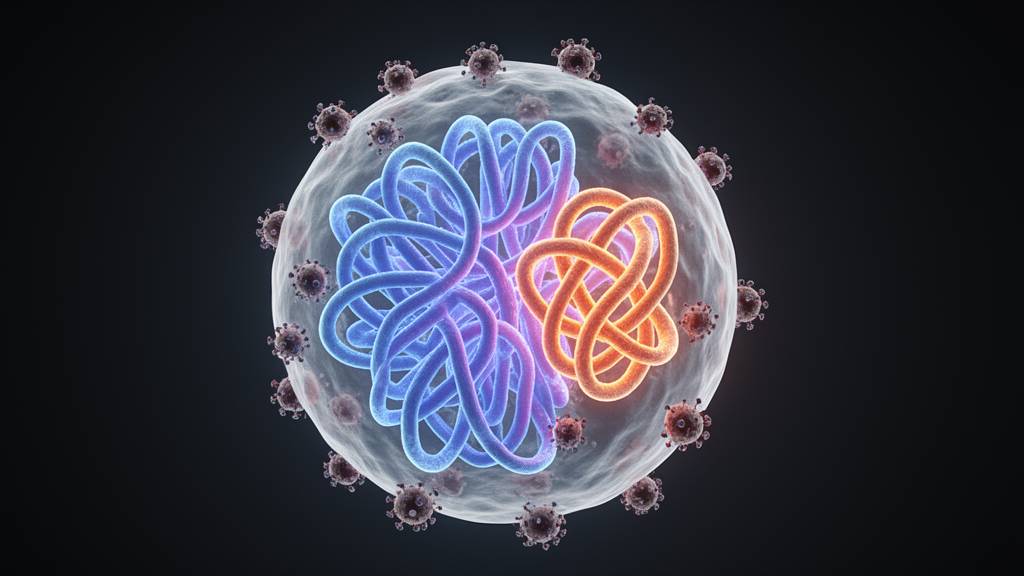
Persistent infection with high-risk human papillomavirus is the principal cause of cervical cancer, yet the familiar story of E6 and E7 disabling the p53 and retinoblastoma protein pathways has never fully explained the clinical behavior of the disease. Why do some HPV-associated lesions persist and progress while others regress? Why do patients with similar viral status respond so differently to chemoradiotherapy, immunotherapy, and targeted agents, and why do relapses occur at all? A new review published in Medical Oncology by Katsuyoshi Kumagai and colleagues at the University of Human Arts and Sciences in Japan argues that a missing piece of the puzzle lies not in the virus itself but in the host cell: the three-dimensional architecture of chromatin, the packaged form of the human genome inside the nucleus.
The central premise of the review is that HPV-mediated checkpoint disruption is only the first act. Once the p53 and RB brakes are released, the malignant cell must still stabilize a proliferative, treatment-tolerant state, and the authors propose that this stabilization depends on epigenetic permissiveness and the spatial organization of the genome. Chromatin is not a passive spool of DNA. It is folded into topologically associating domains, or TADs, insulated neighborhoods in which enhancers preferentially contact the promoters they regulate. Structural maintenance of chromosomes complexes, chiefly cohesin, extrude DNA loops that bring distant regulatory elements together, while the insulator protein CTCF anchors domain boundaries. The WAPL cohesin release factor limits how far loops extend, tuning the overall folding landscape. When any of these components are altered, enhancers can be rewired onto inappropriate promoters, a mechanism long implicated in oncogene activation across many cancers.
HPV integration into the host genome is where viral biology and chromatin architecture collide. Integration is not a random insertion event; it frequently disrupts host regulatory regions and places viral and host sequences into new cis-regulatory relationships. Recent work cited in the review shows that the cis-regulatory effect of HPV integration is constrained by pre-existing host chromatin architecture, meaning the local folding context determines which genes a viral integration event can actually activate. Long-read sequencing of cervical cancer cell lines has revealed the structural complexity of these integration junctions, and genome-wide analyses have documented allele-specific impacts of viral-human rearrangements on cancer genome regulation. In effect, the virus hijacks the host’s own enhancer-promoter wiring, and the resulting rewiring can amplify MYC and E2F-centered transcriptional programs that drive uncontrolled proliferation.
The review gives particular attention to MYC, the transcription factor whose amplification has been detected even in preinvasive cervical lesions. MYC operates as a transcriptional amplifier, and tumors with rewired enhancer landscapes can become addicted to this sustained transcriptional output, a concept known as transcriptional addiction. That dependency creates a therapeutic opening. Bromodomain-containing protein 4, a BET family protein that recruits transcriptional machinery to active enhancers, has emerged as a druggable node: experimental studies show that BRD4 inhibition suppresses HPV16 E6 expression and enhances chemotherapy response, and separate work demonstrates that BRD4 inhibition sensitizes cervical cancer cells to radiotherapy by attenuating DNA repair. Early-phase clinical trials of MYC-targeting approaches in solid tumors, such as the peptide-based OMO-103, suggest that the long-undruggable MYC axis is finally becoming addressable.
Cohesin dynamics add another layer of vulnerability. The authors highlight their own prior finding that WAPL, the cohesin release factor, can induce cervical intraepithelial neoplasia in experimental models even without HPV E6 and E7, when modulated by estrogen signaling. This is a striking result because it implies that perturbing the genome’s folding machinery alone can push cervical epithelium toward premalignant states. Conversely, it suggests that cervical cancers may develop dependencies on specific cohesin regulators to maintain their malignant chromatin configuration. Recent single-molecule imaging of loop extrusion in living cells and studies showing extensive mutual influence among SMC complexes are refining how researchers understand these folding dynamics, and the review argues that such dependencies should be systematically screened in cervical cancer models using CRISPR perturbation and dependency mapping resources such as DepMap.
Chromatin remodeling complexes themselves are also implicated. Loss of ARID1A, the AT-rich interaction domain 1A subunit of the SWI/SNF complex, has been linked to tumor progression and adverse prognosis in cervical cancer, and emerging clinical data suggest that ARID1A and B2M mutations, together with antigen presentation pathway status, may predict response to definitive chemoradiotherapy. Histone modification enzymes, including the polycomb methyltransferase EZH2 and the demethylase KDM6A, are altered in HPV E6/E7-expressing keratinocytes, indicating that viral oncoproteins reprogram the epigenome from the earliest stages of infection. Three-dimensional chromatin analyses have additionally identified the transcription factor Sp1 as a mediator that programs and reprograms HPV-host epigenetic architecture in cervical cancer, providing a concrete molecular handle on how viral and host regulatory systems become intertwined.
Non-genetic plasticity is a recurring theme in the review’s account of therapeutic resistance. Cancer cells can evade drugs by reprogramming their transcriptional states without any new mutation, and rare pre-existing cell variants can seed drug-induced reprogramming within heterogeneous populations. Epigenetic plasticity is increasingly recognized as a hallmark that fuels tumor evolution while simultaneously exposing weaknesses. In cervical cancer specifically, single-nucleus and single-cell RNA sequencing studies have revealed heterogeneous microenvironments and distinct drug responses between squamous cell carcinoma and adenocarcinoma, while spatial transcriptomics is mapping how cancer-associated fibroblasts and immune cells shape the transcriptional landscape. Context-dependent signaling through PI3K-AKT, RAS-ERK, NOTCH1, and the Hippo pathway effectors YAP and TAZ, whose roles vary by HPV type, cooperates with chromatin state to determine whether a cell tolerates treatment or dies.
The tumor microenvironment completes the resistance circuit. CXCL8, a chemokine produced within the inflammatory milieu, has been shown to be essential for acquired radioresistance in cervical cancer cells and is proposed as a therapeutic target. HPV-mediated immune evasion mechanisms, the composition of the immune microenvironment, and the cancer-immune set point all influence how patients respond to the checkpoint inhibitor pembrolizumab, which in the phase 3 KEYNOTE-A18 trial improved outcomes when added to chemoradiotherapy for high-risk locally advanced disease. The review argues that chromatin-informed biomarkers, such as enhancer landscapes and chromatin accessibility profiles measured by ATAC-seq, ChIP-seq, and CUT&Tag, should be integrated with microenvironmental data to stratify patients more accurately than viral status alone allows.
Methodologically, the authors lay out an experimentally testable framework that leans on public datasets from The Cancer Genome Atlas and the Gene Expression Omnibus, perturbation-guided prioritization using CRISPR activation and interference screens, and computational tools including compositional perturbation autoencoders and in silico perturbation methods that predict cellular responses to genetic and pharmacological interventions. Multimodal artificial intelligence approaches that combine imaging, genomic, and clinical data are highlighted as a route to precision management, and network pharmacology offers a way to target causal resistance mechanisms rather than symptoms. Crucially, the framework depends on experimentally faithful models: authenticated cervical cancer cell lines, patient-derived organoids that recapitulate cervical tissue dynamics and viral oncogenesis, and patient-derived xenograft-style cultures that can predict sensitivity to chemotherapy and radiation.
The significance of this review lies in its reframing of HPV-driven cervical cancer as a disease of coupled viral and host genome regulation. Rather than treating E6 and E7 expression as the whole story, it positions chromatin architecture, enhancer rewiring, cohesin dynamics, and epigenetic plasticity as the machinery that converts viral checkpoint disruption into stable, adaptable, treatment-resistant malignancy. If the proposed framework holds up under experimental scrutiny, chromatin-informed stratification could identify which patients need intensified or combination therapy, while vulnerabilities in BET proteins, MYC signaling, cohesin regulators, and microenvironmental cytokines could yield rational combination strategies. For a cancer that remains a major global cause of mortality despite vaccination and screening, shifting the therapeutic lens from the viral oncogenes alone to the three-dimensional regulatory genome they exploit may prove a consequential conceptual advance.
Subject of Research: Host chromatin architecture and 3D genome rewiring in HPV-driven cervical cancer and therapeutic resistance
Article Title: Host chromatin architecture in HPV-driven cervical cancer: molecular mechanisms and therapeutic resistance
Article References: Kumagai, K., Suzuki, Y., Kitahara, K., Chiba, A., & Yajima, H. (2026). Host chromatin architecture in HPV-driven cervical cancer: molecular mechanisms and therapeutic resistance. Medical Oncology, 43(11), Article 324. https://doi.org/10.1007/s12032-026-03445-w
Image Credits: AI Generated
DOI: 10.1007/s12032-026-03445-w
Keywords: HPV, cervical cancer, chromatin architecture, 3D genome, enhancer rewiring, cohesin, WAPL, MYC, BRD4, therapeutic resistance, epigenetic plasticity, tumor microenvironment
News Source: Nathaniel Bowman. (October 9, 2026). How HPV Reshapes the 3D Genome to Lock Cervical Cancer Into Resistant States. Scienmag.