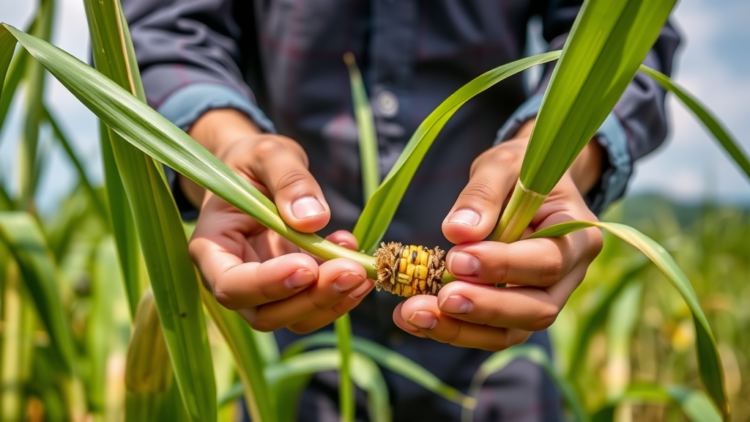
Sugarcane is one of the world’s most important crops, underpinning global sugar supplies, bioethanol production and, increasingly, renewable biomass for materials and energy. Yet the crop remains notoriously difficult to improve genetically. A comprehensive new review published in Theoretical and Applied Genetics synthesises decades of statistical and genomic research to explain why sugarcane breeding advances so slowly, and maps out a strategy for accelerating genetic gain using genomic prediction and computational mate allocation. The authors, led by Andrew Rigby of Sugar Research Australia and colleagues including Ben Hayes and Lee Hickey at the University of Queensland, argue that the biggest untapped opportunities lie not in the final stages of clonal testing, where genomic selection is already entering routine use, but in the earliest decisions a breeding programme makes: which crosses to make, which families to advance, and which parents to recycle.
The central obstacle is sugarcane’s extraordinary genome. Modern cultivars are highly polyploid and frequently aneuploid, typically carrying on the order of 100 to 130 chromosomes, with local copy number varying between roughly six and fourteen copies per homoeologous group. They descend from interspecific hybridisation between the domesticated Saccharum officinarum and the wild S. spontaneum, a history of so-called nobilisation that delivered landmark disease-resistant varieties but left modern germplasm with a narrow founder base, extensive linkage disequilibrium and strong non-additive genetic effects. Recent work, including the highly contiguous polyploid reference genome of the cultivar R570 published in Nature in 2024, has resolved individual haplotypes across approximately 12 chromosome copies, opening the door to far more precise marker development and, potentially, to attributing epistatic interactions to specific genomic regions rather than anonymous marker pairs.
These biological realities collide with an unusually long and structured breeding pipeline. In the Australian system operated by Sugar Research Australia, controlled crosses produce true seed that enters progeny assessment trials, where entire families are ranked and parents selected backwards on the basis of family plot means. Surviving individuals advance to clonal assessment trials and then to multi-environment final assessment trials spanning plant and repeated ratoon crops. The whole journey from cross to commercial release spans a decade or more. Crucially, the review notes, information currently passes between these stages almost entirely through selection decisions: the same parents appear as contributors to family means, as clonal entries and as check clones, yet their breeding values are rarely refined by a model that considers all of these contributions simultaneously.
The statistical challenges of the early stages are substantial and, the authors argue, often underappreciated. Family plots in progeny assessment trials contain multiple unique seedlings from the same full-sib family, so repeated plots are samples from the same cross population rather than true biological replicates. Treating them as replicates of a single genetic entity distorts variance partitioning and inflates error variance, undermining heritability estimates and selection accuracy. Appropriate models must scale Mendelian sampling variance for family plot means. Beyond this, single-row plots are highly sensitive to spatial heterogeneity and interplot competition, which has a heritable component that can be modelled as indirect genetic effects; ignoring it risks selecting genotypes that are aggressive competitors in trials but underperform in commercial single-variety stands. Crop cycle, year and environment are also frequently confounded, complicating genotype-by-environment modelling that relies heavily on factor analytic mixed models.
Genomic selection, which predicts genetic merit from genome-wide markers, has matured rapidly in sugarcane since early proof-of-concept studies in 2013. GBLUP and RR-BLUP models remain robust baselines for the highly polygenic traits that dominate commercial value, including tonnes of cane per hectare, commercial cane sugar and fibre percentage. More complex approaches, including Bayesian variable-selection models, kernel methods and machine learning, have delivered incremental and trait-specific gains. Modelling non-additive effects through dominance and epistatic relationship matrices has improved clonal prediction in some settings, but the review cautions that in populations with strong relatedness and extended linkage disequilibrium, additive relationship matrices can partially absorb non-additive variation, blurring the distinction between the total genetic value relevant to clonal selection and the additive breeding value that drives long-term response in parents.
Allele dosage is a critical unresolved complication. Most operational genomic prediction in sugarcane has relied on pseudo-diploid encoding of single-dose markers, which discards copy-number information. Dosage-aware relationship matrices, formalised for autotetraploid potato and extended to higher ploidies, can dramatically outperform diploidised encodings in simulations with many multi-dose heterozygotes and strong dominance, yet show little advantage in populations dominated by simplex markers, which is precisely the situation in many current sugarcane panels. Continuous genotype representations based on normalised array intensities have delivered modest accuracy gains of roughly five to seven percent for commercial cane sugar and fibre, though not for cane yield. Aneuploidy adds a further layer, because nominal ploidy does not define local ploidy at any given marker, meaning that standard dosage models may be misspecified across a substantial fraction of loci.
The review’s most forward-looking contribution is its treatment of genomic cross prediction and mate allocation. Because crossing capacity, field space and flowering synchrony all limit how many parental combinations can be tested, the choice of crosses shapes the genetic variance entering the pipeline. Sugarcane breeders have long relied on empirically proven crosses, implicitly capturing parental merit and favourable non-additive interactions, but at the cost of reduced exploration of new combinations and heightened inbreeding risk. Predicting the expected mean and within-family genetic variance of untested crosses, and allocating matings under constraints on relatedness, flowering compatibility and seed inventory, could allow programmes to balance short-term gain against long-term diversity. Tools such as AlphaMate and SimpleMating already exist, but the authors stress that full polyploid-aware implementation remains a research priority, hindered by unresolved phasing at approximately twelvefold dosage and by variance predictions that are consistently less accurate than mean predictions.
Lessons from maize, wheat, cassava and potato transfer only partially. Hybrid crops with defined heterotic groups, fixed ploidy and inbred parents present a fundamentally different prediction problem from a clonally propagated, outbred polyploid in which individual-level non-additive effects are not fixed in the product. The usefulness criterion combining cross mean and within-cross variance, validated in diploid and tetraploid systems, may underperform in sugarcane without polyploid-specific adaptation. Nonetheless, training-population design principles hold: representing key founders broadly across many families outperforms deep sampling of a few, and validation schemes should mirror how prediction will actually be used, whether ranking related candidates within a cycle or forecasting performance in future environments.
The authors conclude with a practical research agenda. Family plots should be modelled as means of sampled full sibs rather than replicated genotypes. Environment definitions must distinguish region and year to capture stability under climate variability. Competition should be modelled explicitly in multi-entrial frameworks. Most ambitiously, progeny, clonal and final assessment trial records should be integrated within stage-integrated mixed-model analyses that combine pedigree and genomic relationships, allowing uncertainty to propagate coherently from family evaluation through clonal testing to parent recycling and cross design. Such integration, the review argues, is not merely a statistical refinement but a fundamental shift in breeding strategy, one that could deliver faster, more robust and more sustainable genetic improvement for a crop on which global food and energy systems increasingly depend.
Subject of Research: Statistical and genomic strategies to accelerate sugarcane genetic improvement, from family trials to genomic mate allocation
Article Title: From family trials to genomic mate allocation: statistical and genomic strategies to accelerate sugarcane genetic improvement
Article References: Rigby, A., Atkin, F., Hayes, B., Hickey, L., & Yadav, S. (2026). From family trials to genomic mate allocation: statistical and genomic strategies to accelerate sugarcane genetic improvement. Theoretical and Applied Genetics, 139(10), Article 266. https://doi.org/10.1007/s00122-026-05373-9
Image Credits: AI Generated
DOI: 10.1007/s00122-026-05373-9
Keywords: sugarcane, genomic selection, polyploidy, allele dosage, mate allocation, cross prediction, genetic gain, mixed models, genotype-by-environment interaction, Saccharum, breeding pipeline, non-additive effects
Cite Scienmag News
APA MLA Chicago
Juliet Wilcox. (September 12, 2026). Genomic tools promise faster sugarcane breeding, major review finds. Scienmag. https://scienmag.com/genomic-tools-promise-faster-sugarcane-breeding-major-review-finds/
Juliet Wilcox. “Genomic tools promise faster sugarcane breeding, major review finds.” Scienmag, 12 September 2026, https://scienmag.com/genomic-tools-promise-faster-sugarcane-breeding-major-review-finds/. Accessed 12 September 2026.
Juliet Wilcox. “Genomic tools promise faster sugarcane breeding, major review finds.” Scienmag. September 12, 2026. https://scienmag.com/genomic-tools-promise-faster-sugarcane-breeding-major-review-finds/
Copy citation Download RIS
Tags: advances in sugarcane breeding technologyallele dosagebreeding pipelinechallenges of polyploidy in sugarcane geneticscomputational mate allocation in sugarcanecross predictionearly-stage breeding decision optimizationgenetic complexity of sugarcane genomegenetic diversity in sugarcane hybridsgenetic gaingenetic improvement strategies for sugarcanegenomic prediction in crop breedinggenomic selectiongenotype by environment interactionimpact of genomic tools on sugarcane productivitymate allocationmixed modelsnon-additive effectsPolyploidyrole of genomics in accelerating sugarcane genetic gainSaccharumsugarcanesugarcane genomicssustainable bioenergy crop development