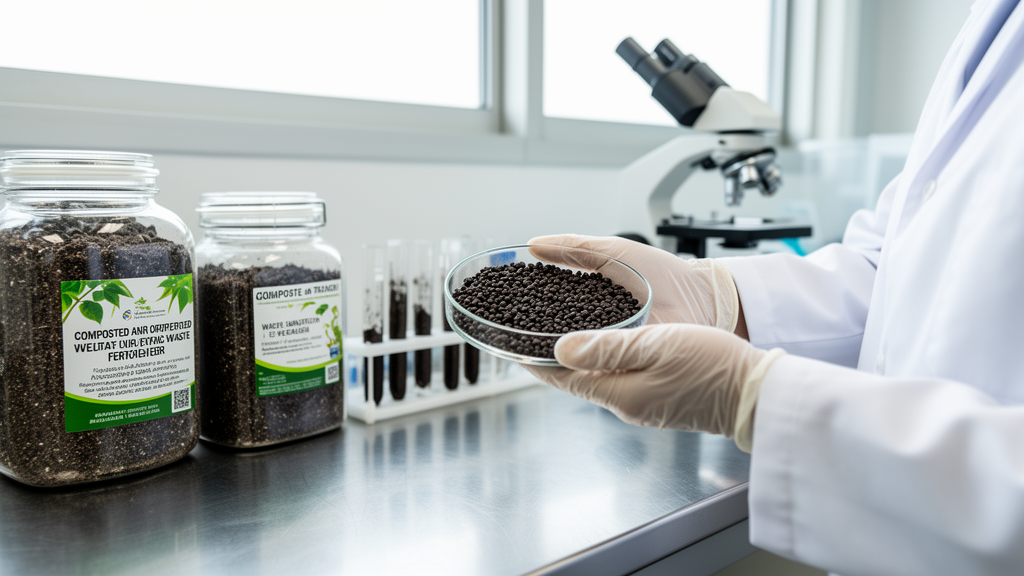
Sustainable fertilisers made from waste streams — manure, compost, digestate, biosolids, struvite and biochar — are promoted as a way to reduce reliance on finite resources and environmental burdens while maintaining agronomic function. But a new review argues that their sustainability depends on treatment performance, contaminant control and life-cycle context, and it puts biological risk at the centre of the assessment.
The review, published in Discover Food on 28 October 2026, is based on a targeted narrative synthesis of literature from 2015 to 2025. From that synthesis the authors built a biological risk framework and tested it through three case scenarios. The first scenario transcribes organism-specific annual probabilities from a published farm-to-fork lettuce model; the other two are qualitative stress tests rather than numerical estimates.
For raw manure applied to lettuce, the published model reported annual infection probabilities of 7.03 × 10⁻⁴ for Cryptosporidium, 2.27 × 10⁻⁴ for pathogenic Escherichia coli, 5.43 × 10⁻⁵ for Listeria and 1.79 × 10⁻¹ for Mycobacterium avium, the latter using an animal-derived dose-response function. When the fertiliser was pasteurised digestate, the corresponding modelled probabilities fell to 1.42 × 10⁻¹⁰ or below — a difference of many orders of magnitude that underlines how strongly treatment determines risk.
The framework is deliberately cautious about what it cannot quantify. No numerical probability is assigned to a carrot scenario, because missing route-specific exposure data prevent application of the published Ascaris dose-response model. Likewise, no absolute probability is estimated for antimicrobial resistance, since validated dose-response functions for environmental acquisition of antimicrobial resistance genes are unavailable.
What the review does support is the value of validated controls. Treatment, curing, monitoring and multi-barrier approaches can reduce biological hazards, but the authors stress that performance must be verified for each specific matrix, process and use — a finding that cannot be generalised from one fertiliser type or pathogen to another.
Key research gaps remain. The authors identify viruses, helminths, transfer of antimicrobial resistance genes, long-term field outcomes, and the environmental burdens of energy- or reagent-intensive treatments as areas where evidence is still insufficient. Until those gaps are filled, the review suggests, claims about the safety of waste-derived fertilisers should be tied to verified treatment performance rather than assumed from the fertiliser category alone.
Subject of Research: Biological risks of waste-derived fertilisers such as manure, compost, digestate, biosolids, struvite and biochar
Article Title: Waste-derived fertilisers under a biological risk lens
Article References: Chojnacka, K. (2026). Waste-derived fertilisers under a biological risk lens. Discover Food. https://doi.org/10.1007/s44187-026-01321-0
Image Credits: AI Generated
DOI: 10.1007/s44187-026-01321-0
Keywords: waste-derived fertilisers, manure, digestate, biosolids, struvite, biochar, pathogens, antimicrobial resistance, food safety, risk assessment, compost, lettuce
News Source: Alan Morgan. (October 29, 2026). Waste-derived fertilisers carry biological risks that depend on treatment, study finds. Scienmag.