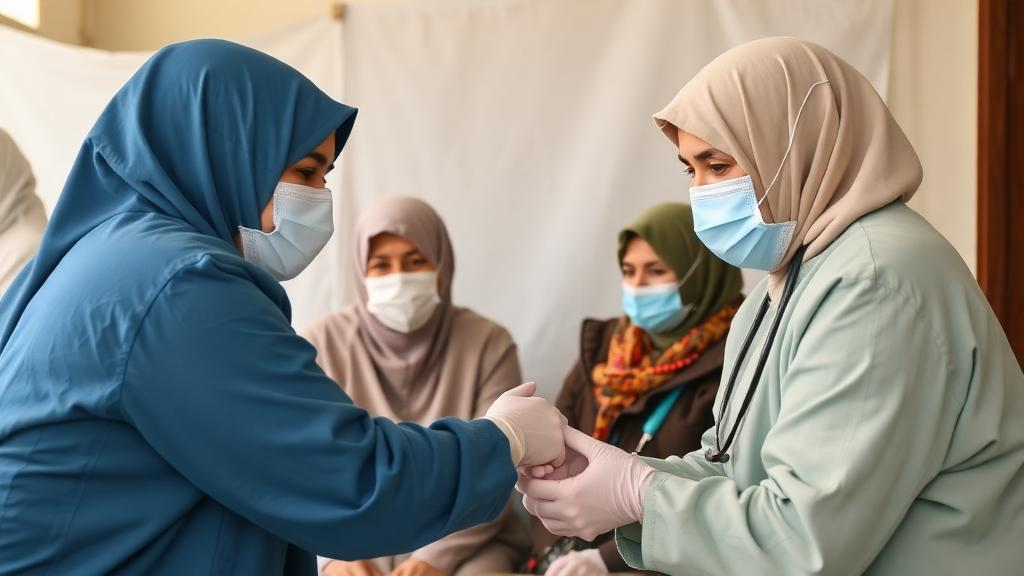
When escalating conflict in Lebanon in 2024 made it impossible for a central research team to supervise a community health intervention, the team handed day-to-day control to people from the affected communities themselves. That shift, described in a comment article published in Conflict and Health, offers field insights from the Self-Efficacy and Knowledge (SEEK) trial, a community-based intervention conducted at two primary healthcare centres in Lebanon to improve sexual and reproductive health service uptake and psychosocial wellbeing among Syrian adolescent girls and young women aged 15 to 24.
The conflict severely restricted mobility and made on-site supervision by the central team unworkable, threatening the continuity of an intervention designed for a population already burdened by displacement, economic hardship and barriers to accessing health services.
Rather than pause the trial, the team restructured its delivery model. The original centralized structure was replaced with a decentralized one that emphasized co-leadership with local communities. Local and affected community members were recruited, trained and supervised to take responsibility for field coordination, logistical procedures and real-time decision-making, with the central team providing remote supervision from a distance.
According to the comment, this redistribution of responsibilities allowed implementation to continue under conditions that would otherwise have halted it. The community members who took over field operations were described as closely aligned with the affected population, which enabled them to manage operations and respond to emerging needs as they arose. The authors argue that this proximity is precisely what makes community actors valuable in humanitarian response, not merely as the most accessible option but as capable leaders of it.
The comment also reports on the trial’s outcomes, and it does so with notable caution. Subsequent outcome evaluations identified positive effects on some outcomes and limited effects on others, indicating that SEEK’s effectiveness varied across the outcomes measured. The authors do not claim uniform success; instead, they frame the implementation experience itself as the central lesson of the trial during the conflict period.
That lesson concerns power. The authors argue that adaptive approaches that shift power to affected communities during implementation amid active conflict can transform contextual constraints into opportunities for culturally responsive and resilient implementation. In their conclusion, they go further, suggesting that community-led models may not be merely emergency substitutes when traditional delivery systems fail, but foundational strategies for effective humanitarian programming during conflict.
The comment situates this argument in the broader context of the population the trial served. Adolescent girls and young women affected by conflict experience persistent sexual and reproductive health challenges along with poorer mental health and wellbeing, the authors write. Among Syrian adolescent girls and young women living in Lebanon, these challenges are exacerbated by displacement, economic challenges and barriers to accessing needed health services. Community-based interventions are increasingly adopted to address these gaps, but evidence remains limited on how such interventions can be implemented effectively while preserving fidelity and quality during active conflict, especially when centralized delivery models are not feasible.
The SEEK experience, the authors suggest, offers one answer to that evidence gap. Shifting power to local and affected communities as co-implementers can strengthen ownership, adaptability and sustainability during active conflict, they write, and community leadership supported by flexible planning and agile decision-making may be essential for building resilient health interventions. The comment is presented as a field reflection rather than a systematic evaluation of the decentralization strategy itself, and the authors note that no datasets were generated or analysed in the study.
For humanitarian health programmers, the takeaway is a challenge to conventional contingency thinking. Community-led implementations, the authors conclude, are not merely contingency plans when traditional models fail; they are core strategies for building resilient and contextually responsive interventions.
Subject of Research: Community-led implementation of the SEEK sexual and reproductive health intervention for Syrian adolescent girls and young women in Lebanon during the 2024 conflict
Article Title: When the system fails, the community leads: field insights from the self-efficacy and knowledge (SEEK) trial during Lebanon’s 2024 active conflict
Article References: Saleh, S., Naal, H., Chamseddine, Z., Sarieddine, D., Govender, V., Bosqui, T., Honein-AbouHaidar, G., Tamim, H., Fouad, F., Say, L., & Dakdouki, A. E. (2026). When the system fails, the community leads: field insights from the self-efficacy and knowledge (SEEK) trial during Lebanon’s 2024 active conflict. Conflict and Health, 20(1), Article 81. https://doi.org/10.1186/s13031-026-00847-5
Image Credits: AI Generated
DOI: 10.1186/s13031-026-00847-5
Keywords: SEEK trial, Lebanon, Syrian refugees, adolescent girls and young women, sexual and reproductive health, community-based intervention, humanitarian health, active conflict, implementation science, mental health and wellbeing, primary healthcare centres, community leadership
News Source: Courtney Benton. (October 29, 2026). Community members stepped in to run a health trial for Syrian refugee women during Lebanon’s 2024 conflict. Scienmag.