


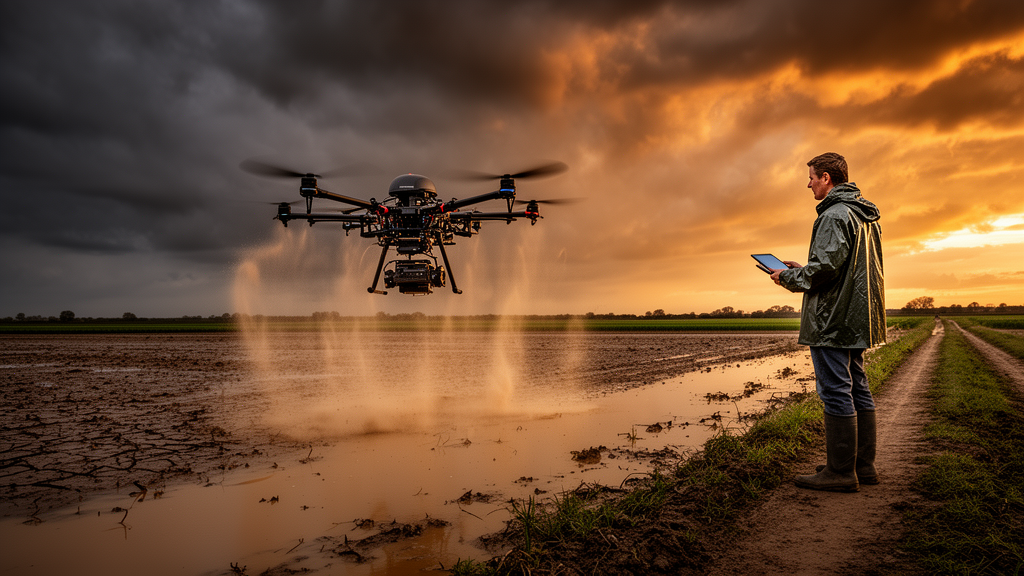
Unmanned aerial vehicles are transforming agriculture, but in the date palm groves of Saudi Arabia their greatest enemy is not a malfunctioning rotor or a drained battery. It is the weather. Sudden wind gusts, thermal stress, blinding sandstorms and flash floods in low-lying wadis can ground a drone without warning, damage its hardware, or worse, send it crashing into a crop it was sent to protect. A new open-access study published in Discover Internet of Things on 15 October 2026 proposes a hybrid scheduling framework that combines fuzzy logic inference with an ensemble of gradient-boosting machine learning classifiers to decide, in real time, whether a UAV should take off, wait, or stay grounded.
The research team, led by Ahmad B. Alkhodre and colleagues, framed the problem around the specific hazards of arid palm-farming regions. Saudi Arabia hosts roughly 35 million palm trees according to 2023 statistics, and date fruits such as the prized Ajwa variety are both a dietary staple and a major export commodity. Managing these groves traditionally demands intensive manual labor for tree health monitoring, pest control, irrigation and pollination, and the sheer height of mature palms makes ground-based inspection difficult. UAVs offer an efficient alternative for disease detection, precision spraying and yield estimation, but their sensitivity to strong winds, rainstorms, extreme temperatures and high humidity has constrained their operational windows. Sandstorms are a particularly acute bottleneck: they reduce visibility, clog propulsion motors, jam optical sensors and abrade exposed airframe components.
What distinguishes the proposed system is not a new mathematical paradigm, as the authors themselves emphasize, but a specialized integration. The framework fuses a Mamdani fuzzy inference engine, whose rules were derived from historical meteorological records and refined by domain experts, with four tree-based ensemble models: Gradient Boosting, XGBoost, LightGBM and CatBoost. The fuzzy component reacts to rapid, real-time environmental shifts, while the machine learning layer, trained on a fifteen-year archive of Saudi weather data, captures complex non-linear atmospheric interactions. The output is a continuous Flight Feasibility score between zero and one, discretized into three operational categories: Safe, Caution and Unsafe, with fixed thresholds at 0.50 and 0.80 and a small hysteresis margin to prevent rapid flip-flopping near decision boundaries.
The fuzzy rule base was built through a two-pronged approach. For sandstorms, the researchers compiled fifteen years of meteorological records from Saudi Arabia, tagged each record with a Sandstorm Impact Index scaled from zero to one, and trained a small, interpretable decision tree using entropy and information gain to locate natural threshold knees. Visibility emerged as the dominant factor, with the highest information gain at a normalized value of 42.29, followed by wind at 49.87 and humidity around 56.86. The resulting decision boundaries were translated into Mamdani rules such as: if visibility is poor and wind is high, risk is high; if visibility is good, risk is low regardless of wind. Experts then slightly rounded these boundaries to align with field perception and known dust-lifting thresholds. The same procedure was applied to wind, visibility, rainfall, temperature and flood probability, with wind risk rising sharply past roughly six to seven meters per second and thermal transition points detected near 23.33, 32.64 and 39.44 degrees Celsius before expert adjustment to practical operating values.
On the machine learning side, the team constructed a hybrid dataset: 1,500 real-time samples gathered over a three-month observation window at 30-minute intervals, augmented to 2,000 using SMOTE to address a roughly five percent Unsafe minority, combined with 3,500 samples drawn from the fifteen-year historical record. The target variable, a flight feasibility score, was synthesized from visibility, humidity and effective wind, with WS_eff deliberately excluded from the input features to prevent target leakage. Engineered interaction terms such as wind multiplied by visibility and precipitation probability multiplied by rainfall amount were added to capture non-linear atmospheric coupling. The models were trained under a two-level evaluation protocol: an 80/20 train-test split with all hyperparameter tuning performed via five-fold cross-validation on the training portion only, and median imputation fit within each fold to avoid information leakage.
The results are striking, though the authors are candid about why. On the 900-sample held-out test set, the four-model ensemble achieved an overall classification accuracy of approximately 99.67 percent with a weighted F1 score near 0.997. The Unsafe class registered 98.9 percent recall, and crucially, no case of an Unsafe condition was ever misclassified as Safe; errors, when they occurred, fell into the more conservative Caution category. Feature importance analysis revealed that visibility and humidity dominated the predictions across all models, followed by the wind-visibility interaction term, while temperature and precipitation contributed weakly, likely because their influence manifests only in extreme values that were rare in the training data. The authors acknowledge that the near-perfect scores partly reflect the fact that the target feasibility score is computed directly from the inputs, meaning the models are essentially learning a known mapping, and they recommend re-validation on harder out-of-distribution scenarios.
Two robustness analyses strengthen the case. First, an ablation study showed that training without SMOTE caused Unsafe class recall to plummet to 24.8 percent, meaning the model would have missed the majority of genuinely hazardous events, whereas the synthetic oversampling technique, applied only to the training split, raised Unsafe recall to 98.91 percent without degrading Safe class precision. Second, a seasonal temporal holdout validation excised the entire November-December block from training, a period notorious in Saudi Arabia for storm fronts, sudden temperature drops and elevated wadi flooding risk. Under these out-of-distribution conditions, the hybrid framework maintained 97.5 percent overall accuracy and 96.2 percent Unsafe recall, suggesting the system learned underlying atmospheric dynamics rather than overfitting to temporal artifacts of the training data.
The decision fusion architecture is designed with safety as the first priority. When the fuzzy engine and the machine learning ensemble agree on a classification, that decision is adopted immediately; the two components showed 93 to 98 percent agreement across test scenarios. When they conflict, a conservative protocol takes over: any Unsafe judgment acts as a veto unless the other stream demonstrates very high and consistent confidence, and otherwise a weighted fusion of the fuzzy and ensemble feasibility scores is computed, with a demotion rule that downgrades a Safe fusion result to Caution if the lower of the two component confidences falls below 0.60. The authors report that the pipeline is real-time capable on commodity hardware, with the fuzzy module evaluating in sub-milliseconds per sample and the four-model ensemble completing inference in tens of milliseconds end-to-end.
Benchmarking against recent hybrid frameworks placed the proposed system ahead of comparable approaches: Zheng et al.’s fuzzy-plus-evolutionary-optimization method at roughly 94.5 percent accuracy, Muthusamy et al.’s adaptive neuro-fuzzy controller at about 93.8 percent, and Hovington et al.’s pure fuzzy telemetry system at approximately 91.2 percent. The authors attribute this margin to the imposition of expert-derived fuzzy vetoes onto a highly accurate machine learning backbone, combining adaptive pattern recognition with explicit, interpretable safety constraints that pure data-driven models lack.
Limitations remain. The Unsafe class constitutes only about five to seven percent of the data, and the authors flag this scarcity as the principal constraint on generalizability, calling for additional extreme-weather samples across varied seasons, locations and night operations. Membership boundaries may require re-tuning for climates beyond arid regions, and the current iteration assumes the absolute integrity of sensor data, leaving the framework vulnerable in principle to false data injection attacks and GPS spoofing within IoT networks. Future work will address adaptive in-flight control for deteriorating conditions, cyber-resilient data pipelines, multi-UAV swarm coordination and expansion of the meteorological matrix to hazards such as geomagnetic storms and icing. For now, the study offers a concrete demonstration that pairing interpretable fuzzy reasoning with powerful gradient-boosting ensembles can turn volatile desert weather from a groundstop into a manageable scheduling variable for agricultural drones.
Subject of Research: A hybrid fuzzy logic and machine learning framework for real-time UAV flight scheduling under hazardous weather in date palm agriculture
Article Title: Real-Time UAV scheduling under hazardous weather conditions using an integrated fuzzy logic and machine learning framework
Article References: Alkhodre, A. B., Sen, A. A. A., Abid, A., Bahbouh, N. M., Mnaouer, A. B., Benaida, M., Alsaawy, Y., & Almoamari, H. (2026). Real-Time UAV scheduling under hazardous weather conditions using an integrated fuzzy logic and machine learning framework. Discover Internet of Things, 6(1), Article 212. https://doi.org/10.1007/s43926-026-00489-2
Image Credits: AI Generated
DOI: 10.1007/s43926-026-00489-2
Keywords: UAV, drone scheduling, fuzzy logic, machine learning, precision agriculture, date palm, sandstorms, flash floods, Saudi Arabia, XGBoost, SMOTE, flight safety
News Source: Alan Morgan. (October 29, 2026). Fuzzy Logic Meets Machine Learning to Keep Farm Drones Flying Through Sandstorms and Floods. Scienmag.



