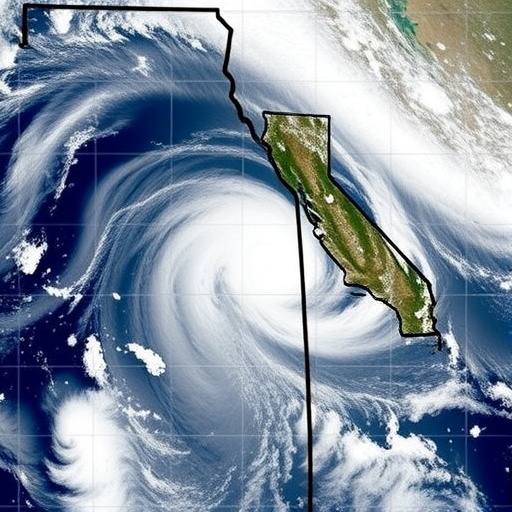
A massive oceanic current critical to regulating Earth’s climate is losing strength, and new research reveals that its decline will dramatically reshape storm patterns thousands of miles away. Scientists at the University of California, Riverside have found that the slowing Atlantic Meridional Overturning Circulation (AMOC) will supercharge atmospheric rivers hitting California while simultaneously starving Greenland of moisture, reducing snowfall and ice accumulation there. The findings, published in Nature Communications, expose a long-range climatic teleconnection that could amplify both flood risks and water supply volatility across North America.
The AMOC functions as a planetary-scale heat pump. Warm, salty surface water journeys northward toward the North Atlantic, where it surrenders heat to the atmosphere, keeping Western Europe relatively mild. As the water cools and becomes denser, it sinks and flows back south along the deep ocean floor. Climate models consistently show that this circulation is weakening as rising global temperatures pour freshwater from melting ice sheets and increase precipitation into the North Atlantic, disrupting the density-driven sinking that powers the conveyor. The new study specifically examines how this slowdown cascades through the atmosphere.
Using high-emission scenario projections, the researchers found that an enfeebled AMOC alters sea surface temperature gradients in ways that ripple upward. “It turns out a weakening AMOC will strengthen storms across parts of North America by the end of the century, along the California coast in particular, while reducing them over Greenland and the Arctic,” said Mohima Mimi, a UCR doctoral student in climate dynamics and the lead author. The mechanism is twofold. First, ocean temperature changes modify how much moisture the atmosphere can hold. Second, the temperature contrasts sharpen upper-level winds, particularly the jet stream, which steers extratropical cyclones.
These stronger high-altitude winds allow storms to tap into tropical moisture and funnel it toward the West Coast as atmospheric rivers—long, concentrated filaments of water vapor that can deliver as much water as the mouth of the Mississippi River. For California, these systems are already a hydrological double-edged sword, providing up to half of the state’s annual precipitation in just a few events but also triggering catastrophic floods and landslides. The study suggests that, as the AMOC continues to falter, these airborne water highways will become even more intense.
The model simulations also project upticks in atmospheric river activity along the eastern coast of South America and around Antarctica. Meanwhile, Greenland and the broader Arctic are expected to see a pronounced drop in storminess. With fewer moisture-laden systems reaching the ice sheet, snowfall will decline, potentially accelerating mass loss at a time when Greenland’s meltwater already threatens to further weaken the AMOC in a dangerous feedback loop. That spatial redistribution of atmospheric moisture underscores how tightly linked ocean circulation and global weather are, even across hemispheres.
Atmospheric rivers get their potency from a combination of abundant moisture and powerful steering winds. In a warming world, the atmosphere can hold about 7% more water vapor for every degree Celsius of temperature rise, a well-established Clausius-Clapeyron relationship. On top of that background thermodynamic intensification, the study isolates the dynamic effect of the AMOC slowdown itself, which reorganizes wind patterns independently of the direct thermal effects of greenhouse gases. The result is a compound risk for regions like California, where infrastructure was not designed for the extreme precipitation rates that a juiced-up atmospheric river can deliver.
The research also highlights silver linings hidden in the heightened hazard. If communities expand reservoir capacity and sharpen forecasting capabilities, stronger atmospheric rivers could be harnessed to bolster water supplies in drought-prone regions. However, the margin for error shrinks as peak intensities climb. Levee failures, urban flooding, and debris flows become more probable, demanding adaptive water management strategies that address both the scarcity and surplus extremes.
Wei Liu, associate professor of climate change and the paper’s senior author, emphasized that greenhouse gas emissions remain the primary lever humanity can pull to moderate these impacts. “Reducing emissions from these sources can lessen the impacts on the AMOC and its intensifying influence on rainfall,” he said. The study serves as a stark reminder that the climate system’s components are not isolated; a perturbation in a deep Atlantic current can rearrange storm tracks, rewrite precipitation patterns, and challenge communities continents away. As the planet’s great oceanic conveyor continues to sputter, understanding these long-distance connections will be essential for building resilient water infrastructure and preparing for a more extreme future.
Subject of Research: Impact of a weakening Atlantic Meridional Overturning Circulation on global atmospheric moisture transport and storm tracks, with a focus on atmospheric river intensification over California and moisture reduction over Greenland.
Article Title: A weakening Atlantic Meridional Overturning Circulation strengthens atmospheric rivers over California and reduces Greenland snowfall
News Publication Date: [Date of press release not provided in source; study publication date 8-Jul-2026]
Web References: 10.1038/s41467-026-72555-w
References: Mimi, M., Liu, W. et al. A weakening Atlantic Meridional Overturning Circulation strengthens atmospheric rivers over California and reduces Greenland snowfall. Nat. Commun. (2026). DOI: 10.1038/s41467-026-72555-w
Image Credits: NASA/NOAA
Keywords
Atlantic Meridional Overturning Circulation, AMOC slowdown, atmospheric rivers, California storms, Greenland snowfall, ocean circulation, climate change, extreme weather, teleconnections, moisture transport, jet stream dynamics, sea surface temperature gradients, climate modeling, water resources, flood risk.
Tags: AMOC slowdown effectsAtlantic Meridional Overturning Circulation (AMOC)California atmospheric riversclimate teleconnectionGreenland snowfall reductionhigh-emission climate projectionslong-range climate impactsNorth American flood risksocean current weakeningsea surface temperature gradientsUniversity of California Riverside researchwater supply volatility