• HOME
  • NEWS
  • EXPLORE
    • CAREER
      • Companies
      • Jobs
    • EVENTS
    • iGEM
      • News
      • Team
    • PHOTOS
    • VIDEO
    • WIKI
  • BLOG
  • COMMUNITY
    • FACEBOOK
    • INSTAGRAM
    • TWITTER
Saturday, February 7, 2026
BIOENGINEER.ORG
No Result
View All Result
  • Login
  • HOME
  • NEWS
  • EXPLORE
    • CAREER
      • Companies
      • Jobs
        • Lecturer
        • PhD Studentship
        • Postdoc
        • Research Assistant
    • EVENTS
    • iGEM
      • News
      • Team
    • PHOTOS
    • VIDEO
    • WIKI
  • BLOG
  • COMMUNITY
    • FACEBOOK
    • INSTAGRAM
    • TWITTER
  • HOME
  • NEWS
  • EXPLORE
    • CAREER
      • Companies
      • Jobs
        • Lecturer
        • PhD Studentship
        • Postdoc
        • Research Assistant
    • EVENTS
    • iGEM
      • News
      • Team
    • PHOTOS
    • VIDEO
    • WIKI
  • BLOG
  • COMMUNITY
    • FACEBOOK
    • INSTAGRAM
    • TWITTER
No Result
View All Result
Bioengineer.org
No Result
View All Result
Home NEWS Science News Chemistry

Electrokinetic proton transport in triple conducting oxides as key descriptor for highly efficient protonic ceramic fuel cells

Bioengineer by Bioengineer
July 6, 2021
in Chemistry
Reading Time: 2 mins read
0
IMAGE
Share on FacebookShare on TwitterShare on LinkedinShare on RedditShare on Telegram

IMAGE

Credit: UNIST

A research team, led by Professor Guntae Kim in the School of Energy and Chemical Engineering at UNIST has introduced an innovative way to quantify proton kinetic properties of triple (H+/O2?/e?) conducting oxides (TCOs) being a significant indicator for characterizing the electrochemical behavior of proton and the mechanism of electrode reactions.

Layered perovskites have recently received much attention as they have been regarded as promising cathode materials for protonic ceramic fuel cells (PCFCs) that use proton conducting oxide (PCO) as an electrolyte. Therefore, quantitative characterization of the proton kinetics in TCO can be an important indicator providing a scientific basis for the rational design of highly efficient electrode materials of PCFCs, noted the research team.

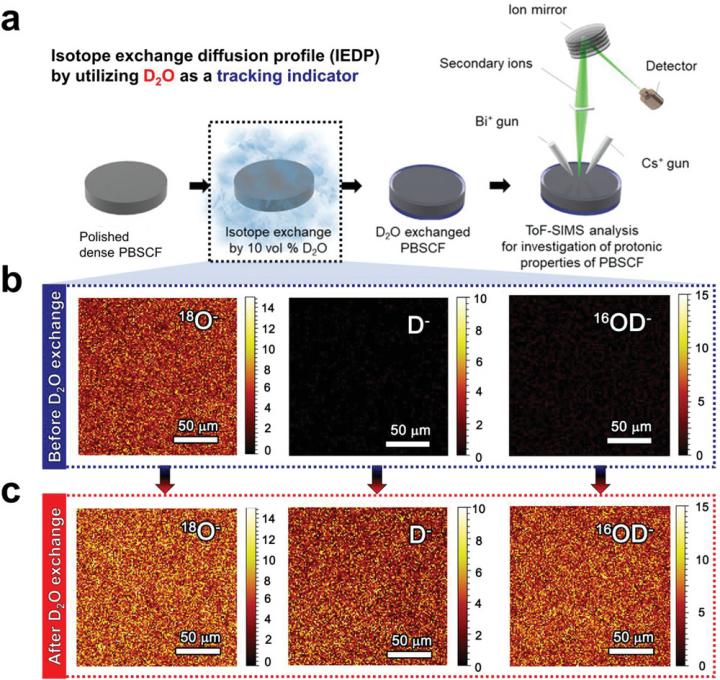
In this study, the research team employed the isotope exchange diffusion profile (IEDP) method to evaluate the proton kinetic properties of proton in the layered perovskite-type TCOs, PrBa0.5Sr0.5Co1.5Fe0.5O5+δ (PBSCF).

Using heavy water (deuterium oxide, D2O), as a tracking indicator of proton diffusion via time-of-flight secondary ion mass spectrometry (ToF-SIMS), the research team observed the proton formation and transport on both surface and bulk of the PBSCF. The findings revealed that the PBSCF showed two orders of magnitude higher proton tracer diffusion coefficient (D*H, 1.04 × 10?6 cm2 s?1 at 550 °C) than its oxygen diffusion coefficient at even higher temperature range (D*O, 1.9 × 10?8 cm2 s?1 at 590 °C). With the application of this fast proton transfer ability, the PBSCF cathode also exhibited excellent electrochemical performance for PCFC operation at low temperatures (e.g., 0.42 W cm?2 at 500 °C), which is bar far the best performance ever reported, noted the research team.

Meanwhile, a fuel cell is an eco-friendly energy conversion system that uses the chemical energy of hydrogen or another fuel to generate electricity. Among them, PCFCs have shown great potential to be operated at relatively low temperatures. Advantages of this class of fuel cells include a wide range of operating temperature and material choice, which could solve critical issues for solid-state electrochemical devices.

This research has been jointly carried out by Professor Sivaprakash Sengodan from UK’s Imperial College London, Professor Meilin Liu from the Georgia Institute of Technology in the United States, and Professor Sihyuk Choi from Kumoh National Institute of Technology. This study was made available online in March 2021 ahead of final publication in Advanced Science in June 2021.

###

Media Contact
JooHyeon Heo
[email protected]

Original Source

https://news.unist.ac.kr/electrokinetic-proton-transport-in-triple-conducting-oxides-as-key-descriptor-for-highly-efficient-protonic-ceramic-fuel-cells/

Tags: Chemistry/Physics/Materials SciencesElectromagneticsEnergy/Fuel (non-petroleum)Materials
Share12Tweet8Share2ShareShareShare2

Related Posts

blank

Breakthrough in Environmental Cleanup: Scientists Develop Solar-Activated Biochar for Faster Remediation

February 7, 2026
blank

Cutting Costs: Making Hydrogen Fuel Cells More Affordable

February 6, 2026

Scientists Develop Hand-Held “Levitating” Time Crystals

February 6, 2026

Observing a Key Green-Energy Catalyst Dissolve Atom by Atom

February 6, 2026
Please login to join discussion

POPULAR NEWS

  • Robotic Ureteral Reconstruction: A Novel Approach

    Robotic Ureteral Reconstruction: A Novel Approach

    82 shares
    Share 33 Tweet 21
  • Digital Privacy: Health Data Control in Incarceration

    63 shares
    Share 25 Tweet 16
  • Study Reveals Lipid Accumulation in ME/CFS Cells

    57 shares
    Share 23 Tweet 14
  • Breakthrough in RNA Research Accelerates Medical Innovations Timeline

    53 shares
    Share 21 Tweet 13

About

We bring you the latest biotechnology news from best research centers and universities around the world. Check our website.

Follow us

Recent News

TPMT Expression Predictions Linked to Azathioprine Side Effects

Improving Dementia Care with Enhanced Activity Kits

Decoding Prostate Cancer Origins via snFLARE-seq, mxFRIZNGRND

Subscribe to Blog via Email

Enter your email address to subscribe to this blog and receive notifications of new posts by email.

Join 73 other subscribers
  • Contact Us

Bioengineer.org © Copyright 2023 All Rights Reserved.

Welcome Back!

Login to your account below

Forgotten Password?

Retrieve your password

Please enter your username or email address to reset your password.

Log In
No Result
View All Result
  • Homepages
    • Home Page 1
    • Home Page 2
  • News
  • National
  • Business
  • Health
  • Lifestyle
  • Science

Bioengineer.org © Copyright 2023 All Rights Reserved.