• HOME
  • NEWS
  • EXPLORE
    • CAREER
      • Companies
      • Jobs
    • EVENTS
    • iGEM
      • News
      • Team
    • PHOTOS
    • VIDEO
    • WIKI
  • BLOG
  • COMMUNITY
    • FACEBOOK
    • INSTAGRAM
    • TWITTER
Monday, May 11, 2026
BIOENGINEER.ORG
No Result
View All Result
  • Login
  • HOME
  • NEWS
  • EXPLORE
    • CAREER
      • Companies
      • Jobs
        • Lecturer
        • PhD Studentship
        • Postdoc
        • Research Assistant
    • EVENTS
    • iGEM
      • News
      • Team
    • PHOTOS
    • VIDEO
    • WIKI
  • BLOG
  • COMMUNITY
    • FACEBOOK
    • INSTAGRAM
    • TWITTER
  • HOME
  • NEWS
  • EXPLORE
    • CAREER
      • Companies
      • Jobs
        • Lecturer
        • PhD Studentship
        • Postdoc
        • Research Assistant
    • EVENTS
    • iGEM
      • News
      • Team
    • PHOTOS
    • VIDEO
    • WIKI
  • BLOG
  • COMMUNITY
    • FACEBOOK
    • INSTAGRAM
    • TWITTER
No Result
View All Result
Bioengineer.org
No Result
View All Result
Home NEWS Science News

Control over water friction with 2D materials points to ‘smart membranes’

Bioengineer by Bioengineer
September 6, 2025
in Science News
Reading Time: 2 mins read
0
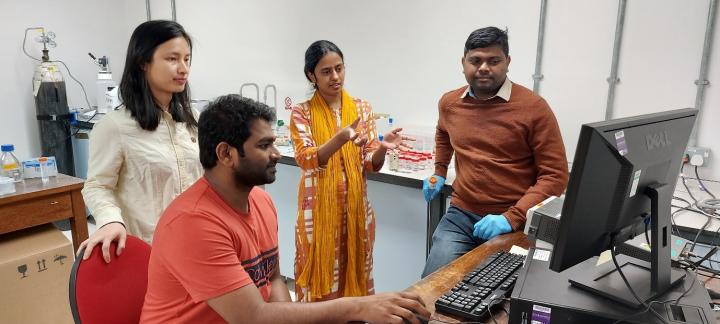
IMAGE
Share on FacebookShare on TwitterShare on LinkedinShare on RedditShare on Telegram

Dramatic decrease in friction when water is passed through nanoscale capillaries made of graphene

The speed of water flow is a limiting factor in many membrane-based industrial processes, including desalination, molecular separation and osmotic power generation.

Researchers at The University of Manchester’s National Graphene Institute (NGI) have published a study in Nature Communications showing a dramatic decrease in friction when water is passed through nanoscale capillaries made of graphene, whereas those with hexagonal boron nitride (hBN) – which has a similar surface topography and crystal structure as graphene – display high friction.

The team also demonstrated that water velocity could be selectively controlled by covering the high friction hBN channels with graphene, opening the door to greatly increased permeation and efficiency in so-called ‘smart membranes’.

Fast and selective fluid-flows are common in nature – for example, in protein structures called aquaporins that transport water between cells in animals and plants. However, the precise mechanisms of fast water-flows across atomically flat surfaces are not fully understood.

The investigations of the Manchester team, led by Professor Radha Boya, have shown that – in contrast to the widespread belief that all atomically flat surfaces that are hydrophobic should provide little friction for water flow – in fact the friction is mainly governed by electrostatic interactions between flowing molecules and their confining surfaces.

Dr Ashok Keerthi, first author of the study, said: “Though hBN has a similar water ‘wettability’ as graphene and MoS2, it surprised us that the flow of water is totally different. Interestingly, roughened graphene surface with few angstroms deep dents/terraces, or atomically corrugated MoS2 surface, did not hinder water flows in nanochannels.”

Therefore, an atomically smooth surface is not the only reason for frictionless water flow on graphene. Rather the interactions between flowing water molecules and confining 2D materials play a crucial role in imparting the friction to the fluid transport inside nanochannels.

Professor Boya said: “We have shown that nanochannels covered with graphene at the exits display enhanced water flows. This can be very useful to increase the water flux from membranes, especially in those processes where evaporation is involved, such as distillation or thermal desalination.”

Understanding of liquid friction and interactions with pore materials is vital to the development of efficient membranes for applications such as energy storage and desalination.

This latest study adds to an increasingly influential body of work from the researchers at the NGI, as Manchester reinforces its position at the forefront of nanofluidic research towards improved industrial applications for sectors including wastewater treatment, pharmaceutical production and food and beverages.

###

Media Contact
James Tallentire
[email protected]

Original Source

https://www.manchester.ac.uk/discover/news/control-over-water-friction-with-2d-materials-towards-smart-membranes/

Related Journal Article

http://dx.doi.org/10.1038/s41467-021-23325-3

Tags: Biomedical/Environmental/Chemical EngineeringBiotechnologyChemistry/Physics/Materials SciencesElectromagneticsIndustrial Engineering/ChemistryMaterialsNanotechnology/MicromachinesTechnology Transfer
Share12Tweet8Share2ShareShareShare2

Related Posts

Humans and Zebra Finches Share Similar Speech Learning Techniques #ASA190 — Chemistry

Humans and Zebra Finches Share Similar Speech Learning Techniques #ASA190

May 11, 2026
New Study Uncovers How Fungal Parasites Attack Strawberries and Raspberries — Agriculture

New Study Uncovers How Fungal Parasites Attack Strawberries and Raspberries

May 11, 2026

City of Hope Researchers to Present Groundbreaking Immunotherapy and Precision Medicine Advances Across Multiple Cancer Types at ASCO 2026

May 11, 2026

Medicaid Expansion Reduces Mortality in Young Adults with Kidney Failure

May 11, 2026
Please login to join discussion

POPULAR NEWS

  • Research Indicates Potential Connection Between Prenatal Medication Exposure and Elevated Autism Risk

    841 shares
    Share 336 Tweet 210
  • New Study Reveals Plants Can Detect the Sound of Rain

    728 shares
    Share 290 Tweet 182
  • Salmonella Haem Blocks Macrophages, Boosts Infection

    62 shares
    Share 25 Tweet 16
  • Breastmilk Balances E. coli and Beneficial Bacteria in Infant Gut Microbiomes

    57 shares
    Share 23 Tweet 14

About

We bring you the latest biotechnology news from best research centers and universities around the world. Check our website.

Follow us

Recent News

Humans and Zebra Finches Share Similar Speech Learning Techniques #ASA190

New Study Uncovers How Fungal Parasites Attack Strawberries and Raspberries

City of Hope Researchers to Present Groundbreaking Immunotherapy and Precision Medicine Advances Across Multiple Cancer Types at ASCO 2026

Subscribe to Blog via Email

Enter your email address to subscribe to this blog and receive notifications of new posts by email.

Join 82 other subscribers
  • Contact Us

Bioengineer.org © Copyright 2023 All Rights Reserved.

Welcome Back!

Login to your account below

Forgotten Password?

Retrieve your password

Please enter your username or email address to reset your password.

Log In
No Result
View All Result
  • Homepages
    • Home Page 1
    • Home Page 2
  • News
  • National
  • Business
  • Health
  • Lifestyle
  • Science

Bioengineer.org © Copyright 2023 All Rights Reserved.