• HOME
  • NEWS
  • EXPLORE
    • CAREER
      • Companies
      • Jobs
    • EVENTS
    • iGEM
      • News
      • Team
    • PHOTOS
    • VIDEO
    • WIKI
  • BLOG
  • COMMUNITY
    • FACEBOOK
    • INSTAGRAM
    • TWITTER
Saturday, March 28, 2026
BIOENGINEER.ORG
No Result
View All Result
  • Login
  • HOME
  • NEWS
  • EXPLORE
    • CAREER
      • Companies
      • Jobs
        • Lecturer
        • PhD Studentship
        • Postdoc
        • Research Assistant
    • EVENTS
    • iGEM
      • News
      • Team
    • PHOTOS
    • VIDEO
    • WIKI
  • BLOG
  • COMMUNITY
    • FACEBOOK
    • INSTAGRAM
    • TWITTER
  • HOME
  • NEWS
  • EXPLORE
    • CAREER
      • Companies
      • Jobs
        • Lecturer
        • PhD Studentship
        • Postdoc
        • Research Assistant
    • EVENTS
    • iGEM
      • News
      • Team
    • PHOTOS
    • VIDEO
    • WIKI
  • BLOG
  • COMMUNITY
    • FACEBOOK
    • INSTAGRAM
    • TWITTER
No Result
View All Result
Bioengineer.org
No Result
View All Result
Home NEWS Science News Biology

Future lake food webs in subarctic have more biomass and contain more omega-3 fatty acids

Bioengineer by Bioengineer
October 30, 2020
in Biology
Reading Time: 3 mins read
0
IMAGE
Share on FacebookShare on TwitterShare on LinkedinShare on RedditShare on Telegram

IMAGE

Credit: Kimmo Kahilainen & Brian Hayden

Subarctic regions are facing rapid changes in climate and land-use intensity. An international research team recently completed an investigation to see how these changes are affecting the food webs and fish communities of lakes in northern Finland. Biomasses and omega-3 fatty acids, EPA and DHA, were determined from the algal producers at the base of food web to large carnivorous fish from 20 lakes along a pronounced climatic and productivity gradient. Increasing nutrient load and rising temperature shift food webs towards murky water adapted communities.

The team measured amount of fish and invertebrates from 20 subarctic lakes along climate and productivity gradient and determined the nutritional quality of organisms in each lake by measuring valuable omega-3 fatty acids, EPA and DHA, from primary producer algae communities to top predators.

Researchers found major differences in the clear and murky water communities. Increasing temperature and productivity increased biomass of algal and cyprinid fish communities.

Professor Kimmo Kahilainen from University of Helsinki, Lammi Biological Station, coordinated this lake research program.

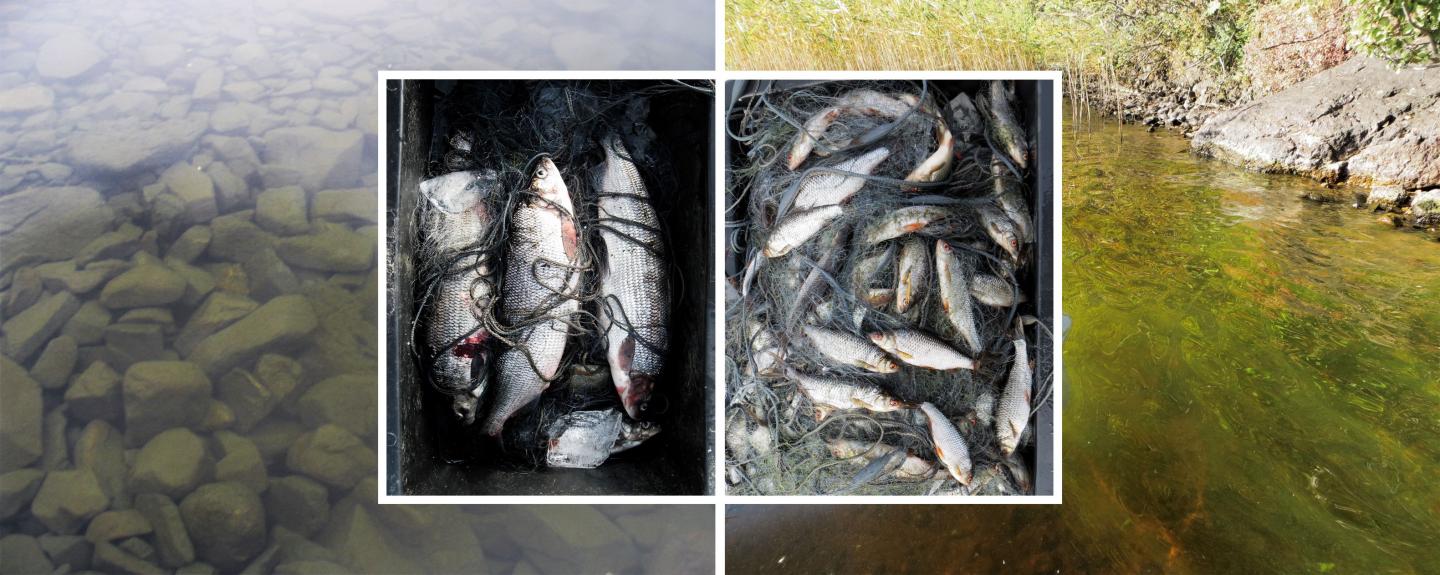
“What we find in these food webs was community shift from clear water to murky lakes. We get a lot of fish from blue-green algal covered lakes, but there were no salmonid fishes anymore and the fish catch consisted almost exclusively of roach” says Kahilainen.

Changes in fatty acid producing algal communities

Biomass in lake food webs is largely composed of water, carbohydrates, proteins and lipids. Part of lipids are nutritionally very important including essential omega-3 fatty acids, such as EPA and DHA, which are efficiently produced by certain algae, such as diatoms in subarctic regions.

Invertebrates consume these algal basal producers and their EPA and DHA are transferred through the food web.
Researchers measured EPA and DHA content from whole food web from algae to carnivorous fish in each lake.

“Algal community changed from diatoms to blue-green algae and their quality decreased from clear to murky lakes, similar decreasing quality was also observed in invertebrates”, says the lead author of study Mr Ossi Keva, a PhD student from University of Jyväskylä.

Despite decreasing prey item quality, the hypothesised cascading effects on fish was not observed. Instead, increasing fish biomass in murky lakes actually led to an increase in total fatty acids.

“Food webs in warmer and more productive environment do contain more fish and fatty acids, while the fish species itself shift from highly valued salmonids towards cyprinid dominated communities. Northern Finnish pristine subarctic lakes are not getting clearer in future, the change is more likely towards warmer and murky lakes modifying food web communities as well”, Keva summarises.

###

Researchers from Finland, Canada and Switzerland collaborated to the subarctic lake food web study.

The research was published in Global Change Biology on 30th of October 2020.

Link to research:
https://doi.org/10.1111/gcb.15387

Further information:

Ossi Keva, University of Jyväskylä, [email protected], tel. +358 400 618 944

Figure credit:
Kimmo Kahilainen & Brian Hayden

Figure legend:
In northern lakes algal and fish biomass are increasing with temperature and productivity. At the same time, fish communities are changing from whitefish towards roach dominance.

Media Contact
Ossi Keva
[email protected]

Original Source

https://www.jyu.fi/en/current/archive/2020/10/future-lake-food-webs-in-subarctic-have-more-biomass-and-contain-more-omega-3-fatty-acids

Related Journal Article

http://dx.doi.org/10.1111/gcb.15387

Tags: BiologyClimate ChangeEcology/EnvironmentFisheries/AquacultureMarine/Freshwater BiologyMicrobiologyPopulation BiologyZoology/Veterinary Science
Share12Tweet8Share2ShareShareShare2

Related Posts

Two Salk Scientists Honored as 2025 AAAS Fellows

Two Salk Scientists Honored as 2025 AAAS Fellows

March 27, 2026
How to sway group opinions: Encourage opponents to stay undecided

How to sway group opinions: Encourage opponents to stay undecided

March 23, 2026

Deep Learning Model Maps How Individual Cells Shape Disease Outcomes

March 20, 2026

Removing only 15 female sharks annually could endanger the entire population, scientists warn

March 20, 2026
Please login to join discussion

POPULAR NEWS

  • blank

    Revolutionary AI Model Enhances Precision in Detecting Food Contamination

    96 shares
    Share 38 Tweet 24
  • Imagine a Social Media Feed That Challenges Your Views Instead of Reinforcing Them

    1004 shares
    Share 397 Tweet 248
  • Uncovering Functions of Cavernous Malformation Proteins in Organoids

    54 shares
    Share 22 Tweet 14
  • Promising Outcomes from First Clinical Trials of Gene Regulation in Epilepsy

    51 shares
    Share 20 Tweet 13

About

We bring you the latest biotechnology news from best research centers and universities around the world. Check our website.

Follow us

Recent News

In-Sensor Cryptography Links Physical Process to Digital Identity

Can Psychosocial Factors Influence Cancer Risk?

Depression Factors in Elderly: Pre vs. Post-COVID Analysis

Subscribe to Blog via Email

Enter your email address to subscribe to this blog and receive notifications of new posts by email.

Join 78 other subscribers
  • Contact Us

Bioengineer.org © Copyright 2023 All Rights Reserved.

Welcome Back!

Login to your account below

Forgotten Password?

Retrieve your password

Please enter your username or email address to reset your password.

Log In
No Result
View All Result
  • Homepages
    • Home Page 1
    • Home Page 2
  • News
  • National
  • Business
  • Health
  • Lifestyle
  • Science

Bioengineer.org © Copyright 2023 All Rights Reserved.