Making masks and personal protective equipment (PPE) with hydrophilic surfaces, where droplets of coronavirus spread out and dry faster, could reduce infection risk.
Credit: R. Bhardwaj and A. Agrawal
WASHINGTON, August 11, 2020 — Since the COVID-19 virus spreads through respiratory droplets, researchers in India set out to explore how droplets deposited on face masks or frequently touched surfaces, like door handles or smartphone touch screens, dry.
Droplets can be expelled via the mouth or nose while coughing, sneezing or simply talking. These droplets are tiny, around twice the width of a human hair, and studies have shown a substantially reduced chance of infection once they dry.
In Physics of Fluids, from AIP Publishing, Rajneesh Bhardwaj and Amit Agrawal, professors at IIT Bombay, publish findings that surface wetting properties to reduce the drying time of droplets could help lessen the risk of infection from coronaviruses.
“We wanted to quantify the droplet drying time on various surfaces and make a recommendation for the ideal types of surfaces for masks and personal protective equipment (PPE) based on the drying time,” said Bhardwaj.
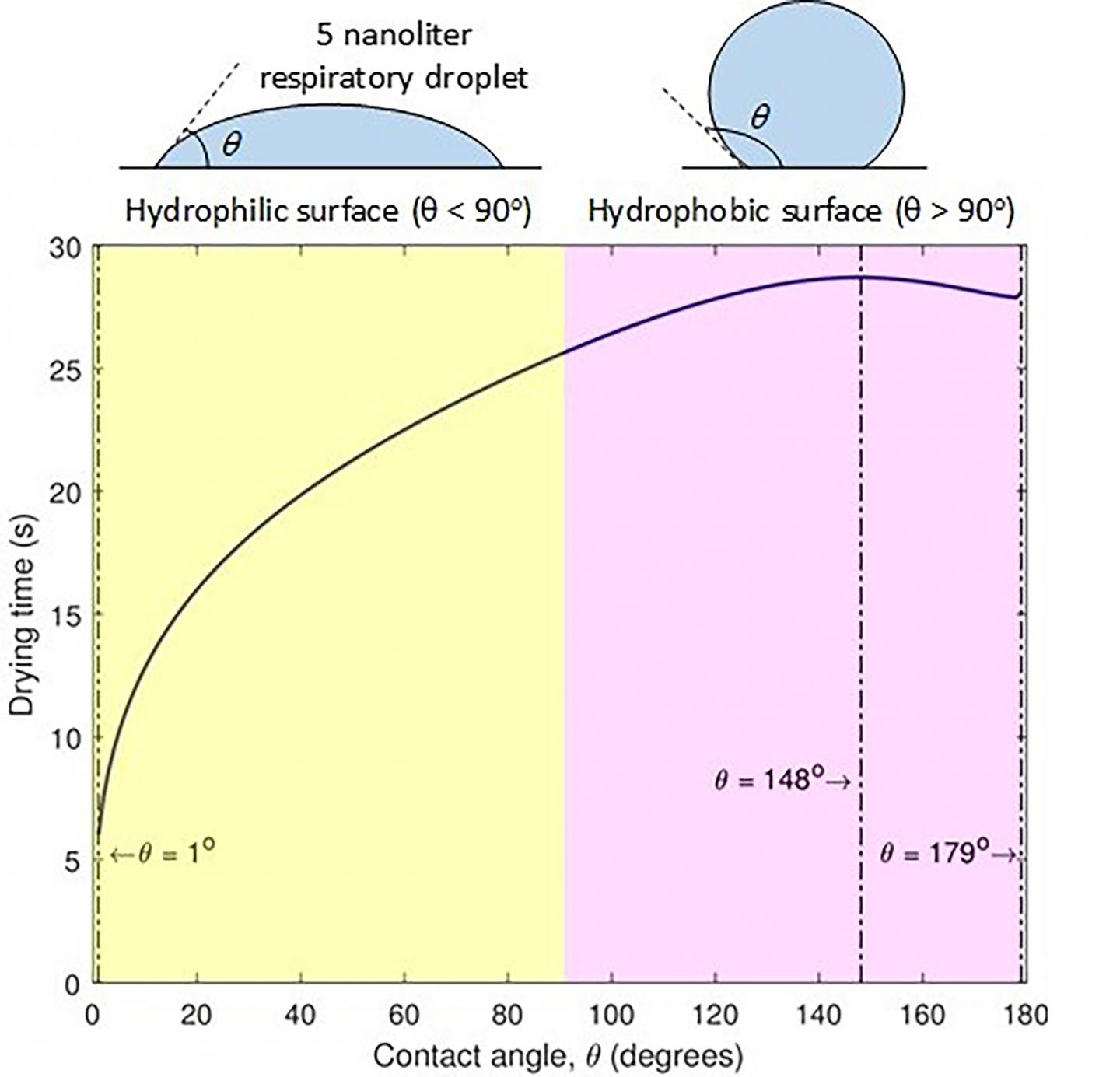
By studying the drying time of a droplet for different contact angles, the expected chances of survival of the coronavirus on a surface can be estimated by using a mathematical physics model.
“Our calculations of the drying time as a function of contact angle show that the droplet dries roughly four times faster on the hydrophilic surface that attracts water than on the one that repels water. This will drastically reduce the chances of virus survival,” Bhardwaj said.
Their work also shows that, by tailoring the surface wettability and drying time, the chances of infection can be reduced.
“Making a surface more hydrophilic reduces the drying time, and it is advisable to use it for masks, PPE and frequently touched surfaces where outbreaks are most likely to occur, such as the common areas within hospitals,” said Agrawal.
In the case of N95 respirators, surgical masks and PPE bodywear, a reduction to a contact angle of a hydrophilic surface implies that the chances of infection of COVID-19 will be cut in half.
“We recommend reducing the contact angle of the surface of face masks and frequently touched surfaces,” Agrawal said.
The biggest surprise was their finding that the maximum drying time occurs at an intermediate contact angle value of 148 degrees.
“This implies that a superhydrophobic surface needs to be made even more superhydrophobic to reduce the drying time,” Agrawal said. “This is counterintuitive, because we normally think of making a surface more hydrophilic, reducing the contact angle, to reduce the drying time.”
This work provides a better understanding of coronavirus survival within a drying droplet, which may be helpful for predicting the survival of other transmissible diseases spread through respiratory droplets, such as the flu.
###
The article, “Tailoring surface wettability to reduce chances of infection of COVID-19 by a respiratory droplet and to improve the effectiveness of personal protection equipment,” is authored by Rajneesh Bhardwaj and Amit Agrawal. It will appear in Physics of Fluids on Aug. 11, 2020 (DOI: 10.1063/5.00020249). After that date, it can be accessed at https:/
ABOUT THE JOURNAL
Physics of Fluids is devoted to the publication of original theoretical, computational, and experimental contributions to the dynamics of gases, liquids, and complex fluids. See https:/
Media Contact
Larry Frum
[email protected]
Related Journal Article
http://dx.