Antibiotics discovered at The University of Queensland will be fast-tracked under an US$11 million international research deal
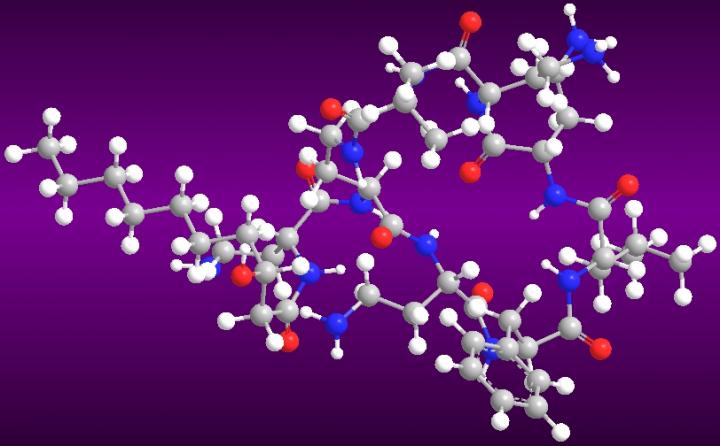
Credit: IMB, University of Queensland
Antibiotics discovered at The University of Queensland will be fast-tracked under an US$11 million international research deal.
An agreement with CARB-X, a global non-profit partnership funding the world’s largest antibacterial development pipeline, initially provides UQ’s Institute for Molecular Bioscience (IMB) with up to US$3.83 million to develop a new antibiotic, and a further US$A7.03 million as project milestones are passed.
Project leader Professor Matt Cooper said the new antibiotic, Octapeptin-X (OPX), would target the most dangerous drug-resistant bacteria that evade all current therapies.
“Much of the world’s current focus is rightly on COVID-19, but superbugs remain a serious and constant threat to global human health,” Professor Cooper said.
UQ Vice-Chancellor and President Professor Peter Høj said it was gratifying UQ was the first Australian organisation that CARB-X had chosen to support.
“We are determined to make a difference to the global antibiotic resistance problem – another example of fundamental research under way at UQ changing the world and saving lives,” Professor Høj said.
“The funding cements the Institute for Molecular Bioscience as the leading place for antibiotic discovery and development in Australia, and one of the leading centres globally.
“The drug discovery capabilities of the Centre for Superbug Solutions, teamed with vital support from CARB-X, will equip us to tackle this challenge and improve outcomes for people with drug-resistant infections in the future.
Centre Director Dr Mark Blaskovich said extensively drug-resistant bacteria strains were on the rise, killing about 700,000 people worldwide annually.
“Commonly these bacteria cause pneumonia, urinary tract and wound infections,” he said.
“Our current antibiotics are increasingly ineffective against them, leaving patients with no alternatives.”
The project’s lead chemist, Dr Karl Hansford, said use of polymyxin – a last-line antibiotic which has severe side-effects – had surged in recent years as doctors struggled to treat superbug infections.
“The CARB-X funding will enable us to develop Octapeptin-X (OPX) as a safe treatment for drug-resistant infections deemed untreatable by these conventional therapies,” Dr Hansford said.
“We’ve demonstrated that OPX antibiotics exert a unique killing action distinct from other antibiotics.”
###
Combating Antibiotic-Resistant Bacteria Biopharmaceutical Accelerator (CARB-X) is a global partnership dedicated to accelerating early development antibacterial R&D to address the rising threat of drug-resistant bacteria.
It supports the world’s largest and most innovative pipeline of preclinical products against drug-resistant infections.
It is led by Boston University and funding is provided by the Biomedical Advanced Research and Development Authority (BARDA), part of the Office of the Assistant Secretary for Preparedness and Response (ASPR) in the US Department of Health and Human Services, the Wellcome Trust, a global charity based in the UK working to improve health globally, Germany’s Federal Ministry of Education and Research (BMBF), the UK Department of Health and Social Care’s Global Antimicrobial Resistance Innovation Fund (GAMRIF), the Bill & Melinda Gates Foundation, and with in-kind support from National Institute of Allergy and Infectious Diseases (NIAID), part of the US National Institutes of Health (NIH).
Image: https:/
Media Contact
Bronwyn Adams
[email protected]