• HOME
  • NEWS
  • EXPLORE
    • CAREER
      • Companies
      • Jobs
    • EVENTS
    • iGEM
      • News
      • Team
    • PHOTOS
    • VIDEO
    • WIKI
  • BLOG
  • COMMUNITY
    • FACEBOOK
    • INSTAGRAM
    • TWITTER
Tuesday, May 12, 2026
BIOENGINEER.ORG
No Result
View All Result
  • Login
  • HOME
  • NEWS
  • EXPLORE
    • CAREER
      • Companies
      • Jobs
        • Lecturer
        • PhD Studentship
        • Postdoc
        • Research Assistant
    • EVENTS
    • iGEM
      • News
      • Team
    • PHOTOS
    • VIDEO
    • WIKI
  • BLOG
  • COMMUNITY
    • FACEBOOK
    • INSTAGRAM
    • TWITTER
  • HOME
  • NEWS
  • EXPLORE
    • CAREER
      • Companies
      • Jobs
        • Lecturer
        • PhD Studentship
        • Postdoc
        • Research Assistant
    • EVENTS
    • iGEM
      • News
      • Team
    • PHOTOS
    • VIDEO
    • WIKI
  • BLOG
  • COMMUNITY
    • FACEBOOK
    • INSTAGRAM
    • TWITTER
No Result
View All Result
Bioengineer.org
No Result
View All Result
Home NEWS Science News Chemistry

Atomic magnetometer points to better picture of heart conductivity

Bioengineer by Bioengineer
March 31, 2020
in Chemistry
Reading Time: 3 mins read
0
IMAGE
Share on FacebookShare on TwitterShare on LinkedinShare on RedditShare on Telegram

Radio-frequency device maps electric currents in solutions that mimic the heart with enough resolutions to study the subtle aberrations related to atrial fibrillation
IMAGE

Credit: Cameron Deans

WASHINGTON, March 31, 2020 — Mapping the electrical conductivity of the human heart would be a valuable tool in the diagnosis and management of diseases, such as atrial fibrillation. But doing so would require invasive procedures, none of which are capable of directly mapping dielectric properties.

Significant advances have been made recently that leverage atomic magnetometers, which are quantum devices, to provide a direct picture of electric conductivity of biological tissues. In this week’s Applied Physics Letters, from AIP Publishing, new work in quantum sensors points to ways such technology could be used to examine the heart.

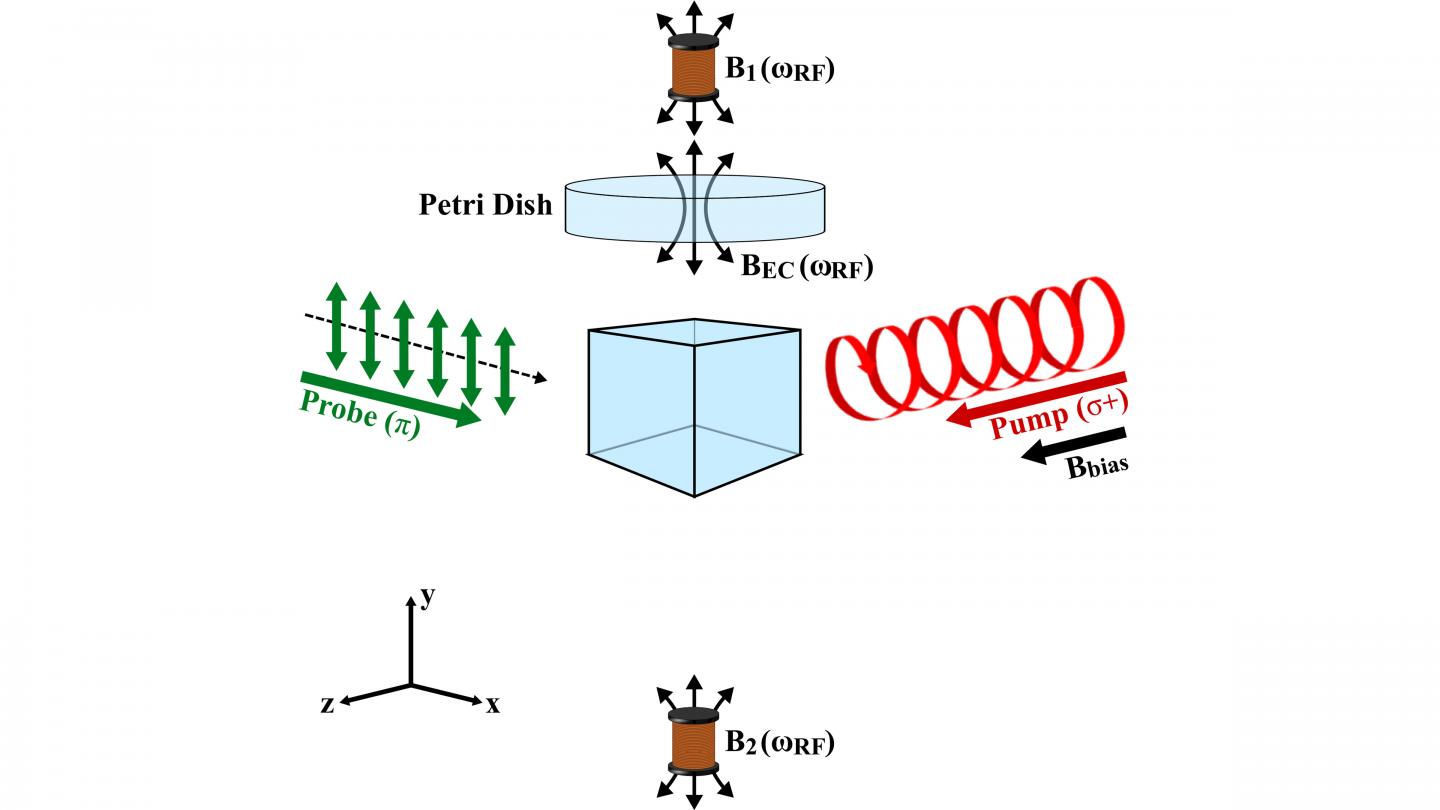
Researchers at University College London have modified approaches used in electromagnetic induction imaging to take a picture of the electrical conduction of models that resembles the human heart. Using a radio-frequency atomic magnetometer that relies on rubidium-87, the group achieved the level of performance required to image the dielectric properties of the supporting structures that drive cardiac function.

“For the first time, we have achieved, in unshielded environments, the sensitivity and stability for imaging low conductivity in small volumes that are comparable to the expected size of the anomalies seen in atrial fibrillation,” said author Luca Marmugi. “Thus, we have demonstrated that noninvasive electromagnetic induction imaging of the heart is technically possible.”

The device the UCL group has developed applies a small oscillating magnetic field that induces a signal in the heart and is detected by an ultrasensitive detector based on laser manipulation of atomic spins.

To map conductivity anomalies in the human heart, such a device would need to detect conductivities on the order of 0.7 to 0.9 siemens per meter. When tested on laboratory solutions of the same conduction features of the human heart, the group’s device was able to yield a signal that small.

The results mark a fiftyfold improvement over previous attempts to capture such small specimens.

Marmugi said the group hopes to continue developing its magnetometer system for clinical use and looks to improve on machine learning techniques to better map heart conductivity data.

“Our work has demonstrated the feasibility of our idea proposed in 2016. Mission accomplished!” Marmugi said. “However, we know we cannot rest. In this sense, I hope it will trigger increased interested in this kind of applications, hopefully encouraging more and more groups to work in the same field and fostering new collaboration and ideas.”

###

The article, “Sub-Sm-1 electromagnetic induction imaging with an unshielded atomic magnetometer,” is authored by Cameron Deans, Luca Marmugi and Ferruccio Renzoni. The article will appear in Applied Physics Letters on March 31, 2020 (DOI: 10.1063/5.0002146). After that date, it can be accessed at https://aip.scitation.org/doi/10.1063/5.0002146.

ABOUT THE JOURNAL

Applied Physics Letters features rapid reports on significant discoveries in applied physics. The journal covers new experimental and theoretical research on applications of physics phenomena related to all branches of science, engineering, and modern technology. See https://aip.scitation.org/journal/apl.

Media Contact
Larry Frum
[email protected]

Related Journal Article

http://dx.doi.org/10.1063/5.0002146

Tags: BiologyBiomechanics/BiophysicsBiomedical/Environmental/Chemical EngineeringBiotechnologyCardiologyChemistry/Physics/Materials SciencesElectromagneticsMedicine/HealthTechnology/Engineering/Computer Science
Share12Tweet8Share2ShareShareShare2

Related Posts

Humans and Zebra Finches Share Similar Speech Learning Techniques #ASA190 — Chemistry

Humans and Zebra Finches Share Similar Speech Learning Techniques #ASA190

May 11, 2026
Unveiling Dark Matter Through Molecular Insights — Chemistry

Unveiling Dark Matter Through Molecular Insights

May 11, 2026

From Touch to Sight: A Bioinspired Multisensory Framework Endows Robots with Human-Like Perception

May 11, 2026

Announcing the 2026 Carbon Future Young Investigator Award Winners

May 11, 2026
Please login to join discussion

POPULAR NEWS

  • Research Indicates Potential Connection Between Prenatal Medication Exposure and Elevated Autism Risk

    841 shares
    Share 336 Tweet 210
  • New Study Reveals Plants Can Detect the Sound of Rain

    728 shares
    Share 290 Tweet 182
  • Salmonella Haem Blocks Macrophages, Boosts Infection

    62 shares
    Share 25 Tweet 16
  • Breastmilk Balances E. coli and Beneficial Bacteria in Infant Gut Microbiomes

    57 shares
    Share 23 Tweet 14

About

We bring you the latest biotechnology news from best research centers and universities around the world. Check our website.

Follow us

Recent News

Humans and Zebra Finches Share Similar Speech Learning Techniques #ASA190

New Study Uncovers How Fungal Parasites Attack Strawberries and Raspberries

City of Hope Researchers to Present Groundbreaking Immunotherapy and Precision Medicine Advances Across Multiple Cancer Types at ASCO 2026

Subscribe to Blog via Email

Enter your email address to subscribe to this blog and receive notifications of new posts by email.

Join 82 other subscribers
  • Contact Us

Bioengineer.org © Copyright 2023 All Rights Reserved.

Welcome Back!

Login to your account below

Forgotten Password?

Retrieve your password

Please enter your username or email address to reset your password.

Log In
No Result
View All Result
  • Homepages
    • Home Page 1
    • Home Page 2
  • News
  • National
  • Business
  • Health
  • Lifestyle
  • Science

Bioengineer.org © Copyright 2023 All Rights Reserved.