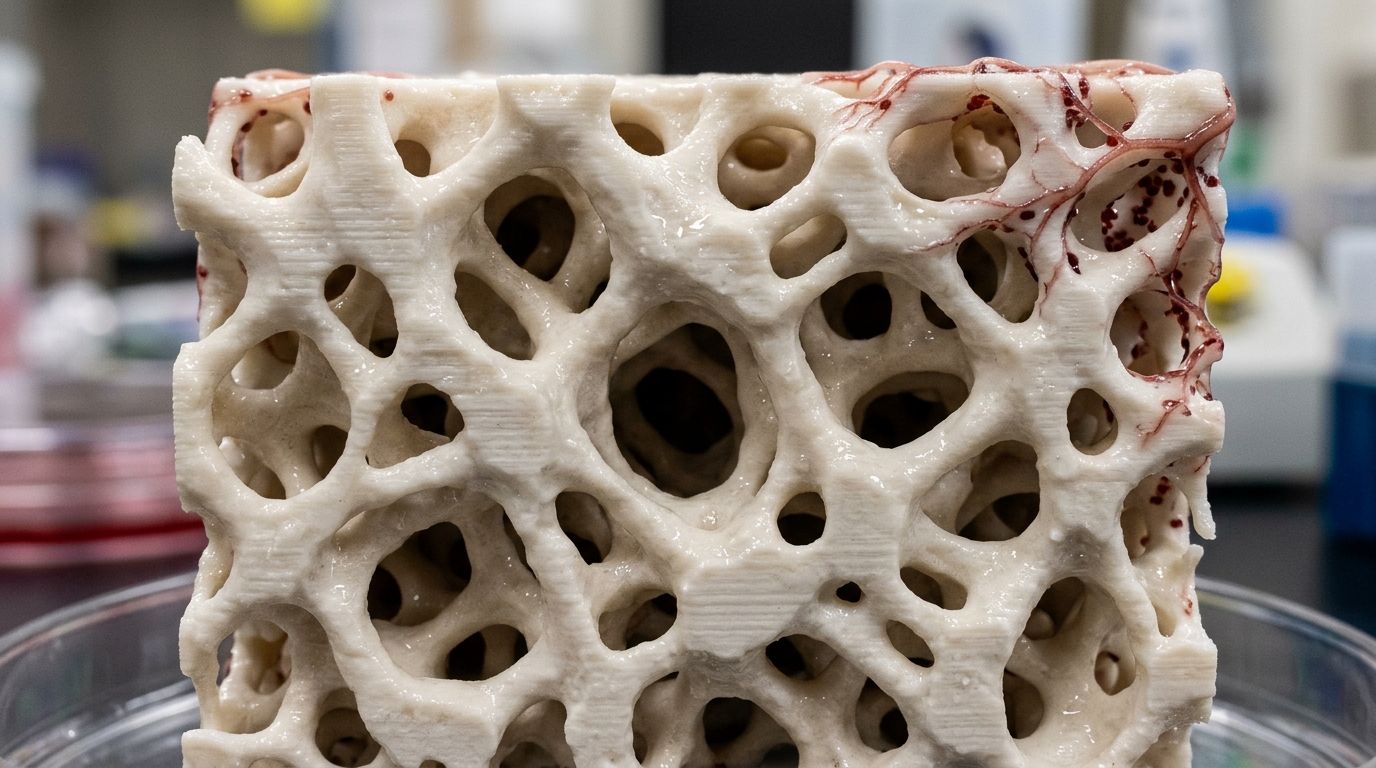
Critical-sized bone defects, those too large for the body to heal on its own, remain a stubborn challenge in regenerative medicine, and a new review argues that the problem lies less in building scaffolds than in making them carry blood. The article is shared early in Discover Materials as an accepted, peer-reviewed manuscript that is citable and carries a permanent DOI, and it examines the biological and engineering challenges associated with vascularizing 3D-printed scaffolds for bone regeneration. The authors, Ramón Román-Doval, Aldo Y. Tenorio-Barajas, Carlos I. Cortes-Martínez, Tábata E. Anton-Guzmán and Gabriela Carrasco-Torres, give special attention to four critical limitations: the oversimplification of vascular architecture in current scaffold designs, the inadequate spatiotemporal control of angiogenic signaling, the disparity between promising in vitro results and poor in vivo integration, and the absence of standardized criteria for vascularization assessment.
The review draws a distinction often blurred in the literature: structural versus functional vascularization. Structural vascularization is defined by the presence of endothelial markers and vessel-like structures. Functional vascularization, by contrast, requires perfusable, anastomosed and hemodynamically stable networks capable of sustaining long-term tissue survival.
Three-dimensional printing allows researchers to design scaffolds with controlled architecture, mechanical properties and spatial distribution of bioactive molecules. Techniques discussed include extrusion-based bioprinting, stereolithography (SLA) and selective laser sintering (SLS). Yet the authors conclude that significant gaps persist between experimental results and clinical translation, attributing much of that gap to how vascular networks are conceived in the first place.
The first limitation is the oversimplification of vascular architecture in current scaffold designs.
The second limitation concerns inadequate spatiotemporal control of angiogenic signaling. The review points to stimuli-responsive delivery systems as an emerging approach intended to address this shortcoming, releasing bioactive molecules in response to environmental triggers rather than passive diffusion.
The third limitation is the disparity between promising in vitro results and poor in vivo integration.
Fourth, the authors identify the absence of standardized criteria for vascularization assessment.
Beyond these four limitations, the review discusses osteogenic–angiogenic coupling and immune regulation through osteoimmunomodulation, as well as additive manufacturing technologies including extrusion-based bioprinting, stereolithography (SLA) and selective laser sintering (SLS), in the context of these limitations. It also surveys computational vascular modeling and hybrid bioprinting strategies as emerging tools. The overall message is cautious: the analysis indicates that reproducible strategies capable of generating hierarchical, perfusable, immunocompatible and mechanically stable vascular networks are still needed before vascularized scaffolds can meaningfully improve the repair of large bone defects.
Subject of Research: Vascularization challenges in 3D-printed scaffolds for bone regeneration
Article Title: Engineering vascularized 3D printed scaffolds for bone regeneration through design and biofunctionalization toward clinical translation
Article References: Román-Doval, R., Tenorio-Barajas, A. Y., Cortes-Martínez, C. I., Anton-Guzmán, T. E., & Carrasco-Torres, G. (2026). Engineering vascularized 3D printed scaffolds for bone regeneration through design and biofunctionalization toward clinical translation. Discover Materials. https://doi.org/10.1007/s43939-026-01028-0
Image Credits: AI Generated
DOI: 10.1007/s43939-026-01028-0
Keywords: 3D printing, bone regeneration, vascularization, scaffolds, bioprinting, angiogenesis, tissue engineering, stereolithography, selective laser sintering, osteoimmunomodulation, clinical translation, regenerative medicine
News Source: Denise Maddox. (November 7, 2026). 3D Printed Scaffolds Still Fall Short on Vascularization for Bone Repair. Scienmag.