A comparative experimental investigation into sustainable building materials has demonstrated that circulating fluidized bed fly ash can effectively replace up to twenty percent of Portland cement in recycled aggregate concrete while preserving key mechanical characteristics and optimizing economic and environmental metrics. Industrial combustion processes in China yield more than one hundred million tonnes of circulating fluidized bed fly ash annually, creating an pressing waste-management challenge due to agricultural runoff, soil degradation, and particulate air emissions. By testing this high-pozzolanic by-product as a supplementary cementitious material in both ordinary natural-aggregate concrete and recycled aggregate concrete, materials researchers determined that recycled aggregates demonstrate superior compatibility with circulating fluidized bed fly ash compared to virgin stone aggregates, balancing technical durability trade-offs against greenhouse gas reductions and raw material expenses.
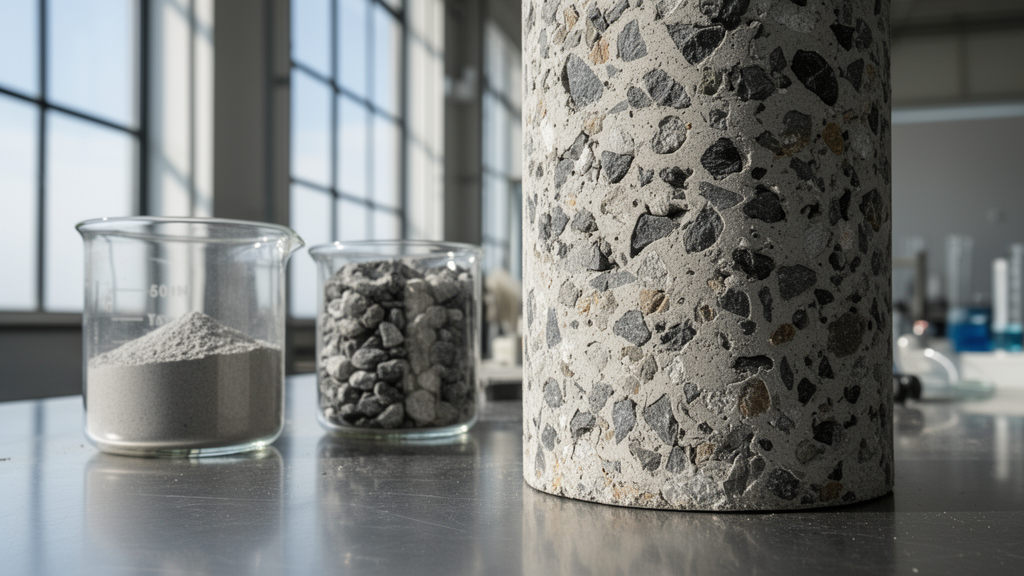
The study formulated concrete mixes using grade 42.5 ordinary Portland cement and industrial fly ash collected from the Jilin power plant, which was oven-dried at 105 degrees Celsius for twenty-four hours before laboratory processing. X-ray fluorescence characterization confirmed that silicon dioxide and aluminum oxide constituted more than eighty percent of the fly ash composition, contributing to its pozzolanic reactivity index exceeding eighty percent under standard curing regimes. Fine aggregate was prepared from natural river sand with a particle size distribution between 0.15 and 2.36 millimeters and a specific gravity of 2.66. For coarse aggregates, the experimental design contrasted crushed granite aggregates against recycled concrete aggregates derived from demolished construction debris processed by a mobile crushing plant, standardizing coarse aggregate sizing between 5 and 20 millimeters while fixing total cementitious binder content at 380.0 kilograms per cubic meter across a constant water-to-binder ratio of 0.45.
To evaluate the direct implications of cement replacement, the researchers established binder replacement dosages of zero, ten, twenty, and thirty percent fly ash by mass, using polycarboxylate superplasticizer adjustments to achieve target concrete slumps of 180 millimeters. Experimental protocols assessed five primary performance vectors across defined hydration periods: compressive strengths at 3, 7, 28, 56, and 90 days following national compression test standards; drying shrinkage and evaporative mass loss up to 180 days in controlled chambers held at 20 degrees Celsius and 60 percent relative humidity; accelerated carbonation resistance over 28 days inside environmental chambers maintained with twenty percent carbon dioxide concentrations; four-point Wenner probe surface electrical resistivity through 180 days; and normalized economic and life-cycle carbon emission calculations based on unit strength.
Mechanical testing revealed that incorporating ten percent fly ash maintained compressive strengths practically equivalent to control mixes for both ordinary concrete and recycled aggregate concrete. This baseline equivalence stems from the fine fly ash particles accelerating cement hydration while initiating pozzolanic reactions that counterbalance the reduced volume of Portland cement clinker. When cement replacement reached twenty percent, however, the 28-day compressive strength of ordinary concrete fell by 13.1 percent, whereas the strength reduction in recycled aggregate concrete was limited to 9.0 percent. At thirty percent replacement, ordinary concrete exhibited a 25.3 percent loss in 28-day strength compared to its unblended control. Over extended curing intervals of 56 and 90 days, the compressive strength deficits progressively narrowed across all blended batches because ongoing reactions between active silica, alumina, and liberated calcium hydroxide continuously refined internal concrete pore structures.
The comparative data emphasized that recycled aggregate concrete sustained less strength penalty from higher ash content than conventional concrete. At 28 days of standard curing, recycled aggregate concrete mixes containing zero, ten, twenty, and thirty percent fly ash retained 88.4, 87.9, 92.6, and 94.3 percent of the absolute compressive strengths measured in their corresponding ordinary concrete counterparts. The enhanced compatibility in recycled systems arises because residual mortar adhering to recycled concrete aggregates provides supplementary calcium hydroxide reserves. This alkaline reservoir fuels the pozzolanic reaction of the circulating fluidized bed fly ash, synthesizing extra calcium silicate hydrate and related hydration products that reinforce the porous interfacial transition zones binding recycled aggregate surfaces to newly formed cement paste.
Dimensional stability assessments demonstrated that incorporating fly ash increased drying shrinkage rates and corresponding evaporative mass loss across both material categories, with recycled aggregate mixtures displaying higher vulnerability. Over the 180-day monitoring timeline, final drying shrinkage for ordinary concrete rose from 0.064 percent without ash to 0.067, 0.069, and 0.071 percent at ten, twenty, and thirty percent replacement levels, representing increases of 4.7, 7.8, and 10.9 percent over the control. In recycled aggregate concrete, 180-day shrinkage values reached 0.075, 0.079, 0.082, and 0.086 percent, marking increases of 5.3, 9.3, and 14.7 percent. Roughly eighty percent of total drying shrinkage manifested within the initial 28 days of exposure. The greater dimensional deformation in recycled aggregate concrete results from the porous attached mortar lowering the aggregate elastic modulus, which diminishes mechanical restraint against matrix shrinkage while facilitating moisture transport toward exposed evaporation surfaces.
Durability testing through accelerated carbonation showed that replacing Portland cement with fly ash compromised concrete carbonation resistance by diminishing alkaline reserves within the pore network. After 28 days of exposure to a twenty percent carbon dioxide atmosphere, ordinary concrete carbonation depths increased by 32.5, 56.8, and 74.3 percent at replacement levels of ten, twenty, and thirty percent fly ash relative to unblended ordinary concrete. Recycled aggregate concrete registered carbonation depths that were 37.7, 27.9, 31.1, and 34.4 percent greater than ordinary concrete at equivalent ash percentages. Consumption of calcium hydroxide during pozzolanic reactions, combined with reduced cement clinker content, lowered pore solution pH; nevertheless, the additional calcium hydroxide supplied by old mortar adhering to recycled aggregates mitigated the relative rate of carbonation deterioration compared to ordinary mixtures.
Conversely, long-term electrical resistivity measurements demonstrated dramatic enhancements in transport durability and chloride ion penetration resistance. Initial one-day resistivity values decreased slightly with increasing fly ash additions due to increased early pore volume, but extended curing from 7 through 180 days reversed this behavior entirely. By 180 days, ordinary concrete containing ten, twenty, and thirty percent fly ash achieved resistivity gains of 98.9, 404.6, and 798.3 percent over unblended concrete. Qualitative penetration assessments derived from 28-day surface resistivity classified zero-ash concrete as possessing high chloride ion permeability, whereas concrete with ten, twenty, and thirty percent fly ash achieved moderate, low, and very low permeability ratings, driven by the densification of microstructures and the chemical binding of pore solution ions within newly formed aluminum-bearing hydration phases.
Economic and environmental benefit analyses highlighted distinct optimal replacement points when normalized against load-bearing strength. Calculating raw material expenditures revealed that the lowest cost per unit of strength occurred at ten percent fly ash, yielding 8.6 yuan per unit strength in ordinary concrete and 7.4 yuan per unit strength in recycled aggregate concrete, compared to 8.9 and 7.7 yuan for unblended baselines. Exceeding ten percent ash increased unit costs because strength reductions outweighed cement savings and necessitated higher superplasticizer dosages. Conversely, total cradle-to-gate carbon emissions per unit strength reached their minimum at twenty percent fly ash replacement, recording 6.2 kilograms of carbon dioxide equivalent in ordinary concrete and 6.7 kilograms in recycled aggregate concrete, representing reductions of 8.2 and 11.6 percent relative to zero-ash mixtures.
While confirming the viability of utilizing circulating fluidized bed fly ash in structural concrete applications, the authors acknowledged notable analytical boundaries within the current research. The laboratory investigation focused entirely on macroscopic engineering properties, mechanical thresholds, and macro-durability responses, omitting direct microstructural characterization such as scanning electron microscopy coupled with energy dispersive spectroscopy, X-ray diffraction, or nanoindentation profiling. Future research efforts will focus on mapping the precise micro-mechanical evolution of the interfacial transition zone between recycled aggregates and ash-blended paste, tracking pozzolanic conversion rates to refine performance prediction models and advance the structural deployment of circular construction materials.
Subject of Research: Comparative performance, durability, economics, and emissions of ordinary and recycled aggregate concrete utilizing circulating fluidized bed fly ash
Article Title: Comparative performance of ordinary and recycled aggregate concrete incorporating CFA as SCM
Article References: Wu, C.-R., Tang, W., Luo, F.-M., Kou, S.-C., & Xing, F. (2025). Comparative performance of ordinary and recycled aggregate concrete incorporating CFA as SCM. Low-carbon Materials and Green Construction, 3(1), Article 19. https://doi.org/10.1007/s44242-025-00079-5
Image Credits: AI Generated
DOI: 10.1007/s44242-025-00079-5
Keywords: circulating fluidized bed fly ash, supplementary cementitious materials, recycled aggregate concrete, ordinary concrete, compressive strength, drying shrinkage, carbonation depth, surface resistivity, chloride ion penetration, carbon emissions, recycled concrete aggregate, polycarboxylate superplasticizer, material cost, pozzolanic reaction, sustainable construction, concrete durability, coarse aggregate
News Source: Denise Maddox. (November 19, 2026). Fly Ash Boosts Recycled Concrete Compatibility While Balancing Strength and Emissions. Scienmag.