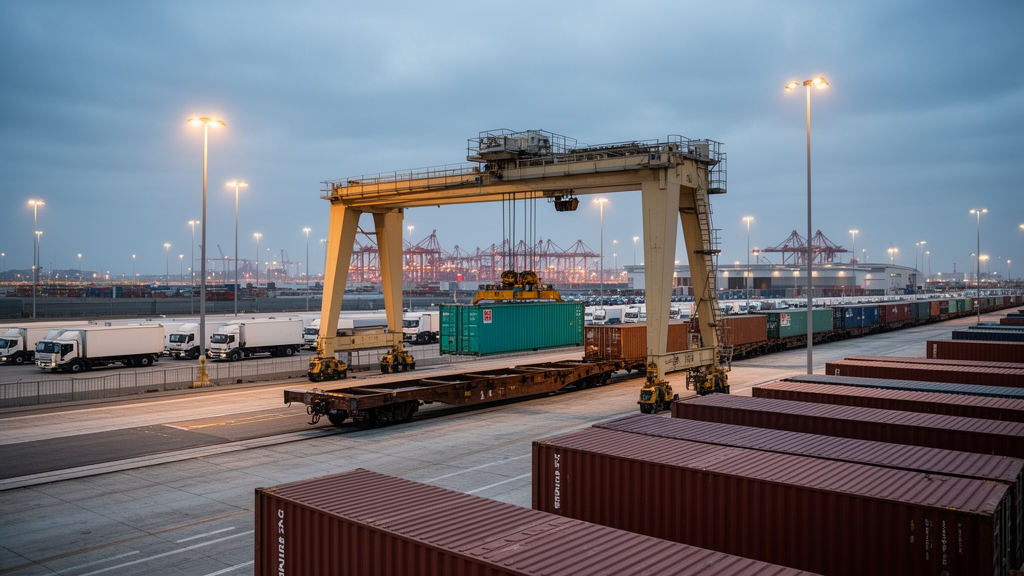
An integrated computational framework combining established multimodal data fusion, graph learning, and reinforcement learning techniques offers a promising new methodology for logistics network resilience evaluation and adaptive recovery decision-making in uncertain environments. Outlined in a newly published study by researchers Zhu Zheng, Na Xiong, and Xuping Wang, the research addresses the critical challenge of maintaining and restoring logistics network functionality when unexpected operational disruptions occur across complex distribution infrastructures.
To establish a thorough baseline understanding of network status, the proposed model employs a visual-language pre-training framework designed to deeply integrate multimodal data and construct a unified global semantic feature representation. For the task of resilience evaluation, the authors designed a specialized hybrid architecture combining a graph convolutional network with a Transformer module. This dual architecture is configured to generate accurate network resilience scores by jointly capturing topological network structures and underlying spatiotemporal dependencies that govern logistics operations.
Beyond evaluating resilience, the system introduces a specialized mechanism for adaptive recovery decisions during periods of disruption. By integrating deep reinforcement learning with meta-learning, the model enables rapid adaptation and autonomous policy optimization under dynamic disruption conditions. This integration helps determine timely recovery actions, allowing logistics systems to adapt to evolving environmental uncertainties rather than relying exclusively on static or conventional operational protocols.
The research team evaluated the performance of the proposed architecture using the Smart Logistics Supply Chain Dataset. In resilience evaluation benchmarks, the model achieved a Mean Squared Error of 0.074 and an F1-Score of 0.905, outperforming all comparative baselines. Furthermore, when applied to recovery decision tasks, the framework reduced average recovery time by 23.9 percent and decreased overall recovery by 39.2 percent compared with conventional recovery methods.
Ablation studies conducted during the investigation confirmed the essential contributions of both the Transformer module and the spatiotemporal encoder in maintaining evaluation accuracy. The findings indicate that the integrated framework represents a viable, promising solution for enhancing logistics network resilience in practical applications. Looking ahead, the researchers noted that future work will extend the model to cross-border multimodal transportation scenarios while incorporating carbon emission constraints to support low-carbon recovery strategies.
Subject of Research: Multimodal data fusion and reinforcement learning for logistics network resilience and adaptive recovery
Article Title: Resilience evaluation and adaptive recovery decision model of logistics network based on multimodal data fusion
Article References: Zheng, Z., Xiong, N., & Wang, X. (2026). Resilience evaluation and adaptive recovery decision model of logistics network based on multimodal data fusion. Discover Applied Sciences. https://doi.org/10.1007/s42452-026-09880-8
Image Credits: AI Generated
DOI: 10.1007/s42452-026-09880-8
Keywords: Logistics network resilience, Multimodal data fusion, Adaptive recovery, Graph convolutional network, Transformer module, Deep reinforcement learning, Meta-learning, Visual-language pre-training, Spatiotemporal dependencies, Smart Logistics Supply Chain Dataset, Spatiotemporal encoder, Network topology, Policy optimization, Dynamic disruptions, Mean squared error, F1-score, Low-carbon recovery
News Source: Denise Maddox. (November 19, 2026). Multimodal Data Fusion Framework Enhances Logistics Network Resilience and Recovery. Scienmag.