• HOME
  • NEWS
  • EXPLORE
    • CAREER
      • Companies
      • Jobs
    • EVENTS
    • iGEM
      • News
      • Team
    • PHOTOS
    • VIDEO
    • WIKI
  • BLOG
  • COMMUNITY
    • FACEBOOK
    • INSTAGRAM
    • TWITTER
Monday, May 11, 2026
BIOENGINEER.ORG
No Result
View All Result
  • Login
  • HOME
  • NEWS
  • EXPLORE
    • CAREER
      • Companies
      • Jobs
        • Lecturer
        • PhD Studentship
        • Postdoc
        • Research Assistant
    • EVENTS
    • iGEM
      • News
      • Team
    • PHOTOS
    • VIDEO
    • WIKI
  • BLOG
  • COMMUNITY
    • FACEBOOK
    • INSTAGRAM
    • TWITTER
  • HOME
  • NEWS
  • EXPLORE
    • CAREER
      • Companies
      • Jobs
        • Lecturer
        • PhD Studentship
        • Postdoc
        • Research Assistant
    • EVENTS
    • iGEM
      • News
      • Team
    • PHOTOS
    • VIDEO
    • WIKI
  • BLOG
  • COMMUNITY
    • FACEBOOK
    • INSTAGRAM
    • TWITTER
No Result
View All Result
Bioengineer.org
No Result
View All Result
Home NEWS Science News Biology

0.5°C of additional warming has a huge effect on global aridity

Bioengineer by Bioengineer
September 17, 2020
in Biology
Reading Time: 3 mins read
0
IMAGE
Share on FacebookShare on TwitterShare on LinkedinShare on RedditShare on Telegram

IMAGE

Credit: Institute of Industrial Science, the University of Tokyo

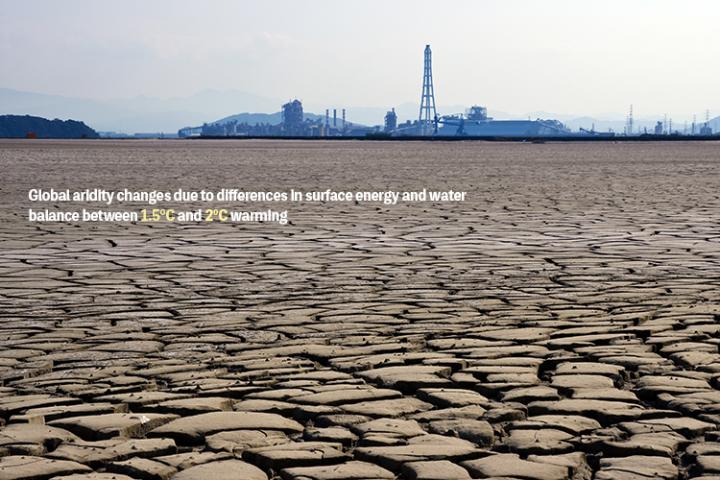
Tokyo, Japan – In a new climate modeling study, researchers from the Institute of Industrial Science, The University of Tokyo have revealed major implications for global drought and aridity when limiting warming to 1.5°C rather than 2°C above pre-industrial levels. Drought has serious negative impacts on both human society and the natural world and is generally projected to increase under global climate change. As a result, assessment of the risk of drought under climate change is a critical area of climate research.

In the 2015 Paris Agreements, the United Nations Framework Convention on Climate Change (UNFCCC) proposed that the increase in global average temperature should be limited to between 1.5°C and 2°C above pre-industrial levels to limit the effects of severe climate change. However, there have been few studies focusing on the relative importance of this 0.5°C of global average temperature rise and what effect it might have on drought and aridity around the world.

“We wanted to contribute to the understanding of how important that 0.5°C could be, but it such a study is not easy to conduct based on previous modeling approaches,” explains corresponding author Hyungjun Kim. “This is mainly because most models look at the extreme high levels and you cannot simply take a slice out of the data while the model spins up to this maximum. Therefore, we used data from the specially designed Half a degree Additional warming Prognosis and Projected Impacts (HAPPI) project to assess the impacts on aridity based on estimations of the balance between water and energy at the Earth’s surface.”

The study revealed that 2°C of warming led to more frequent dry years and more severe aridification in most areas of the world compared with 1.5°C, which emphasizes that efforts should be made to limit warming to 1.5°C above pre-industrial levels.

“There is a really strong message that some parts of the world could have more frequent drought at 2°C than at 1.5°C. This situation could be especially severe in the Mediterranean, western Europe, northern South America, the Sahel region, and southern Africa,” says lead author Akira Takeshima. “However, this situation is highly regional. In some parts of the world, like Australia and some of Asia, the opposite situation was simulated, with a wetter climate at 2°C than at 1.5°C.”

These findings show the importance of considering the regional impacts of the additional 0.5°C of warming, especially with respect to any future relaxation of the 1.5°C target.

###

The article, “Global aridity changes due to differences in surface energy and water balance between 1.5ºC and 2ºC warming” was published in Environmental Research Letters at DOI: 10.1088/1748-9326/ab9db3

About Institute of Industrial Science (IIS), the University of Tokyo

Institute of Industrial Science (IIS), the University of Tokyo is one of the largest university-attached research institutes in Japan.

More than 120 research laboratories, each headed by a faculty member, comprise IIS, with more than 1,000 members including approximately 300 staff and 700 students actively engaged in education and research. Our activities cover almost all the areas of engineering disciplines. Since its foundation in 1949, IIS has worked to bridge the huge gaps that exist between academic disciplines and real-world applications.

Media Contact
Hyungjun Kim
[email protected]

Original Source

https://www.iis.u-tokyo.ac.jp/en/news/3353/

Related Journal Article

http://dx.doi.org/10.1088/1748-9326/ab9db3

Tags: Atmospheric ScienceClimate ChangeClimate ScienceEcology/EnvironmentEnergy SourcesGeographyHydrology/Water ResourcesMeteorologyTemperature-Dependent PhenomenaWeather/Storms
Share13Tweet8Share2ShareShareShare2

Related Posts

Ancient Plant Populations Reveal Fresh Insights into Climate Resilience — Biology

Ancient Plant Populations Reveal Fresh Insights into Climate Resilience

May 8, 2026
Rare Brain Disorders in Children Linked to Mutations in Lesser-Known Protein Complex — Biology

Rare Brain Disorders in Children Linked to Mutations in Lesser-Known Protein Complex

May 8, 2026

From Odd Insect to Underwater Predator: The Remarkable Evolution of a Bloodthirsty Fruit Fly

May 8, 2026

SNU Professor Sangwoo Seo’s Team Develops Next-Generation CRISPR Biocontainment Technology to Control Microbial Survival Without DNA Cleavage

May 8, 2026
Please login to join discussion

POPULAR NEWS

  • Research Indicates Potential Connection Between Prenatal Medication Exposure and Elevated Autism Risk

    840 shares
    Share 336 Tweet 210
  • New Study Reveals Plants Can Detect the Sound of Rain

    727 shares
    Share 290 Tweet 181
  • Scientists Investigate Possible Connection Between COVID-19 and Increased Lung Cancer Risk

    68 shares
    Share 27 Tweet 17
  • Salmonella Haem Blocks Macrophages, Boosts Infection

    61 shares
    Share 24 Tweet 15

About

We bring you the latest biotechnology news from best research centers and universities around the world. Check our website.

Follow us

Recent News

Evaluating Digoxin Use in Patients with Symptomatic Rheumatic Heart Disease

Evaluating the Effectiveness and Safety of Digitalis Glycosides in Treating Heart Failure

Urdu Fall Risk Questionnaire Adapted for Elderly

Subscribe to Blog via Email

Success! An email was just sent to confirm your subscription. Please find the email now and click 'Confirm' to start subscribing.

Join 82 other subscribers
  • Contact Us

Bioengineer.org © Copyright 2023 All Rights Reserved.

Welcome Back!

Login to your account below

Forgotten Password?

Retrieve your password

Please enter your username or email address to reset your password.

Log In
No Result
View All Result
  • Homepages
    • Home Page 1
    • Home Page 2
  • News
  • National
  • Business
  • Health
  • Lifestyle
  • Science

Bioengineer.org © Copyright 2023 All Rights Reserved.