• HOME
  • NEWS
  • EXPLORE
    • CAREER
      • Companies
      • Jobs
    • EVENTS
    • iGEM
      • News
      • Team
    • PHOTOS
    • VIDEO
    • WIKI
  • BLOG
  • COMMUNITY
    • FACEBOOK
    • INSTAGRAM
    • TWITTER
Friday, May 15, 2026
BIOENGINEER.ORG
No Result
View All Result
  • Login
  • HOME
  • NEWS
  • EXPLORE
    • CAREER
      • Companies
      • Jobs
        • Lecturer
        • PhD Studentship
        • Postdoc
        • Research Assistant
    • EVENTS
    • iGEM
      • News
      • Team
    • PHOTOS
    • VIDEO
    • WIKI
  • BLOG
  • COMMUNITY
    • FACEBOOK
    • INSTAGRAM
    • TWITTER
  • HOME
  • NEWS
  • EXPLORE
    • CAREER
      • Companies
      • Jobs
        • Lecturer
        • PhD Studentship
        • Postdoc
        • Research Assistant
    • EVENTS
    • iGEM
      • News
      • Team
    • PHOTOS
    • VIDEO
    • WIKI
  • BLOG
  • COMMUNITY
    • FACEBOOK
    • INSTAGRAM
    • TWITTER
No Result
View All Result
Bioengineer.org
No Result
View All Result
Home NEWS Science News Biology

Zero-emission diesel combustion using a non-equilibrium-plasma-assisted MnO2 filter

Bioengineer by Bioengineer
March 7, 2019
in Biology
Reading Time: 2 mins read
0
IMAGE
Share on FacebookShare on TwitterShare on LinkedinShare on RedditShare on Telegram

IMAGE

Credit: Kanazawa University

Diesel engines are widely used in agricultural machinery, vehicles, and ships because of their high thermal efficiency. The sulfur contained in the diesel fuel is oxidized to sulfur dioxide by combustion. This sulfur dioxide not only harms human health but also causes deactivation of the catalysts used to treat NOx in the exhaust stream.

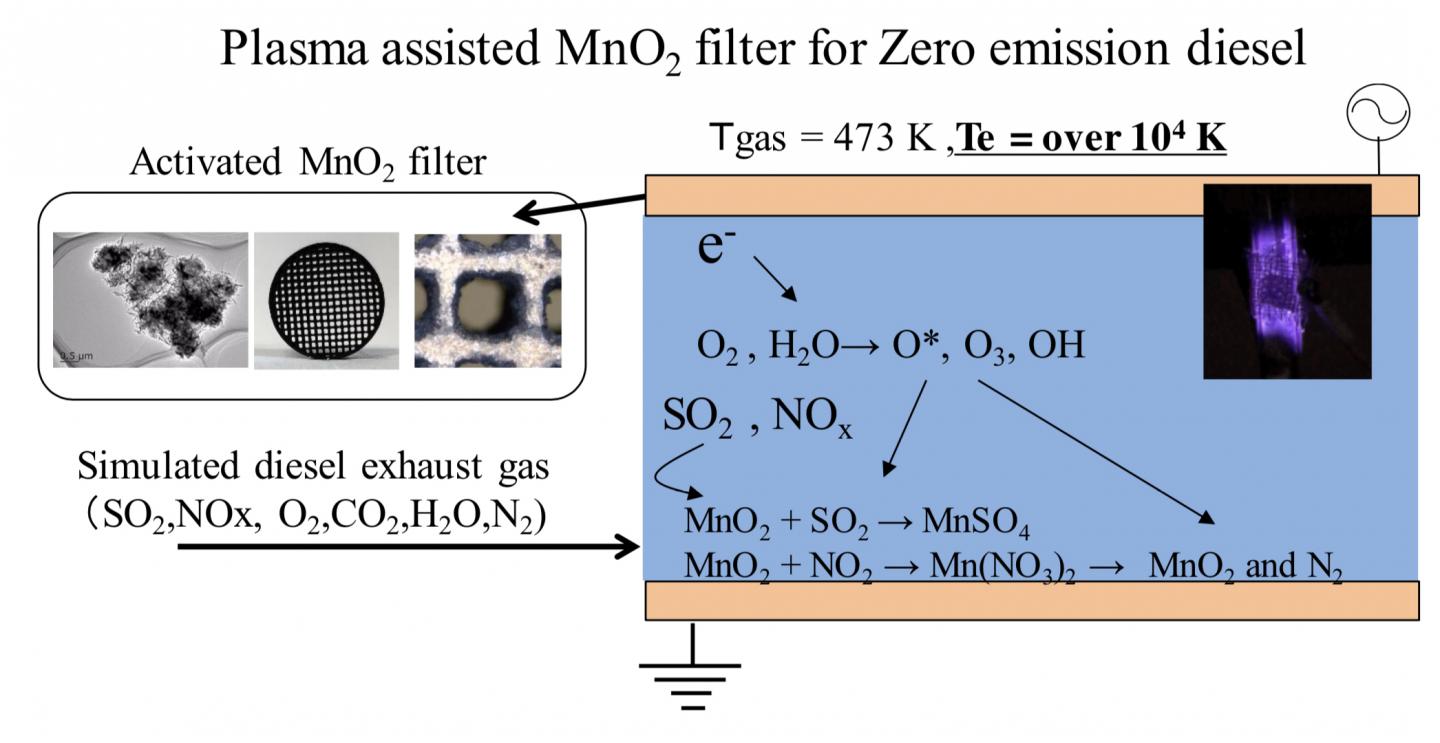
This problem can be overcome by using sulfur-free fuels based on biomass or clean coal technology or by installing a desulfurizing filter to remove sulfur oxides upstream of the NOx catalyst. Researchers at Kanazawa university have developed a plasma-assisted MnO2 filter that produces exhaust free of NOx and SOx. This technology augments the desulfurization properties of MnO2 with the activity of ozone from an atmospheric-pressure non-equilibrium plasma (Figure 1). Activated chemical species (O3, OH radicals, etc.) present in the plasma promote desulfurization and denitration reactions.

[Results]

MnO2 reacts with sulfur and nitrogen oxides to produce sulfates and nitrates, respectively. The interaction between SO2 and NO2 degrades the performance of MnO2 catalysts in eliminating both species. Prof Huang of the Guangzhou Institute of Energy Conversion analyzed the MnO2 catalyst material after exposure to simulated exhaust gas containing both SO2 and NO2 and found that both manganese nitrate and manganese sulfate were produced.

We evaluated the impact of ozone on the performance of the catalyst for SO2 and NO2 removal (Figure 2). An atmospheric-pressure non-equilibrium plasma was generated by the dielectric barrier discharge method. The performance of the catalyst in eliminating both SO2 and NO2 was improved by the introduction of ozone at a low concentration of about 50 ppm. The enhancement in NO2 elimination was particularly notable. The introduction of ozone seems to give a reaction to reduce nitrogen oxides to nitrogen. At the initial stage of the reaction, over 99% of SO2 and NO2 were removed from the exhaust stream. The Kanazawa University researchers, led by Yugo Osaka, demonstrated for the first time that zero emissions of NOx can be achieved even in the presence of sulfur oxides by using a plasma-assisted MnO2 filter. The plasma-assisted filter seems to augment the elimination of SO2 because of SO3 generation and also reduce nitrogen oxides to nitrogen.

[Future prospects]

These findings are expected to be widely applicable in the purification of exhaust from diesel engines using sulfur-containing fuels. We have clarified the mechanism by which the induction of the non-equilibrium plasma augments the performance of the MnO2 filter. We hope to spur further development of plasma-assisted MnO2 filters and thus allow for a greater diversity of fuels to be used without adversely impacting air quality.

###

Media Contact
Tomoya Sato
[email protected]

Related Journal Article

http://dx.doi.org/10.1016/j.seppur.2018.12.077

Tags: Electrical Engineering/ElectronicsIndustrial Engineering/ChemistryMechanical EngineeringPollution/RemediationTechnology/Engineering/Computer Science
Share12Tweet8Share2ShareShareShare2

Related Posts

Supercomputer Simulations Uncover How Bacterial Enzyme Pumps Sodium Ions, Opening Doors to Novel Antibiotics — Biology

Supercomputer Simulations Uncover How Bacterial Enzyme Pumps Sodium Ions, Opening Doors to Novel Antibiotics

May 15, 2026
New Astrobiology Special Collection Highlights Emerging Evidence Supporting Land-Based Origins of Life — Biology

New Astrobiology Special Collection Highlights Emerging Evidence Supporting Land-Based Origins of Life

May 14, 2026

Revolutionizing Textiles: Engineered Protein Fibers Pave the Way for Sustainable, Recyclable Fabrics

May 14, 2026

URI Master’s Student Emilio Pedroza Lopez Awarded Prestigious NSF Graduate Research Fellowship

May 14, 2026
Please login to join discussion

POPULAR NEWS

  • Research Indicates Potential Connection Between Prenatal Medication Exposure and Elevated Autism Risk

    843 shares
    Share 337 Tweet 211
  • New Study Reveals Plants Can Detect the Sound of Rain

    729 shares
    Share 291 Tweet 182
  • Salmonella Haem Blocks Macrophages, Boosts Infection

    62 shares
    Share 25 Tweet 16
  • Breastmilk Balances E. coli and Beneficial Bacteria in Infant Gut Microbiomes

    58 shares
    Share 23 Tweet 15

About

We bring you the latest biotechnology news from best research centers and universities around the world. Check our website.

Follow us

Recent News

A*STAR Scientists Unveil Novel Technique to Decipher RNA Structure’s Impact on Health and Disease

Smart Hydrogels Revolutionize Information Security with Photo-Patterning and Multi-Stimuli Responsive Structural Colors

Unveiling the Unseen: POSTECH Team Creates AI Framework to Detect Hidden Defects in Metal 3D Printing

Subscribe to Blog via Email

Enter your email address to subscribe to this blog and receive notifications of new posts by email.

Join 82 other subscribers
  • Contact Us

Bioengineer.org © Copyright 2023 All Rights Reserved.

Welcome Back!

Login to your account below

Forgotten Password?

Retrieve your password

Please enter your username or email address to reset your password.

Log In
No Result
View All Result
  • Homepages
    • Home Page 1
    • Home Page 2
  • News
  • National
  • Business
  • Health
  • Lifestyle
  • Science

Bioengineer.org © Copyright 2023 All Rights Reserved.