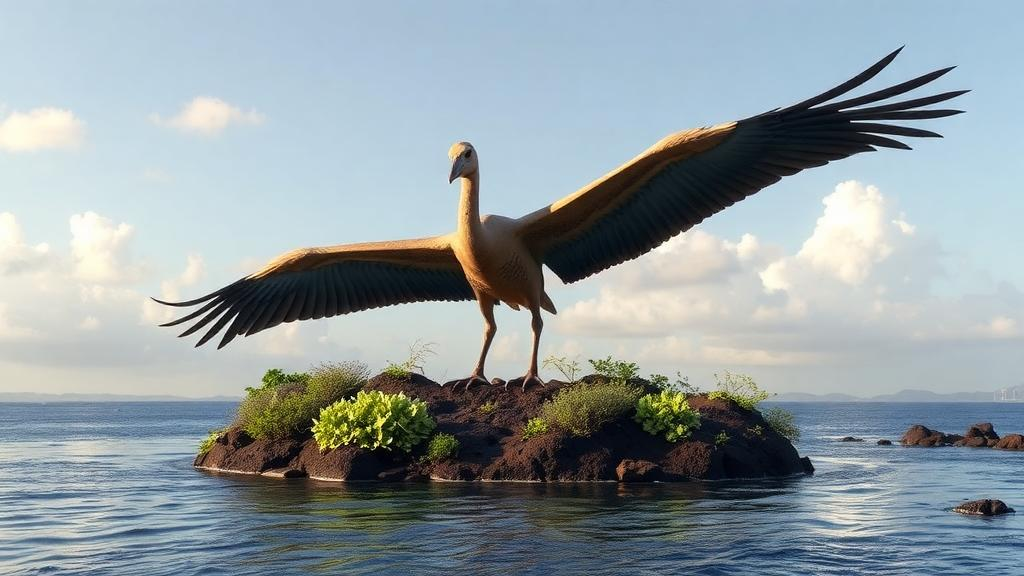
The Canary Island of Lanzarote has never been connected to the African mainland. It rose from the Atlantic as a volcanic edifice, separated from the coast of what is now Morocco by the Lanzarote Passage, a stretch of open ocean. Yet buried in its Lower Pliocene rocks are the eggs and eggshells of giant palaeognathous birds, the group that today includes ostriches, rheas, emus and cassowaries. These flightless giants, some of which would have weighed on the order of 100 kilograms, somehow reached an island they could never have walked to. A new study published in The Science of Nature by Christophe Lécuyer of the Laboratoire de Géologie de Lyon, Eric Buffetaut of Paléospace and Antonio Sánchez Marco of the Institut Català de Paleontologia Miquel Crusafont tackles one of the most stubborn puzzles in island biogeography: how does a bird that cannot fly cross dozens of kilometres of open sea?
The fossil evidence itself is not in doubt. Ratite eggshells have been recovered from Lanzarote since the 1960s and 1970s, when palaeontologists first described fossil ostrich eggs from the island’s Miocene and Pliocene deposits, and subsequent work has confirmed the presence of a terrestrial fauna in Lower Pliocene sites. What is missing is any associated skeletal material, which means the precise identity, size and anatomy of the Lanzarote birds remain inferred largely from their eggs. Oxygen isotope analyses of the eggshell calcite, published by some of the same authors in earlier work, have helped reconstruct the body water and environmental conditions of the laying females, but the fundamental question of arrival has stood unanswered. The new study does not claim to have found the smoking gun. Instead, it asks a deceptively simple question: was the journey even physically and biologically possible?
The mechanism the authors evaluate is oceanic rafting, the passive transport of terrestrial animals on masses of floating vegetation swept out to sea by rivers and storms. Rafting has long been invoked to explain the distribution of land animals on oceanic islands, from lizards and small mammals to, more controversially, larger vertebrates. Charles Darwin himself mused about floating islands carrying seeds and animals across oceans, and modern biogeographers have documented natural rafts of tangled roots, logs and plant debris drifting far from coastlines. What has made rafting unattractive for very large animals is buoyancy: a floating mat of vegetation must be enormous and structurally coherent to bear the weight of a 100-kilogram bird without disintegrating or submerging.
Lécuyer and his colleagues argue that the early Pliocene offered unusually favourable conditions for building such rafts. Geological and palaeoclimatic evidence indicates that northwestern Africa during this interval was warmer and wetter than it is today. Palaeoclimate reconstructions, including work on Pliocene monsoon dynamics and a documented North African humid period preceding mid-Pliocene glaciation, point to enhanced fluvial activity across the region. More rain means more powerful rivers, and more powerful rivers mean the mobilization of large volumes of plant debris, uprooted trees, and accumulated vegetation along drainage networks. Under such conditions, substantial floating mats of vegetation could plausibly have been launched into the Atlantic, where the Canary Current and the trade winds provide a natural conveyor toward the archipelago.
To test whether such a raft could actually carry a giant bird, the researchers turned to hydrostatics. Their calculations, based on the buoyancy of natural vegetation masses of realistic dimensions, indicate that rafts of plausible size could support an adult bird of approximately 100 kilograms without sinking. The analysis draws on comparative data from living ostriches, whose body masses, feeding requirements, water needs and physiology are well documented from field studies in the Namib and from captive populations. Ostriches are remarkably drought-tolerant animals, able to meet much of their water demand through food and metabolic processes, and their feather structure provides insulation against both heat and moisture. These physiological traits matter enormously for a castaway bird, because the limiting factor on a raft is not only buoyancy but the animal’s ability to survive days of exposure, dehydration and stress without access to fresh water or solid footing.
The second half of the study is probabilistic. Rather than asserting that a single voyage succeeded, the authors modelled survival as a function of transport duration, using survival-analysis frameworks of the kind developed for failure-time data in statistics. Their simulations show a pattern that is intuitive but has rarely been quantified for animals of this size: survival probability decreases steadily as the crossing lengthens, and adult individuals fare considerably better than eggs under the modelled conditions. An egg adrift on a wet, thermally fluctuating raft faces challenges that an adult does not. Eggs require carefully regulated temperature and humidity for the embryo inside to develop, and prolonged exposure to seawater spray, solar heating and nighttime cooling would push the egg’s microclimate far outside viable bounds. An adult bird, by contrast, can regulate its own posture, shelter behind raft vegetation, and tolerate water stress for extended periods.
To handle the many uncertainties inherent in reconstructing a voyage that happened, if it happened, nearly five million years ago, the team employed Bayesian analyses. This statistical approach allows the researchers to explore the full space of parameter combinations, raft size, drift speed, bird mass, dehydration tolerance, and transport duration among them, and to identify which combinations are compatible with a successful crossing. Rather than producing a single yes-or-no verdict, the Bayesian framework yields a landscape of plausibility, showing how the probability of success responds to changes in each assumption. The result is a nuanced conclusion: rare passive transport of adult giant palaeognathous birds across the Lanzarote Passage is compatible with the geological, physiological and oceanographic constraints considered, even though many individual voyages would have ended in failure.
The authors are careful about what their results do and do not demonstrate. The study does not prove that rafting occurred, and it explicitly frames its findings as showing compatibility rather than confirmation. No skeletal remains of the birds have been found, no raft has been observed in the fossil record, and the exact timing of the colonization relative to the deposition of the egg-bearing sediments remains a matter of stratigraphic inference. What the paper provides is a quantitative demolition of the strongest objection to rafting, namely that a giant flightless bird could not possibly survive such a journey. By showing that the physics of buoyancy and the biology of ostrich-like physiology do not rule the scenario out, the researchers shift the burden of proof. Rare events, after all, only need to happen once in millions of years to leave a permanent mark on an island’s fauna.
The implications reach well beyond Lanzarote. Island biogeographers have long debated the relative roles of dispersal over water versus ancient land connections, and the Canary Islands have served as a natural laboratory for this debate. Giant lizards of the genus Gallotia colonized the archipelago, genetic studies of the extinct giant rat of Tenerife point to recent divergence from mainland relatives, and the strange terrestrial fauna of the Lower Pliocene sites has puzzled researchers for decades. If a 100-kilogram flightless bird could plausibly make the crossing, then the rafting hypothesis becomes harder to dismiss for almost any terrestrial vertebrate. The study also highlights how climate shapes dispersal: the warm, wet early Pliocene may have opened a transient corridor of opportunity, with enhanced river discharge launching rafts that a drier climate would never produce. Colonization, in this view, is not a constant process but a window that opens and closes with the planet’s climate rhythms.
For now, the giant birds of Lanzarote remain shadows known mainly from their eggs, their bones still waiting in Pliocene rock. But the new modelling transforms them from biogeographical impossibilities into plausible castaways, birds that may have clung to a drifting tangle of African vegetation and ridden the Canary Current to a young volcanic shore. The Python code behind the survival models has been released as supplementary material, inviting other researchers to probe the parameter space further. Whether future fieldwork on Lanzarote recovers the skeletal evidence that would settle the question remains to be seen. What is already clear is that the ocean barrier that seems so absolute to us was, under the right climatic conditions, a barrier with cracks, and evolution has repeatedly found its way through them.
Subject of Research: Oceanic rafting dispersal of giant flightless palaeognathous birds to Lanzarote in the early Pliocene
Article Title: Evaluating the plausibility of oceanic rafting by giant palaeognathous birds to Lanzarote during the early Pliocene
Article References: Lécuyer, C., Buffetaut, E., & Marco, A. S. (2026). Evaluating the plausibility of oceanic rafting by giant palaeognathous birds to Lanzarote during the early Pliocene. The Science of Nature, 113(6), Article 124. https://doi.org/10.1007/s00114-026-02172-6
Image Credits: AI Generated
DOI: 10.1007/s00114-026-02172-6
Keywords: palaeognathous birds, Lanzarote, Canary Islands, Pliocene, oceanic rafting, island biogeography, paleontology, ostrich, survival probability, Bayesian analysis, hydrostatics, dispersal
News Source: Violet Maxwell. (October 5, 2026). Giant Flightless Birds May Have Sailed to a Volcanic Island on Floating Rafts of Vegetation. Scienmag.