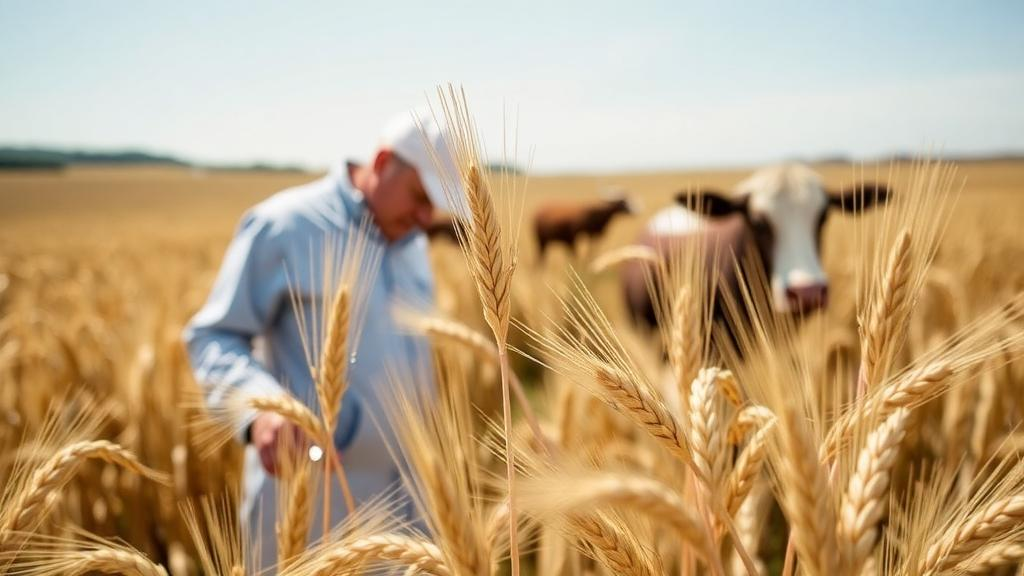
In the rolling winter fields of Georgia, a single wheat crop is asked to do two jobs at once. It must produce lush, nutritious forage for grazing cattle in late winter, and then recover to deliver a profitable grain harvest in early summer. This dual-purpose system is a cornerstone of southeastern U.S. agriculture, but it places wheat plants under an unusual physiological burden: defoliation at a critical developmental stage, followed by the need to regrow, flower, and fill grain. A new genome-wide association study published in BMC Genomics by Maria Ali, Ali Missaoui, Ali Babar, and Mohamed Mergoum of the University of Georgia and the University of Florida now offers the most detailed genetic map to date of how soft red winter wheat balances these competing demands, identifying dozens of genomic regions that breeders could target to develop varieties purpose-built for the region’s grazing-plus-grain production systems.
The research team evaluated 182 soft red winter wheat lines across multi-location trials at three Georgia sites over two growing seasons, spanning 2023 to 2025. Sixteen traits were measured on each line, capturing the full arc of the dual-purpose lifecycle: Zadoks growth stage as a measure of developmental timing, eight forage quality traits including crude protein, neutral detergent fiber, acid detergent fiber, acid detergent lignin, total digestible nutrients, sugars, and relative forage quality, three forage yield components covering fresh weight, dry weight, and aboveground biomass, and four grain yield and related traits. This breadth matters because dual-purpose performance is not a single trait but a syndrome, and the study was designed to detect whether the same genes influence multiple components of that syndrome.
The phenotypic results quantify the central trade-off with unusual precision. When forage harvest was delayed to later growth stages beyond Zadoks 30 to 31, forage yield increased by roughly 670 to 1,670 kilograms per hectare for each additional growth stage, but grain yield fell by approximately 100 to 300 kilograms per hectare for the same delay. In agronomic terms, every day a farmer leaves cattle on the field buys more biomass but spends grain potential, because removing leaf area during stem elongation removes photosynthetic machinery and developing sinks that would otherwise contribute to yield. The first hollow stem stage, a well-known threshold in southern wheat grazing, marks the point at which this trade-off steepens, and the new data confirm that developmental timing is the pivot on which the entire system turns.
Heritability estimates told a nuanced story about what breeders can realistically select for. In the combined multi-environment dataset, heritability ranged from essentially zero to a modest 0.33, reflecting the strong influence of environment, management, and genotype-by-environment interaction on traits like biomass and grain yield. Within individual locations, however, heritability climbed as high as 0.81 for some traits. This pattern is a classic signature of quantitative traits whose expression is context-dependent: a line that excels in one field and year may not repeat that performance elsewhere. For breeding programs, the implication is that genomic selection models trained across environments, rather than simple phenotypic selection in a single nursery, will be essential for making reliable gains in dual-purpose performance.
Despite the environmental noise, the study identified clear genetic winners. Several genotypes combined above-average forage biomass, reaching a maximum of 13,929.56 kilograms per hectare, with grain yields that remained commercially acceptable. Notably, lines developed by the Georgia and Louisiana breeding programs ranked among the highest for dual-purpose productivity, suggesting that regional breeding programs have already been selecting, perhaps inadvertently, for the physiological architecture that dual-purpose systems require. These elite lines now serve as both immediate variety candidates and as parents for crossing programs aimed at stacking the favorable alleles identified in the study.
The genome-wide association analysis itself was a large-scale exercise in statistical genetics. Scanning the wheat genome for single-nucleotide polymorphisms correlated with trait variation, the team identified 138 marker-trait associations for grain yield and related traits, resolving into 74 quantitative trait loci, of which 24 were classified as major-effect loci explaining at least 10 percent of phenotypic variance. For forage quality traits, 121 QTL were detected, including 27 major-effect loci, and forage yield traits yielded 59 QTL with 18 major-effect regions. The use of multiple association models, including mixed linear model frameworks implemented in tools such as GAPIT, helps filter out false positives, a persistent hazard in GWAS with hundreds of lines and highly structured breeding germplasm.
Perhaps the most biologically interesting finding is the set of thirteen multi-trait QTL detected on chromosomes 1B, 2A, 2B, 4A, 6B, and 7A. These genomic regions were associated with multiple traits simultaneously, including growth stage, dry matter, sugar content, crude protein, plant height, regrowth height, fresh and dry forage weight, and grain yield. Pleiotropic regions like these are the genetic equivalent of a control panel: a single locus that influences developmental timing, canopy architecture, and biomass accumulation can explain why some lines gracefully tolerate grazing while others collapse. The authors highlight that the abundance of stable QTL for growth stage and plant height points to developmental timing and canopy architecture as the primary determinants of dual-purpose adaptation in this germplasm, a conclusion that reframes breeding priorities around phenology and plant structure rather than yield per se.
The practical pathway from these discoveries to farmers’ fields runs through marker-assisted selection and genomic selection. Major-effect QTL that are stable across locations and seasons can be converted into DNA markers that breeders use to screen seedlings in the lab, long before any plant is planted in a grazing trial. Because dual-purpose trials are expensive and slow, requiring livestock, fencing, and multi-year evaluation, the ability to select for the genetic determinants of regrowth capacity and post-grazing grain recovery at the seedling stage would compress breeding cycles substantially. The authors are careful to note that the identified loci require further validation before deployment, but the framework they provide, linking trait architecture to genomic regions in regionally adapted germplasm, is exactly the foundation such validation efforts need.
The broader significance of the work lies in the economics of southern agriculture. Dual-purpose wheat allows growers to capture income from winter grazing on the same land that produces a grain crop, improving whole-farm profitability and providing high-quality forage during a season when cool-season pasture is often the limiting resource for cattle producers. But the system only works if the wheat variety can withstand defoliation without sacrificing too much grain, and until now breeders have lacked genomic tools tuned to that specific balance. By quantifying the trade-off, identifying superior lines already adapted to southeastern conditions, and mapping the loci that govern the balance, the study converts a largely empirical management practice into a genetically tractable breeding target.
As climate variability intensifies across the Southeast, with warmer winters shifting grazing windows and erratic spring rains complicating grain fill, the value of wheat varieties engineered for resilience under dual defoliation and grain production will only grow. The Georgia study provides the raw material for that effort: a validated panel of lines, a catalog of QTL spanning forage quality, biomass, phenology, and yield, and evidence that the genetic architecture of dual-purpose performance is concentrated in a manageable number of chromosomal regions. If follow-up work confirms the major-effect loci on chromosomes 1B, 2A, 2B, 4A, 6B, and 7A, marker-assisted and genomic selection could deliver a new generation of soft red winter wheat that lets southern farmers graze their fields hard in February and still haul a full grain harvest in June.
Subject of Research: Genetic mapping of forage and grain yield trade-offs in dual-purpose soft red winter wheat using genome-wide association studies
Article Title: Genetics and trait associations in dual-purpose wheat production under southeastern U.S. production systems
Article References: Ali, M., Missaoui, A., Babar, A., & Mergoum, M. (2026). Genetics and trait associations in dual-purpose wheat production under southeastern U.S. production systems. BMC Genomics. https://doi.org/10.1186/s12864-026-13402-6
Image Credits: AI Generated
DOI: 10.1186/s12864-026-13402-6
Keywords: dual-purpose wheat, soft red winter wheat, GWAS, QTL, forage quality, grain yield, marker-assisted selection, genomic selection, plant breeding, southeastern United States, growth stage, biomass
News Source: Juliet Wilcox. (October 5, 2026). Scientists Map the Genes That Let Wheat Feed Livestock and Fill Grain Bins. Scienmag.