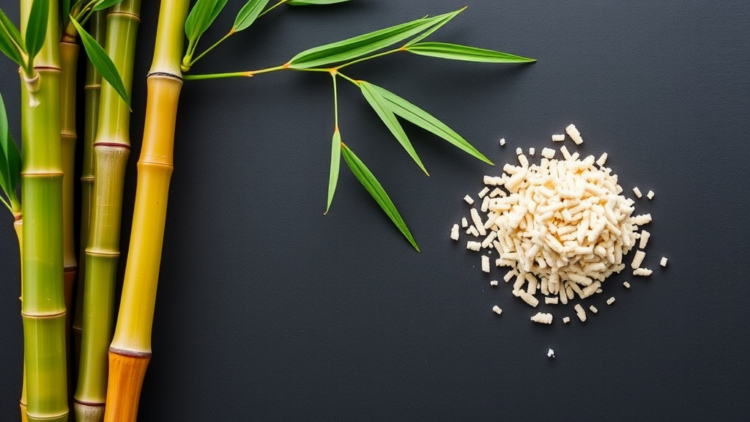
A fast-growing grass that can shoot to full height in a matter of months may be on the verge of becoming one of the world’s most important industrial raw materials. Researchers at the Forest Research Institute in Dehradun, India, have shown that carefully selected young bamboo can be converted into commercial-grade dissolving pulp — the ultra-pure cellulose that underpins viscose rayon, lyocell fibres, cellophane, cellulose acetate and a long list of everyday products from textiles and tire cord to pharmaceuticals, paints and food additives. The study, published in Discover Industrial Chemistry and Materials, evaluated five bamboo species across two age classes and identified a clear winner: one-year-old Bambusa nutans, which produced pulp with 93.7 percent alpha cellulose, 92.3 percent brightness and a viscosity of 467 millilitres per gram — figures that meet key specifications for commercial dissolving-grade applications.
The significance of the work lies in the mounting pressure on the global dissolving pulp supply chain. The market for dissolving-grade pulp was valued at approximately 5,540 million US dollars in 2023 and is projected to grow at a compound annual rate of 3.3 percent through 2032, driven largely by rising demand for man-made cellulosic fibres in emerging economies such as China and India. Traditionally, the industry has relied on wood pulp and cotton linters, but rising pulpwood prices and growing deforestation concerns have intensified the search for fast-growing, renewable alternatives. Bamboo, a woody grass in the subfamily Bambusoideae encompassing roughly 1,250 species in 75 genera, offers abundant fibre, rapid regeneration, high carbon sequestration potential and the ability to thrive on degraded land — yet systematic, side-by-side comparisons of species and harvest ages have been largely missing from the literature.
Dissolving pulp is not ordinary paper pulp. It is a chemically refined, low-yield product with an overall fibre-line yield of only 30 to 35 percent, engineered to contain 90 to 99 percent pure cellulose, less than 4 percent hemicelluloses, and only trace amounts of lignin, resins and inorganic impurities. Grades are classified by cellulose content: low grades at about 90 percent serve textiles and cellophane, medium grades at roughly 94 to 95 percent, and high grades above 96 percent are reserved for cellulose acetate and specialty derivatives. Because the pulp is ultimately dissolved and regenerated or chemically modified, its reactivity — the accessibility of hydroxyl groups on the cellulose chain — is a critical quality parameter, demanding a narrow molecular weight distribution, an open porous structure and minimal microfibril aggregation.
The research team, led by Vikas Rana, Gyanesh Joshi and Ajay Thakur, obtained one- and two-year-old culms of Dendrocalamus asper, Bambusa tulda, Bambusa nutans, Melocanna baccifera and Bambusa bambos from the institute’s bambusetum in Dehradun, all cultivated under National Bamboo Mission guidelines. Culms were split and chipped into uniform pieces, and proximate chemical analysis was carried out using TAPPI standard methods. The analysis revealed that all five species carried high cellulose and comparatively low lignin, ash and silica contents — a favourable starting profile for pulping. Notably, Klason lignin ranged from 19.68 to 25.40 percent, with the lowest value recorded in one-year-old B. nutans and the highest in two-year-old B. bambos, confirming that younger bamboo is chemically predisposed toward easier delignification because secondary cell-wall lignification accumulates with age.
Before pulping, the chips underwent a simple hot-water pretreatment at 150 degrees Celsius for either 60 or 90 minutes, with a solid-to-liquor ratio of 1:5. This autohydrolysis step exploits the self-dissociation of water at elevated temperature: protonated water liberates acetyl groups from hemicellulose, creating a mildly acidic environment that hydrolyses the branched, low-degree-of-polymerization hemicellulosic sugars and washes them out of the biomass. The treatment extracted between 5.88 and 15.21 percent of hemicelluloses across samples, with longer reaction times consistently improving extraction. Crucially, the pretreatment also stripped out significant quantities of inorganic contaminants: ash fell from a range of 1.67 to 5.70 percent in untreated material to 0.44 to 1.79 percent after treatment, while silica dropped from 0.08 to 1.51 percent down to 0.03 to 0.44 percent. Because silica is notorious for causing scaling in digesters and evaporators and for inflating chemical consumption in recovery cycles, its removal markedly improves bamboo’s industrial credentials.
Pretreated chips were then kraft-cooked with an 18 percent active alkali charge expressed as sodium oxide and 20 percent sulphidity. Screened pulp yields ranged from 38.73 percent for two-year-old D. asper pretreated for 60 minutes to a standout 52.57 percent for one-year-old B. nutans under the same conditions — and every two-year-old species yielded less pulp than its one-year-old counterpart, a pattern the authors attribute to lower lignin and higher cellulose content in juvenile culms. Counterintuitively, pretreatment sometimes increased yield relative to untreated controls: two-year-old D. asper pretreated for 60 minutes delivered roughly 48.45 percent yield versus about 40.07 percent untreated, because removing water-soluble extractives and minerals beforehand improved chemical penetration and made delignification more selective, sparing cellulose from degradation. Kappa numbers, a proxy for residual lignin, fell across the board after pretreatment, with the lowest value of 9.14 achieved by one-year-old B. nutans pretreated for 60 minutes — the same sample that combined the highest yield with the easiest bleaching response.
That champion pulp was carried forward into an elemental chlorine-free D0EpD1 bleaching sequence, the industry’s preferred environmentally acceptable route. In the D0 stage, a 2 percent chlorine dioxide charge at 70 degrees Celsius and pH 4.5 oxidized and fractured residual lignin; the subsequent alkaline extraction stage, boosted with 1 percent sodium hydroxide and 0.5 percent hydrogen peroxide at pH 11, solubilized the oxidized fragments and accounted for the largest yield loss at 95.88 percent; a final 1 percent chlorine dioxide stage polished brightness. Kappa number declined stepwise from 5.30 to 4.50 to 3.80 across the sequence, and the finished pulp reached 92.3 percent brightness — comfortably above the 88 percent minimum typical of commercial dissolving grades.
X-ray diffraction analysis of the extracted alpha cellulose added a structural dimension to the story. Crystallinity indices for one-year-old samples ranged from 55.17 percent for B. tulda to 60.4 percent for B. nutans, and dipped slightly for all species in the second year, suggesting that maturation redistributes lignin and hemicelluloses within the cell-wall matrix and expands amorphous regions. Higher crystallinity in juvenile bamboo reflects tightly packed cellulose microfibrils, which the authors note could benefit strength-critical applications, while the more open structure of older material may suit chemically intensive processing. B. bambos and B. tulda held their crystallinity most stable over the two-year window, hinting at more uniform cellulose organization over time.
The final characterization of the B. nutans dissolving pulp read like a specification sheet: 93.70 percent alpha cellulose, 1.70 percent hemicellulose measured as pentosan, 0.81 percent lignin, 0.23 percent ash and 467 millilitres per gram intrinsic viscosity in cupriethylenediamine — squarely within the 400 to 600 millilitres per gram window considered desirable for downstream conversion. Ash was marginally above the roughly 0.15 percent typical of commercial pulps, but the overall profile matched or exceeded benchmarks reported for dissolving pulps from other bamboo species and from conventional wood sources.
Beyond the laboratory, the implications are economic and environmental. Bamboo attains most of its height within four months of sprouting and most of its biomass within eleven, meaning a harvest cycle dramatically shorter than the decades required for pulpwood plantations. Its regeneration after cutting can relieve pressure on natural forests, its tolerance of marginal soils opens degraded land to productive use, and the hemicellulose-rich liquors recovered during pretreatment could feed a biorefinery stream rather than a waste stream. For India — home to roughly 125 indigenous bamboo species yet still an importer of dissolving-grade pulp — the study offers a practical recipe: choose one-year-old B. nutans, pretreat with hot water at 150 degrees for an hour, kraft-cook, and bleach chlorine-free. The result is a renewable, domestically grown feedstock capable of anchoring the viscose, lyocell and cellulose-derivative industries of a circular material economy.
Subject of Research: Species- and age-dependent evaluation of bamboo feedstocks for sustainable dissolving-grade pulp production
Article Title: Evaluating bamboo species and age effects on dissolving grade pulp production for sustainable materials
Article References: Rana, V., Joshi, G., Thakur, A., Malik, S., Chauhan, J., & Chaudhary, U. (2026). Evaluating bamboo species and age effects on dissolving grade pulp production for sustainable materials. Discover Industrial Chemistry and Materials, 1(1), Article 6. https://doi.org/10.1007/s44508-026-00006-x
Image Credits: AI Generated
DOI: 10.1007/s44508-026-00006-x
Keywords: bamboo, dissolving pulp, Bambusa nutans, kraft pulping, hot water pretreatment, alpha cellulose, elemental chlorine-free bleaching, viscose rayon, crystallinity index, silica removal, sustainable materials, Forest Research Institute Dehradun
Cite Scienmag News
APA MLA Chicago
Bethany Barker. (September 20, 2026). Young Bamboo Delivers Commercial-Grade Dissolving Pulp in Head-to-Head Species Trial. Scienmag. https://scienmag.com/young-bamboo-delivers-commercial-grade-dissolving-pulp-in-head-to-head-species-trial/
Bethany Barker. “Young Bamboo Delivers Commercial-Grade Dissolving Pulp in Head-to-Head Species Trial.” Scienmag, 20 September 2026, https://scienmag.com/young-bamboo-delivers-commercial-grade-dissolving-pulp-in-head-to-head-species-trial/. Accessed 20 September 2026.
Bethany Barker. “Young Bamboo Delivers Commercial-Grade Dissolving Pulp in Head-to-Head Species Trial.” Scienmag. September 20, 2026. https://scienmag.com/young-bamboo-delivers-commercial-grade-dissolving-pulp-in-head-to-head-species-trial/
Copy citation Download RIS
Tags: alpha celluloseapplications of dissolving pulp in textiles and packagingbamboobamboo species comparison for pulp productionbamboo-based dissolving pulpBambusa nutansBambusa nutans pulp propertieschallenges in dissolving pulp supply chaincrystallinity indexdissolving pulpeco-friendly textile fiber productionelemental chlorine-free bleachingForest Research Institute Dehradunglobal dissolving pulp market growthhot water pretreatmentIndia research on bamboo celluloseindustrial raw materials from bambookraft pulpinglong-term prospects for bamboo as raw materialsilica removalsustainable materialssustainable materials from fast-growing grassesviscose rayonyoung bamboo as cellulose source