• HOME
  • NEWS
  • EXPLORE
    • CAREER
      • Companies
      • Jobs
    • EVENTS
    • iGEM
      • News
      • Team
    • PHOTOS
    • VIDEO
    • WIKI
  • BLOG
  • COMMUNITY
    • FACEBOOK
    • INSTAGRAM
    • TWITTER
Sunday, May 17, 2026
BIOENGINEER.ORG
No Result
View All Result
  • Login
  • HOME
  • NEWS
  • EXPLORE
    • CAREER
      • Companies
      • Jobs
        • Lecturer
        • PhD Studentship
        • Postdoc
        • Research Assistant
    • EVENTS
    • iGEM
      • News
      • Team
    • PHOTOS
    • VIDEO
    • WIKI
  • BLOG
  • COMMUNITY
    • FACEBOOK
    • INSTAGRAM
    • TWITTER
  • HOME
  • NEWS
  • EXPLORE
    • CAREER
      • Companies
      • Jobs
        • Lecturer
        • PhD Studentship
        • Postdoc
        • Research Assistant
    • EVENTS
    • iGEM
      • News
      • Team
    • PHOTOS
    • VIDEO
    • WIKI
  • BLOG
  • COMMUNITY
    • FACEBOOK
    • INSTAGRAM
    • TWITTER
No Result
View All Result
Bioengineer.org
No Result
View All Result
Home NEWS Science News Health

X-ray microscopy at BESSY II: Nanoparticles can change cells

Bioengineer by Bioengineer
February 12, 2020
in Health
Reading Time: 2 mins read
0
IMAGE
Share on FacebookShare on TwitterShare on LinkedinShare on RedditShare on Telegram

IMAGE

Credit: Burcu Kepsutlu/HZB


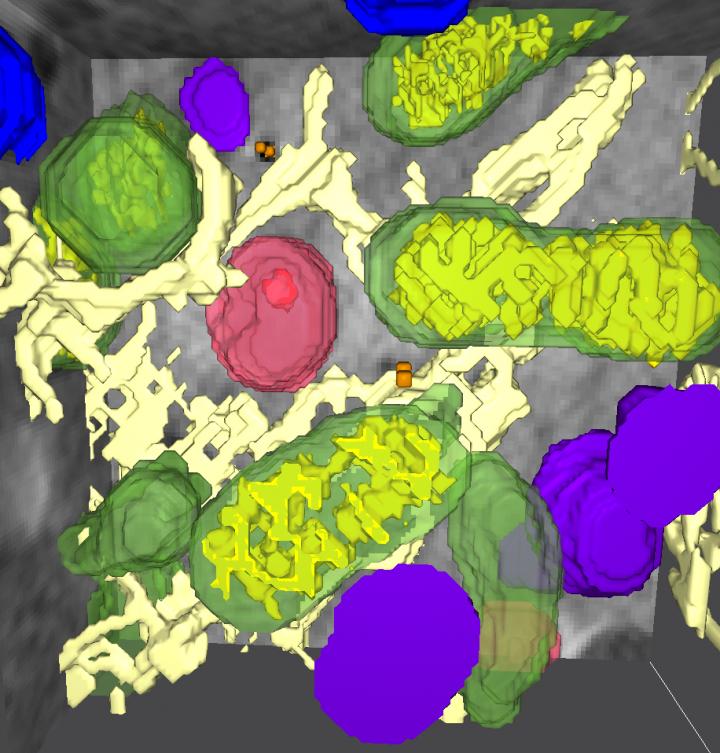
Today, nanoparticles are not only in cosmetic products, but everywhere, in the air, in water, in the soil and in food. Because they are so tiny, they easily enter into the cells in our body. This is also of interest for medical applications: Nanoparticles coated with active ingredients could be specifically introduced into cells, for example to destroy cancer cells. However, there is still much to be learned about how nanoparticles are distributed in the cells, what they do there, and how these effects depend on their size and coating.

New insights have come from a study at BESSY II, where Prof. Gerd Schneider’s team can take X-ray microscopy images with soft, intensive X-rays. Researchers from the X-ray microscopy group led by HZB biophysicist Dr. James McNally investigated cells with differently coated nanoparticles. The nanoparticles were exactly the same size, but were coated with different active ingredients.

“X-ray microscopy offers significantly better resolution than light microscopy, and a much better overview than electron microscopy,” emphasizes Schneider. For the first time, the team obtained complete, three-dimensional, high-resolution images of the nanoparticle-treated cells with the organelles contained therein: including lipid droplets, mitochondria, multivesicular bodies and endosomes. Lipid droplets act as energy stores in the cell, while mitochondria metabolize this energy.

The analysis of the images showed: The nanoparticles accumulate preferentially in a subset of the cell organelles and also change the number of certain organelles at the expense of other organelles. The changes in organelle numbers were similar regardless of the nanoparticle coating, suggesting that many different kinds of nanoparticle coatings may induce a similar effect. To evaluate how general this effect is, further studies with other nanoparticle coatings and with other cell types must be performed.

“X-ray microscopy allows us to see the cell as a whole, so we were able to observe this behavior for the first time,” explains McNally. “We found that the absorption of such nanoparticles increases the number of mitochondria and endosomes, while other organelles, namely lipid droplets and multivesicular bodies, decrease,” says Burcu Kepsutlu, who carried out the experiments for her doctorate.”When we go on a starvation diet or run a marathon, we see similar changes in the cell – namely an increase in mitochondria and a decrease in lipid droplets,” says McNally. “Apparently it takes energy for the cell to absorb the nanoparticles, and the cell feels like it has just run a marathon.”

###

Media Contact
Antonia Roetger
[email protected]

Original Source

https://www.helmholtz-berlin.de/pubbin/news_seite?nid=21060;sprache=en;seitenid=1

Related Journal Article

http://dx.doi.org/10.1021/acsnano.9b09264

Tags: BiologyBiomechanics/BiophysicsBiotechnologyCell BiologyEcology/EnvironmentMicrobiologyNanotechnology/MicromachinesPhysiologyPollution/Remediation
Share12Tweet8Share2ShareShareShare2

Related Posts

Advancements and Insights into Life Expectancy for Chronic Obstructive Pulmonary Disease Patients

May 17, 2026

Intrinsic Capacity, Resilience, Frailty in Stroke Recovery

May 17, 2026

Physical Resilience Linked to Aging Views in Chinese Elders

May 17, 2026

Tau T205 Phosphorylation Controls Memory and Engrams

May 17, 2026
Please login to join discussion

POPULAR NEWS

  • Research Indicates Potential Connection Between Prenatal Medication Exposure and Elevated Autism Risk

    844 shares
    Share 338 Tweet 211
  • New Study Reveals Plants Can Detect the Sound of Rain

    730 shares
    Share 291 Tweet 182
  • Salmonella Haem Blocks Macrophages, Boosts Infection

    62 shares
    Share 25 Tweet 16
  • Breastmilk Balances E. coli and Beneficial Bacteria in Infant Gut Microbiomes

    58 shares
    Share 23 Tweet 15

About

We bring you the latest biotechnology news from best research centers and universities around the world. Check our website.

Follow us

Recent News

Targeted Radiotherapy Extends Control of Early-Stage Breast Cancer Spread

Just Two Radiotherapy Sessions Over Eight Days Effectively Treat Prostate Cancer Without Additional Side Effects

Advancements and Insights into Life Expectancy for Chronic Obstructive Pulmonary Disease Patients

Subscribe to Blog via Email

Enter your email address to subscribe to this blog and receive notifications of new posts by email.

Join 82 other subscribers
  • Contact Us

Bioengineer.org © Copyright 2023 All Rights Reserved.

Welcome Back!

Login to your account below

Forgotten Password?

Retrieve your password

Please enter your username or email address to reset your password.

Log In
No Result
View All Result
  • Homepages
    • Home Page 1
    • Home Page 2
  • News
  • National
  • Business
  • Health
  • Lifestyle
  • Science

Bioengineer.org © Copyright 2023 All Rights Reserved.