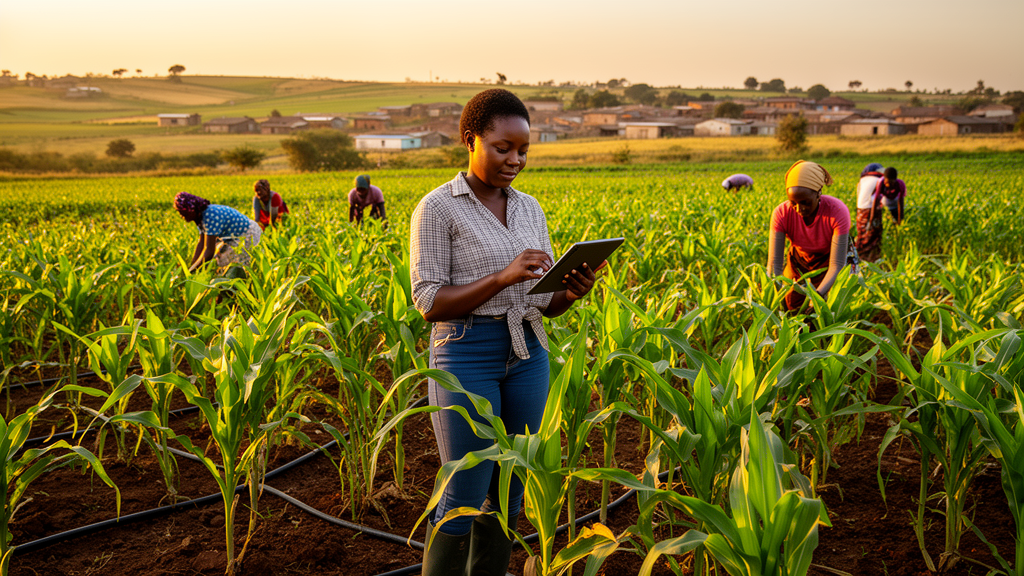
A new open-access study published in Agriculture & Food Security reports that women’s legal rights and labour force participation show significant positive associations with climate-resilient agricultural outcomes in the short run across ten Sub-Saharan African countries, while female educational attainment appears to matter more over the long run. The research, led by Adewale Matthew Adekanmbi and Oladimeji Abeeb Olaniyi, analysed annual panel data from 2005 to 2024 for Senegal, Sierra Leone, South Africa, Angola, Kenya, Ghana, Ethiopia, Cameroon, Nigeria and Zimbabwe, using a pooled mean group autoregressive distributed lag (PMG-ARDL) estimator to separate short-run dynamics from long-run relationships.
The study was guided by participatory governance theory and feminist political ecology, frameworks that frame women’s exclusion from land, credit, extension services and decision-making institutions as structural constraints on agricultural adaptation. The authors set out to address what they describe as a fragmented evidence base: most previous work on women’s adaptive strategies in the region has been qualitative, single-country or sector-specific, offering limited scope for cross-country generalisation. Their stated aim was to provide quantitative, multi-country evidence relevant to Sustainable Development Goals 2, 5 and 13, covering zero hunger, gender equality and climate action respectively.
Measuring climate-resilient agriculture posed a central methodological challenge. Because the concept is multidimensional, encompassing adaptive production systems, technology adoption and institutional capacity, consistent measurement across countries and two decades is difficult. The researchers settled on agricultural irrigated land as a percentage of total agricultural land as their proxy. Irrigation, they argue, reduces dependence on rainfall variability and drought, reflects sustained investment and policy commitment, and has been used in prior empirical work as an indicator of adaptive capacity. The authors acknowledge the measure does not capture dimensions such as crop diversification or agroecological practices. The explanatory variables were women’s legal rights, measured by the Women, Business and the Law index; female secondary school enrolment as a proxy for human capital; women’s economic participation; and food security, measured by the prevalence of undernourishment. All variables were lagged to reduce potential endogeneity concerns.
The econometric pipeline was extensive. Panel unit root tests, including Levin–Lin–Chu, Im–Pesaran–Shin, ADF-Fisher and PP-Fisher procedures, indicated the variables were integrated of order one, a precondition for the ARDL framework. Kao and Pedroni residual-based cointegration tests supported the existence of a long-run equilibrium relationship among the variables, with the Kao ADF statistic significant at the 1% level. A Breusch–Pagan test found no evidence of heteroscedasticity in the residuals. The authors stress, however, that the ten-country sample was chosen on data availability rather than representativeness, and that findings should be read as indicative of broader regional patterns rather than universal outcomes.
In the short-run estimates, women’s legal rights stood out. A 1% improvement in the legal rights index was associated with a 1.19% rise in the climate-resilient agriculture proxy in the short term, a statistically significant positive association. The authors interpret this as evidence that legally enforceable rights and institutional protections for women coincide with greater adaptive capacity in the agricultural sector. By contrast, female secondary school enrolment showed a negative but statistically insignificant short-run coefficient, roughly a 0.20% decline per 1% increase in enrolment. Food security and female economic participation both showed positive but insignificant short-run associations, of 4.61% and 1.44% per 1% improvement respectively.
The long-run picture inverted several of these patterns. Women’s legal rights showed a small but statistically significant negative long-run association, with a 1% gain corresponding to a 0.10% decline in the resilience proxy. The authors argue this does not mean legal empowerment is harmful; rather, they suggest formal legal reforms alone cannot deliver sustained benefits where enforcement, access to land, technology, inputs and finance remain weak. Female secondary school enrolment, meanwhile, showed a significant positive long-run effect, with a 1% increase associated with a 0.05% rise in the resilience indicator, supporting the interpretation that education builds adaptive capacity gradually through human capital accumulation rather than through immediate returns.
Two long-run results were more pointedly negative. Food security, measured by undernourishment prevalence, showed a significant negative long-run association, with a 1% rise corresponding to a 0.38% decline in the resilience proxy. The authors speculate that food security in the region may sometimes be achieved through channels that are not climate-sustainable, such as reliance on rain-fed staples, food imports or soil-depleting monocropping, though the aggregate panel data cannot test these mechanisms directly. Female economic participation showed the largest negative long-run coefficient, with a 1% rise associated with a 2.58% decline. The authors attribute this pattern to the concentration of women’s agricultural work in low-productivity, climate-vulnerable activities without access to extension services, land ownership, finance or technology, and call for investment in gender-responsive agricultural finance, land tenure reform and skills development. The error correction term was negative and significant, indicating convergence toward the long-run equilibrium after short-run shocks, though the reported adjustment speed of 141% per year exceeds the conventional 0-to-1 range and suggests the estimate should be treated with caution.
Country-specific short-run estimates revealed substantial heterogeneity. Women’s legal rights showed predominantly positive, significant short-run effects in Angola, Ghana, Kenya, Nigeria, Sierra Leone, South Africa and Zimbabwe, with coefficients ranging from 0.17% in Kenya to 0.67% in Sierra Leone, but negative effects in Ethiopia and Senegal. Female secondary enrolment boosted the resilience proxy in Cameroon, Ethiopia and Kenya, with the largest effect of 0.42% in Kenya, while showing negative associations in Angola, Ghana, Nigeria, Senegal, Sierra Leone, South Africa and Zimbabwe. Food security effects diverged sharply, positive and significant in Cameroon at 3.22% but negative and significant in Angola at 0.42%. The authors read this variation as evidence that a uniform regional policy instrument will not produce uniform resilience outcomes, and that legal rights yield adaptive benefits mainly where implementation capacity exists.
The authors are explicit about the limits of causal inference. They note that the empirical framework omits institutional, climatic and macroeconomic controls such as GDP growth, agricultural investment, rainfall variability and temperature dynamics, choices driven by data availability and model parsimony. The analysis relies on aggregated macro-level panel data that may obscure subnational heterogeneity in governance quality and climate exposure, and potential endogeneity cannot be ruled out, meaning the estimated relationships should be interpreted as associative rather than causal. They recommend future work using household-level datasets, quasi-experimental and geospatial designs, and complementary qualitative institutional analysis.
For policy, the study’s headline message is that different empowerment channels operate on different timescales. Legal reforms appear to coincide with short-run resilience gains but require enforcement and material support to sustain them; education shows its strongest association with resilience only over the long run; and welfare-oriented food security programmes alone do not automatically translate into climate-resilient production systems. The authors argue that effective frameworks must align legal reform, human capital investment and climate adaptation policy within an integrated, gender-responsive governance architecture, and they caution that their findings should be interpreted within the methodological constraints of macro-panel analysis, particularly around data aggregation and the associative nature of the estimates.
Subject of Research: Statistical associations between gender-inclusive governance indicators, women's empowerment and climate-resilient agricultural outcomes in ten Sub-Saharan African countries from 2005 to 2024.
Article Title: Gender-inclusive governance, women’s empowerment, and climate-resilient agriculture in Sub-Saharan Africa
Article References: Adekanmbi, A. M., & Olaniyi, O. A. (2026). Gender-inclusive governance, women’s empowerment, and climate-resilient agriculture in Sub-Saharan Africa. Agriculture & Food Security, 15(1), Article 35. https://doi.org/10.1186/s40066-026-00617-9
Image Credits: AI Generated
DOI: 10.1186/s40066-026-00617-9
Keywords: Sub-Saharan Africa, climate-resilient agriculture, women's empowerment, gender-inclusive governance, panel ARDL, women's legal rights, female education, food security, irrigation, agricultural adaptation, economic participation, SDGs
News Source: Alan Morgan. (October 29, 2026). Women’s Legal Rights Boost Short-Term Farm Resilience in Ten African Nations. Scienmag.