Replacing one fifth of the concentrate ration of crossbred dairy cows with freshly sprouted hydroponic oat fodder left milk output unchanged while nudging several milk quality components upward, according to a feeding trial conducted at the Ghion Agro-Industry dairy farm in Ethiopia and published in Dairy Science and Management. When the replacement level was pushed to 40%, however, both feed intake and milk yield fell, suggesting that the technology has a practical ceiling in this production system.
The study set out to test three hypotheses: that substituting concentrate with hydroponic oats would raise milk yield, that it would improve milk quality, and that it would be economically feasible in crossbred cows. Nine lactating crossbred cows, Holstein crossed with the local Fogera zebu breed, were assigned to a 3 × 3 changeover design with three experimental periods. Each period lasted 30 days, and every cow received each of the three treatment diets once in a randomized sequence. The treatments were a control diet of natural pasture hay plus full concentrate, a diet in which 20% of the concentrate was replaced with hydroponic oat fodder, and a diet with 40% replacement. To guard against carryover effects between periods, the researchers included 14 days of gradual adaptation and a 9-day washout on the baseline diet before data collection resumed.
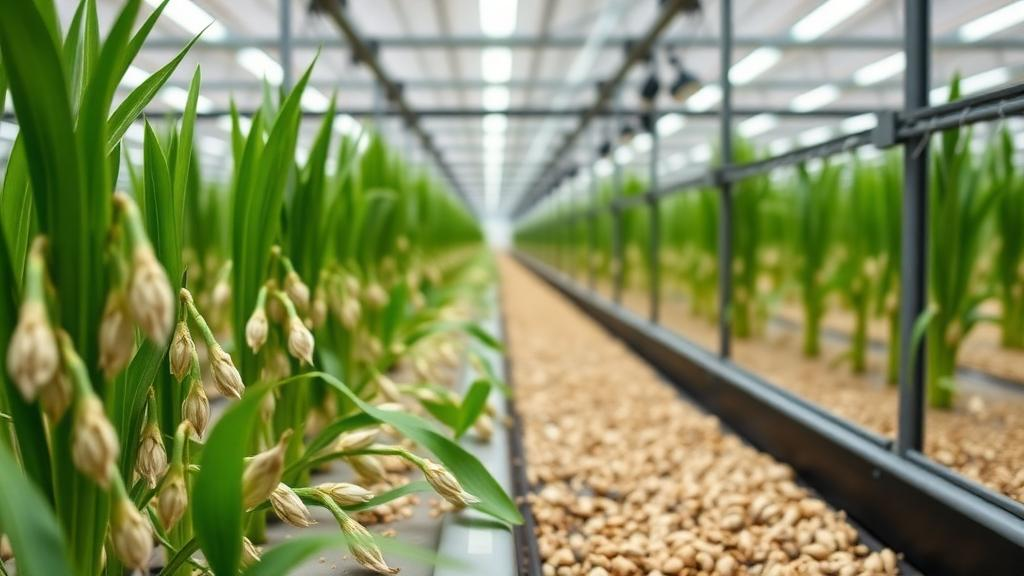
The experimental animals were multiparous cows in early lactation, roughly 40 days in milk at the start, with an average body weight of about 400 kilograms and an initial average milk yield of around 6 kilograms per day. They were housed in individual pens, drenched with an anthelminthic before the trial, and fed three times daily with water available at all times. Hydroponic oat fodder was produced on site in a unit built from wood, bamboo and transparent plastic, with trays of seeds irrigated three times a day under an 18-hour light and 6-hour dark cycle at ambient temperatures of 19 to 22 degrees Celsius. Seeds were soaked in a dilute bleach solution to control mold, sprouted for seven days, and then harvested, chopped and fed to the cows.
Chemical analysis revealed the characteristic signature of sprouted fodder. The dry matter content of the oat material dropped from 910 grams per kilogram in the seed to 250 grams per kilogram in the seven-day fodder, while ash rose from 32 to 50 grams per kilogram and crude protein climbed from 90 to 133 grams per kilogram. The fiber fractions also increased, with neutral detergent fiber rising from 190 to 420 grams per kilogram and acid detergent fiber from 120 to 270 grams per kilogram. The authors attribute the dry matter loss to respiration during germination and the shift of seed starch into root and shoot structure, while the apparent protein increase reflects the concentration effect of losing dry matter even as total protein mass stays roughly constant.
Feed intake differed significantly among treatments. Cows on the 20% replacement diet consumed the most dry matter, 13.8 kilograms per day, whereas intake on the 40% diet fell to 11.9 kilograms per day. The researchers suggest that the high moisture and succulence of the fresh fodder makes the ration bulky, restricting gut fill and dry matter intake once the proportion of hydroponic material becomes large. At the moderate 20% level, the palatability of the fresh green fodder may instead have stimulated consumption.
Milk yield told a parallel story. Cows fed the 20% hydroponic oat diet produced 9.8 kilograms per day, statistically indistinguishable from the 9.7 kilograms per day recorded on the full concentrate control, while the 40% group dropped significantly to 8.2 kilograms per day. In other words, a moderate substitution preserved production, but replacing too much concentrate with a low-dry-matter, high-fiber fodder reduced the energy and nutrients available for milk synthesis. The authors note that the high water content of fresh hydroponic fodder and the relatively low feeding level limited intake and gut fill at the highest inclusion rate.
Milk composition responded more sensitively than yield. Apart from fat and total solids, which did not differ among treatments, the measured components differed significantly. The 20% replacement diet produced the highest values for milk protein at 3.5%, lactose at 5.2% and solids-not-fat at 9.4%. Increasing the replacement to 40% reduced protein, lactose and solids-not-fat relative to the moderate diet. Body condition scores, measured on a five-point scale before and after the trial, were statistically similar across treatments at 2.7, 3.2 and 3.0 for the control, 20% and 40% groups respectively, although all improved compared with baseline.
The economic analysis painted a more cautious picture. Gross return was highest for the 20% diet, but net return was statistically equivalent between the control at 170.4 euro per cow and the 20% treatment, a figure the abstract reports as 141.2 euro. The authors attribute the lack of a profit advantage to the labor costs of growing the fodder daily and the cost of the nutrient solution used in the hydroponic unit. Their marginal rate of return calculation indicated that every euro invested in the 20% treatment returned about 0.50 euro, which they characterize as moderately profitable. Because the cost of hydroponic fodder depends heavily on seed price, roughly 90% by their account, profitability will vary with local grain prices.
The researchers conclude that replacing concentrate with hydroponic oat fodder at the 20% level improves feed intake and certain milk quality components, specifically protein, lactose and solids-not-fat, without affecting milk yield, fat content, total solids, body condition or economic return in Ethiopian crossbred dairy cows. They are explicit that the result should be interpreted carefully: the trial involved only nine cows over three 30-day periods at a single farm. The authors call for further research using larger herds, longer durations and multiple farms to determine the technology’s potential at the farmer level and to explain the mechanisms behind the observed responses. For smallholder and peri-urban producers facing land constraints for conventional fodder cultivation, the findings suggest hydroponic oats could partially displace purchased concentrate, but the yield and intake penalties at higher inclusion rates and the thin economic margins mean the practice is best viewed as a partial, carefully calibrated substitution rather than a wholesale replacement.
Subject of Research: The effects of replacing concentrate feed with hydroponic oat fodder on milk yield, milk composition, body condition and economics in crossbred dairy cows
Article Title: Effects of concentrate replacement with hydroponic oat on milk yield and milk composition at the Ghion Agro-Industry dairy farm
Article References: Fentahun, S., Kassa, A., & Teshager, N. (2025). Effects of concentrate replacement with hydroponic oat on milk yield and milk composition at the Ghion Agro-Industry dairy farm. Dairy Science and Management, 2(1), Article 9. https://doi.org/10.1186/s44363-025-00009-7
Image Credits: AI Generated
DOI: 10.1186/s44363-025-00009-7
Keywords: hydroponic fodder, dairy cows, oat fodder, milk yield, milk composition, Ethiopia, crossbred cattle, feed intake, concentrate replacement, changeover design, smallholder dairy farming, Effects
News Source: Alan Morgan. (October 29, 2026). Hydroponic oat fodder can replace a fifth of dairy concentrate without cutting milk yield. Scienmag.