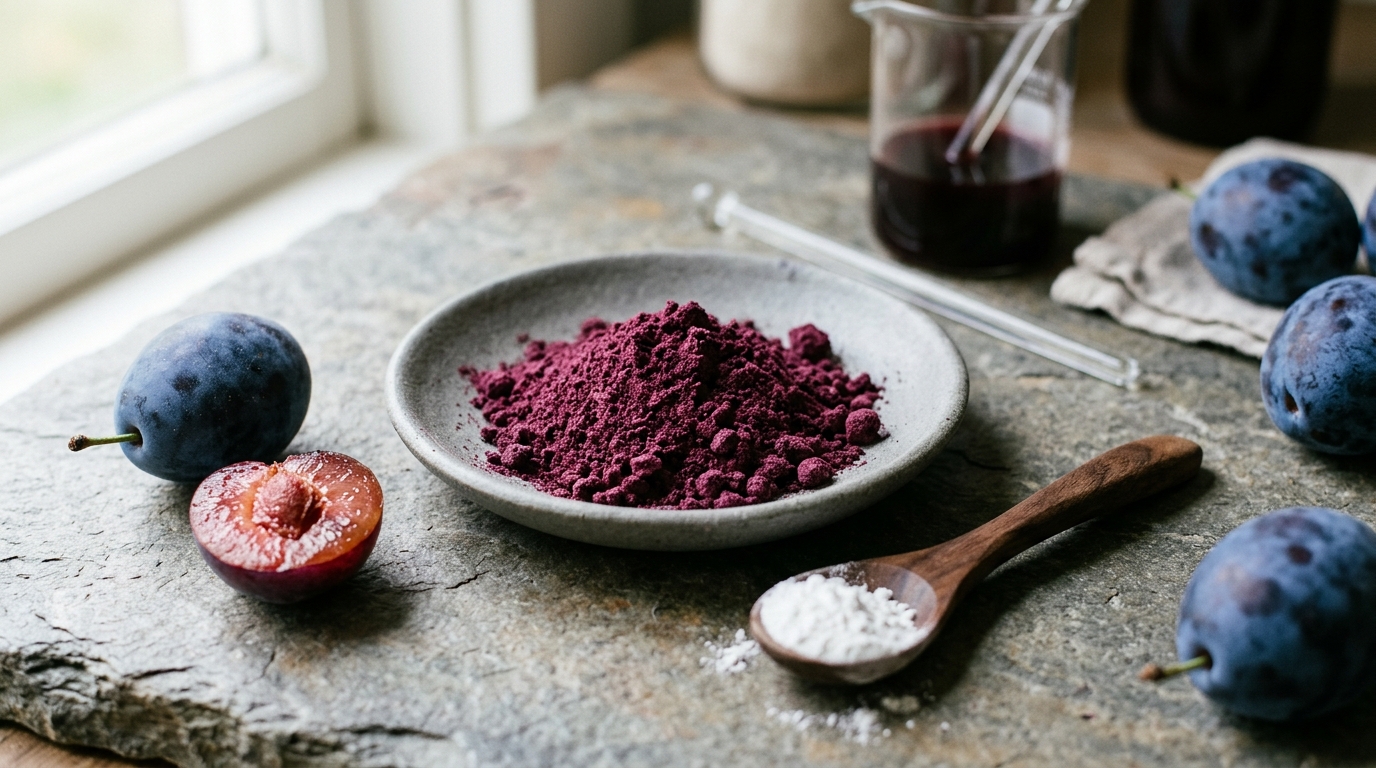
A wild African fruit that spoils almost as soon as it is picked can now be dried into a stable, antioxidant-rich powder, according to a new optimization study published in Discover Industrial Chemistry and Materials. Researchers in Cameroon used spray drying and statistical modeling to turn juice from Ximenia americana, a small tree fruit known regionally as wild plum or tchaboule, into microcapsules held together by a carrier made from locally grown sweet potato starch. The work identified a precise combination of drying temperature, air flow, and starch concentration that preserved the majority of the fruit’s polyphenols and carotenoids while keeping the final powder dry enough to store.
The research team, led by Roli Karole Tsague Tsatsop of the University of Ngaoundere, collected fully ripe yellow X. americana fruits from wild plants near Marza in Cameroon’s Vina division in March 2022. A botanist authenticated the plant, and a voucher specimen was deposited in the Cameroon National Herbarium. The researchers de-pulped and de-seeded the fruits by hand, ground the pulp, and strained it through muslin to obtain a juice containing 10.32 grams of solids per 100 grams, measuring 10 degrees Brix with a pH of 3.48. The juice was frozen at minus 18 degrees Celsius until it was needed for the drying experiments.
Ximenia americana has drawn scientific attention because its fruits are unusually rich in antioxidant phytochemicals, particularly polyphenols and carotenoids. Previous studies have reported total phenolic contents ranging from roughly 1,298 to 3,002 milligrams of gallic acid equivalents per 100 grams of fruit, depending on the country of origin, along with measurable free-radical scavenging activity. Yet the fruit’s high perishability severely limits how long it remains available after harvest. Converting perishable juices into powders is a standard industrial strategy, and spray drying is considered the most cost-effective technique for rapid dehydration that preserves quality, because atomization creates fine droplets with a huge surface area that dry almost instantly into spherical particles.
Spray-dried fruit juices present a well-known technical problem, however. The sugars and organic acids in fruit juice have low glass transition temperatures, which makes the resulting powders sticky and highly hygroscopic. Adding high-molecular-weight carrier agents solves this, and the industry typically relies on carbohydrate polymers such as gum arabic, modified starches, or cellulose derivatives. The Cameroon team chose a less conventional option: starch extracted from white sweet potato tubers grown at a local agricultural research farm, then gelatinized by heating a suspension at 70 degrees Celsius for 300 seconds. Pregelatinized starch swells and dissolves readily in cold water, forms films, and has encapsulation properties that make it a promising wall material for protecting heat-sensitive compounds during drying.
To find the best operating conditions, the researchers applied response surface methodology using a central composite design, varying three factors simultaneously: drying temperature from 140 to 170 degrees Celsius, inlet air flow rate from 60 to 80 cubic meters per hour, and carrier agent concentration from 10 to 20 grams per 100 grams of juice. The design generated 20 experimental runs, including six replicates at the center point. Feed temperature, feed flow rate, and chamber pressure were held constant throughout. The team measured four responses for each run: drying yield, moisture content, encapsulation efficiency of polyphenols, and encapsulation efficiency of carotenoids, fitting second-order polynomial models to the data.
The statistical models performed well. Coefficients of determination ranged from 0.954 to 0.979, lack-of-fit tests were non-significant, and coefficients of variation between 3.07 and 10.10 percent indicated satisfactory reproducibility. Analysis of variance showed that drying temperature and carrier agent content, along with their interaction, significantly influenced every response measured. The trends were clear in the response surfaces. Raising the drying temperature increased the temperature gradient between hot air and atomized droplets, accelerating water evaporation, reducing stickiness and wall deposition, and pushing drying yield higher. More carrier agent raised the total solids of the feed and built a stronger protective matrix around the particles, also improving powder recovery.
Moisture content responded in the opposite direction to temperature but revealed a subtlety about air flow. Higher drying temperatures drove residual moisture down, consistent with earlier spray drying studies on watermelon juice and gac fruit. Increasing the inlet air flow rate, however, raised moisture content, because droplets spend less time suspended in the drying chamber and evaporate less completely before collection. At low drying temperatures this effect was especially pronounced. More starch in the feed lowered moisture across the board, echoing reports that carriers improve the drying of sticky materials. Meanwhile, total phenolic content of the powder actually fell as drying temperature rose from 140 to 170 degrees Celsius, a sign of thermal degradation, but rose as carrier concentration increased, because the polymeric matrix shielded phenolics from heat and oxidation.
Encapsulation efficiency, the fraction of each bioactive compound hidden inside the capsule rather than sitting on the particle surface, ranged from 43 to 85 percent for polyphenols and 40 to 70 percent for carotenoids across the experimental conditions. Both classes benefited from higher drying temperatures, which rapidly form a semi-permeable crust that limits migration of compounds toward the particle surface, and from higher carrier concentrations, which build a more continuous protective barrier. Polyphenols consistently encapsulated better than carotenoids, most likely because polyphenols are hydrophilic and mix readily with the starch matrix, whereas carotenoids are hydrophobic and fit less comfortably into a starch-based wall. The researchers note this compatibility effect matches earlier findings with gum arabic, gellan gum, and maltodextrin carriers.
Because the best conditions for yield, moisture, and the two encapsulation efficiencies did not coincide in any single experiment, the team used a desirability function to find a compromise. The optimum landed at a drying temperature of 170 degrees Celsius, an inlet air flow rate of 65.79 cubic meters per hour, and a carrier concentration of 20 grams per 100 grams of juice, with an overall desirability of 0.815. Under these conditions the models predicted a drying yield of 48.60 percent, encapsulation efficiency of 81.22 percent for polyphenols and 61.67 percent for carotenoids, a total phenolic content of 96.04 milligrams of gallic acid equivalents per gram of powder, and a moisture content of 2.08 percent. An experimental validation run at the optimum closely matched these predictions, with relative errors below 5 percent for yield and both encapsulation efficiencies, and 10.34 percent for moisture, where the measured value of 2.32 percent remained close to the predicted 2.08 percent.
The authors argue the study broadens the palette of encapsulating materials available for spray drying and opens a route to valorizing underutilized tropical fruits and locally sourced starches. Pregelatinized sweet potato starch, they conclude, is a promising carrier for preserving the bioactive compounds of X. americana juice during drying and could underpin stable functional ingredients from a fruit that currently goes largely to waste. They caution that several questions remain before such powders reach food products: future work should test long-term storage stability, characterize how the encapsulated compounds are released and how bioaccessible they are in the digestive tract, and evaluate incorporation into foods such as bakery products and jellies. Until those studies are done, the optimized powder remains a laboratory-validated proof of concept rather than a commercial ingredient.
Subject of Research: Optimization of spray drying microencapsulation of Ximenia americana fruit juice bioactive compounds using pregelatinized sweet potato starch as a carrier agent
Article Title: Optimization of spray drying process for the microencapsulation of Ximenia americana bioactive compounds using pregelatinized sweet potato starch as a carrier agent
Article References: Tsague Tsatsop, R. K., Balingui, C. F., Tchienou Djiobie, G. E., Maka Antini, B., Simo Fopossi, D. J., Mbouga Nguemtchouin, M., & Ngassoum, M. B. (2026). Optimization of spray drying process for the microencapsulation of Ximenia americana bioactive compounds using pregelatinized sweet potato starch as a carrier agent. Discover Industrial Chemistry and Materials, 1(1), Article 27. https://doi.org/10.1007/s44508-026-00027-6
Image Credits: AI Generated
DOI: 10.1007/s44508-026-00027-6
Keywords: Ximenia americana, spray drying, microencapsulation, sweet potato starch, polyphenols, carotenoids, response surface methodology, wild plum, functional food ingredients, Cameroon, bioactive compounds, fruit powder
News Source: Bethany Barker. (November 5, 2026). Wild plum juice powder optimized with sweet potato starch carrier. Scienmag.