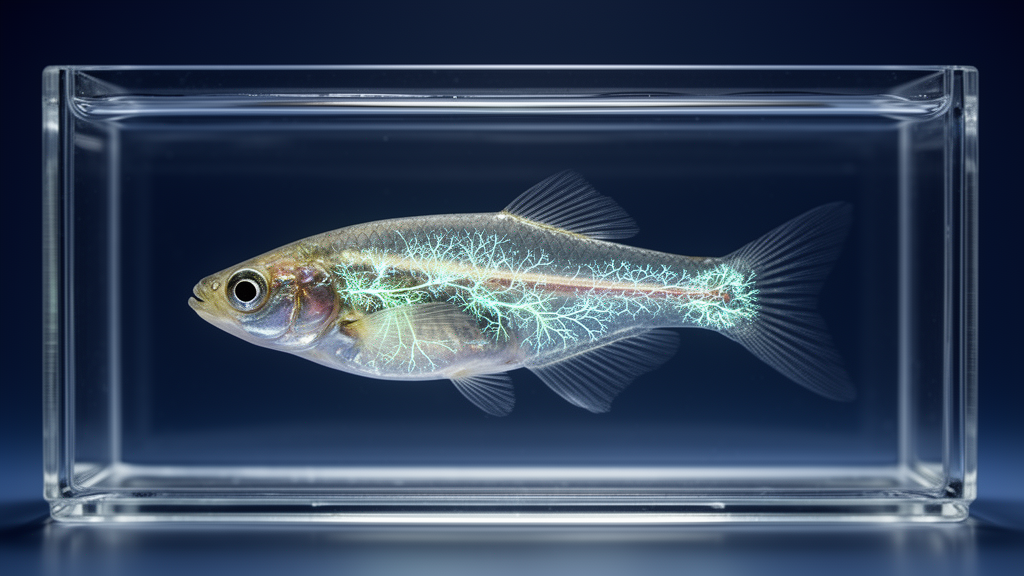
A new imaging system called WHOLISTIC has recorded calcium-based communication signals from nearly every cell in a living larval zebrafish, capturing the brain, muscles, organs and other tissues at the same time as the animal swam, ate and slept. Developed at HHMI’s Janelia Research Campus with collaborators from University College London, Virginia Tech and Tsinghua University, the method revealed coordinated activity across the body and identified cellular patterns associated with low-oxygen survival, motor quiescence, cold responses and ketamine exposure. The study provides a body-wide view of signaling in a vertebrate, linking individual cells with the behavior and physiology of the whole animal.
Nearly every cell in the body uses calcium to communicate with neighboring cells, and researchers can follow these exchanges by tracking changes in calcium. Previous work by the Ahrens Lab and its collaborators had established ways to image calcium signals across the entire brain of a transparent larval zebrafish, including methods for equipping neurons with sensors that light up when calcium changes. Those approaches supplied glimpses of activity within one major system, but they did not provide a simultaneous account of communication across the fish’s brain, cardiovascular system, digestive system, muscles and other organs.
WHOLISTIC, an abbreviation for WHole Organism Live Imaging System for recording Tissue and IntraCellular activity, was designed to address that gap. Its central technical challenge was to introduce a calcium sensor into almost every cell in the fish’s body, then detect the resulting activity despite differences among tissues and cell types. The researchers used high-speed volumetric fluorescence imaging to record signals throughout the body at once. They also developed computational methods that tracked signals as the fish moved, aligned them across the recording and identified different cell types from their activity patterns. Because many cells lacked specific labels, the team subsequently used whole-body expansion microscopy to enlarge the tissue and reveal fine structural details that helped confirm the identities of cells captured by WHOLISTIC.
The method allows researchers to examine individual cells while retaining information about the organism-wide context in which their activity occurs. Virginie Ruetten, a postdoctoral researcher in Misha Ahrens’s lab who performed the work as a joint graduate student with Ahrens and Maneesh Sahani, described the technique as a bridge between two fundamental scales of biology: the cell and the organism. This combination makes it possible to observe cellular responses at scale while also recording the behavior and physiological state of the same animal. It also allows investigators to examine networks that are distributed among organs rather than contained in a single location, potentially revealing relationships that would be difficult to identify by studying one tissue in isolation.
Initial applications showed widespread correlations in cellular activity among the brain, muscles and organs, indicating broad coupling between these systems. Many cell types from different organs also displayed characteristic temporal dynamics. Those patterns allowed the computational analysis to identify cell types even when the cells had no specific fluorescent labeling, adding another way to characterize the cellular organization captured in the recordings. Ahrens said the simultaneous view permits scientists to examine which elements are connected, when their activity changes together and which relationships may otherwise be overlooked. The observations do not, by themselves, establish that every detected correlation is causal, but they show that coordinated signaling can be measured across the same vertebrate at cellular resolution and in real time.
One application addressed the physiological response to insufficient oxygen. WHOLISTIC revealed body-wide mechanisms involved in survival under low-oxygen conditions and showed that the brainstem controls the redirection of blood flow from the gut toward the brain and muscles. This finding brought the nervous and cardiovascular systems into the same cellular recording, making it possible to observe a coordinated response across distant organs as the animal faced a common physiological challenge. The study further illustrates the practical value of a whole-body approach: information that would otherwise be divided among separate specialties can be analyzed concurrently in one living animal.
A second series of observations was made during prolonged motor quiescence, a state that may be associated with sleep. The researchers detected traveling activity oscillations along the spinal cord and brain that originated in ependymal cells, the cells lining the ventricles that contain cerebrospinal fluid. Because the recordings captured both these cells and the spatial propagation of their activity, the findings suggest that ependymal cells may participate in sleep-related processes. The evidence does not establish that the traveling oscillations generate sleep, nor does it resolve the full causal chain connecting cellular activity, neural propagation and behavioral state. It does, however, identify a candidate cellular source for a coordinated body-wide pattern and provide a means of testing that role in future experiments.
The whole-body recordings also identified cell types that respond to cold, including chondrocytes, the main cellular components of cartilage. Ketamine produced a separate pattern in which the meninges — the cells and connective tissue surrounding the brain — responded along with neurons. These observations demonstrate that an imaging strategy focused on the entire animal can detect activity in tissues that might be missed when a study concentrates only on the brain or one peripheral organ. They also show that WHOLISTIC can be applied to questions involving physiological challenges, behavioral states and responses to a pharmacological agent within the same experimental framework.
The team is now adapting WHOLISTIC to Danionella, a fish that remains transparent throughout its life. The days-old larval zebrafish used in the reported experiments can be observed under a microscope, but the researchers note that Danionella can display more complex behaviors, potentially making it useful for investigating how a vertebrate brain generates behavior. They also plan to share the fish with the scientific community and make the computational methods open source. The microscope used for the technique is commonly found in biology laboratories, which the researchers hope will support broader adoption. The work is an early step toward simultaneous observation of cellular communication across an animal; it does not provide a complete account of human physiology or demonstrate that the same circuits operate in mammals.
Subject of Research: Whole-organism calcium imaging of cellular communication in larval zebrafish
Article Title: A ‘WHOLISTIC’ view of cellular communication across an entire animal
Article References: A ‘WHOLISTIC’ view of cellular communication across an entire animal. Original publication (Bibliographic details unavailable.)
Image Credits: AI Generated
DOI: Not provided
Keywords: WHOLISTIC, larval zebrafish, calcium imaging, cellular communication, whole-body circuits, fluorescence microscopy, behavior, physiology, cell identification, neuroscience, view, cellular
News Source: Cassandra Pierce. (October 22, 2026). WHOLISTIC captures cellular communication across a living zebrafish. Scienmag.