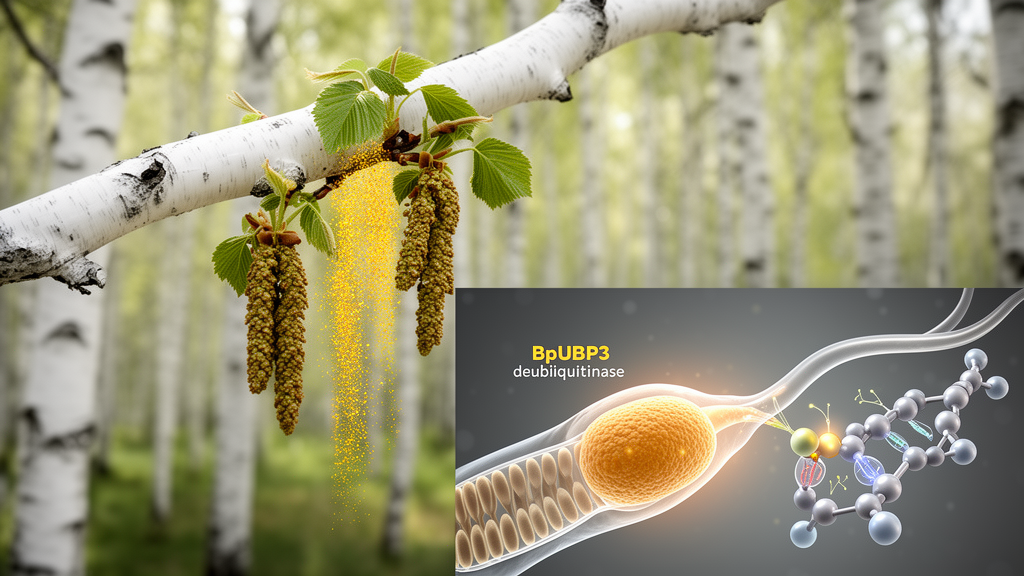
A genome-wide analysis of white birch identified 56 deubiquitinase genes and singled out BpUBP3 as a potential contributor to pollen germination and pollen-tube elongation. The researchers classified the enzymes into six conserved subfamilies and found that the broad-spectrum deubiquitinase inhibitor PR-619 markedly impaired both processes. RNA-sequencing showed stage-specific induction of BpUBP3 during pollen germination, while antisense oligonucleotide-mediated downregulation of BpUBP3 reduced pollen germination and pollen-tube growth. Together, these results provide preliminary evidence that BpUBP3 contributes to reproductive development in the woody plant Betula platyphylla and offer a basis for further investigation of deubiquitinase functions.
The study, published in Plant Molecular Biology on 20 October 2026, addresses a gap in the systematic characterization of deubiquitinases, or DUBs, in white birch. These enzymes remove ubiquitin from substrate proteins and form part of the ubiquitination–deubiquitination system, a key regulatory mechanism for maintaining proteome homeostasis in eukaryotic cells. DUBs regulate plant development, stress responses and other physiological processes, but their genomic characterization in this species has remained limited. This knowledge gap restricts understanding of their potential roles in reproduction in woody plants.
Using genome-wide analysis, the researchers identified 56 BpDUB genes in B. platyphylla. They divided the genes into six conserved subfamilies: UBP, OTU, UCH, MJD, JAMM and MINDY. Comparative and synteny analyses indicated that DUB genes are evolutionarily conserved across angiosperms while exhibiting lineage-specific divergence. The results therefore place the birch genes within a broadly shared angiosperm framework while also revealing characteristics that may distinguish them in the birch lineage.
The researchers examined promoters upstream of the BpDUB genes and found diverse cis-acting elements associated with growth and development, stress responses, hormone signalling and transcription-factor binding. These regulatory features identify possible routes through which individual DUB genes may respond to developmental and environmental signals. The presence of such elements does not by itself establish their activity in vivo, so the promoter analysis provides a framework for future experiments rather than a complete account of when or where each birch deubiquitinase is expressed or functions.
To test whether deubiquitination activity influences pollen development, the team treated pollen with PR-619. The treatment markedly impaired pollen germination and pollen-tube elongation, linking DUB activity with two central features of pollen development: the emergence of a germinating pollen grain and extension of its tube. Because PR-619 broadly inhibits deubiquitinases rather than selectively targeting BpUBP3, the experiment supports involvement of DUB activity generally and does not identify BpUBP3 as the sole enzyme responsible for the observed effects.
RNA sequencing provided more focused evidence for BpUBP3. The gene exhibited stage-specific induction during pollen germination, indicating that its expression changed as pollen progressed through this developmental stage. This pattern is consistent with a possible role in pollen development, although induction alone does not establish the function of the encoded protein. The researchers therefore combined the RNA-sequencing result with a targeted perturbation using an antisense oligonucleotide, or AS-ODN, to downregulate BpUBP3 and examine the consequences for pollen growth.
AS-ODN-mediated downregulation of BpUBP3 reduced pollen germination and pollen-tube growth. This finding strengthened the case for a functional contribution by the particular deubiquitinase because two complementary observations pointed in the same direction: BpUBP3 was induced in a stage-specific manner during germination, and reducing its expression impaired germination and tube extension. The targeted experiment narrows the interpretation of the broad inhibitor results, but it does not identify the complete range of BpUBP3 substrates or reveal every molecular step through which the protein influences pollen growth.
The findings position BpUBP3 within a larger network of plant regulation. The white birch genome contains 56 DUB genes belonging to six conserved subfamilies, while promoter sequences associate family members with growth, development, stress, hormone-signalling and transcription-factor pathways. The pollen experiments connect this genomic inventory to reproductive function. By combining family-wide identification, comparative and synteny analyses, promoter analysis, pharmacological inhibition, stage-specific transcript profiling and targeted gene downregulation, the researchers assembled several lines of evidence rather than relying on a single measurement.
Important limitations remain. The effects of PR-619 cannot be assigned exclusively to BpUBP3, and AS-ODN downregulation demonstrates a relationship between reduced BpUBP3 expression and impaired pollen performance without establishing every underlying mechanism. The source characterizes the findings as preliminary evidence and a basis for further investigation of DUB functions in reproductive development. The strongest supported conclusion is therefore specific: in white birch, BpUBP3 shows potential involvement in pollen germination and pollen-tube growth, while its direct targets and broader biological significance require further study.
Subject of Research: Genome-wide characterization of white birch deubiquitinases and the role of BpUBP3 in pollen development
Article Title: Genome-wide characterization of DUB genes in Betula platyphylla and BpUBP3 function in pollen tube growth
Article References: Wang, X., Zhao, C., Shi, J., Mei, Z., Jiang, Y., Shi, J., & Lan, X. (2026). Genome-wide characterization of DUB genes in Betula platyphylla and BpUBP3 function in pollen tube growth. Plant Molecular Biology, 116(6), Article 104. https://doi.org/10.1007/s11103-026-01770-2
Image Credits: AI Generated
DOI: 10.1007/s11103-026-01770-2
Keywords: Betula platyphylla, white birch, deubiquitinases, BpUBP3, pollen germination, pollen tube growth, ubiquitination, plant reproduction, RNA sequencing, functional genomics, Genome-wide, characterization
News Source: Juliet Wilcox. (October 20, 2026). White birch study links deubiquitinase BpUBP3 to pollen growth. Scienmag.