Water kefir grains, the gelatinous cultures behind the fizzy homemade drink, are usually treated as a surplus by-product once the beverage has been brewed. A team of Argentine researchers has now shown that this leftover biomass can be dried, milled, dissolved in a mild alkaline solution, and cast into dense, flexible films whose dextran chains stretch to more than three and a half times their original length before breaking. The work, published in the journal Discover Polymers, describes a simplified immersion route that avoids ultrasonic homogenization entirely and relies instead on controlled dissolution, precipitation, and the slow diffusion of glycerol into the forming film.
The starting material is far from exotic. Water kefir grains are composed largely of water and polysaccharides, with dextran forming the major exopolysaccharide fraction produced by the resident bacteria. This dextran has a backbone of α-1,6-linked glucose units that can branch at the O2, O3, and O4 positions. Methylation analysis cited in the study found that α-1,6 linkages accounted for 78.6% of the total glycosidic linkages, while α-1,3 and α-1,4 linkages appeared only in small amounts, at 1.0% and 0.5% respectively. The authors note that other α-glucans such as mutans, alternans, and reuterans, if present, occur only in minor quantities.
Characterization of the dried and milled grains confirmed a high-molecular-weight, highly branched dextran. Nuclear magnetic resonance spectroscopy showed chemical shifts consistent with previously reported dextran spectra, including a diagnostic signal at 4.99 ppm for the α-anomeric proton of the glucose residues. Intrinsic viscosity measurements, carried out on a solution of the polysaccharide in 0.5 M NaOH, yielded an estimated viscosity-average molecular mass of 3.3 × 10⁶ Da. Because the Mark–Houwink–Sakurada parameters used in this calculation are recommended for dextrans up to 2.0 × 10⁶ Da, the authors caution that the value could be somewhat overestimated, and they conclude that the molecular mass exceeds 3 × 10⁶ Da. X-ray diffraction of the grains showed only a broad, low-intensity amorphous halo, indicating a non-crystalline material.
The limited water solubility of such a large, hyperbranched polymer posed a practical problem for film making. The researchers exploited a well-known chemical property: dextrans dissolve in aqueous sodium hydroxide solutions but are insoluble in water–ethanol mixtures. Flow behavior tests on dispersions containing 3, 4, and 5 wt% dried kefir biomass in NaOH solutions ranging from 0.25 to 3.00 wt% showed non-Newtonian, power-law rheology. The consistency index K rose as NaOH concentration increased up to 1.0 wt%, likely reflecting the disaggregation of powder particles and the incorporation of more polymer into the solution phase, then fell at higher NaOH levels, suggesting complete dissolution of the particulate material. The flow behavior index n showed the same pattern, decreasing up to 1.0 wt% NaOH and rising again above that threshold.
These rheological measurements guided two distinct processing routes. For the adapted homogenization method, a 3.0 wt% solution of dried kefir powder in 0.50 wt% NaOH was stirred, ultrasonicated at 80% amplitude for 30 minutes, heated at 90 °C for 20 minutes, ultrasonicated again, and then supplemented with glycerol at 15, 20, or 25 wt% relative to the dry biomass before casting and drying. The resulting films were designated H15, H20, and H25 according to their glycerol content. For the new immersion method, a more concentrated 5.0 wt% biomass suspension in 3.0 wt% NaOH was stirred until fully dissolved, centrifuged, and degassed under vacuum to remove air bubbles trapped by the high viscosity of the mixture.
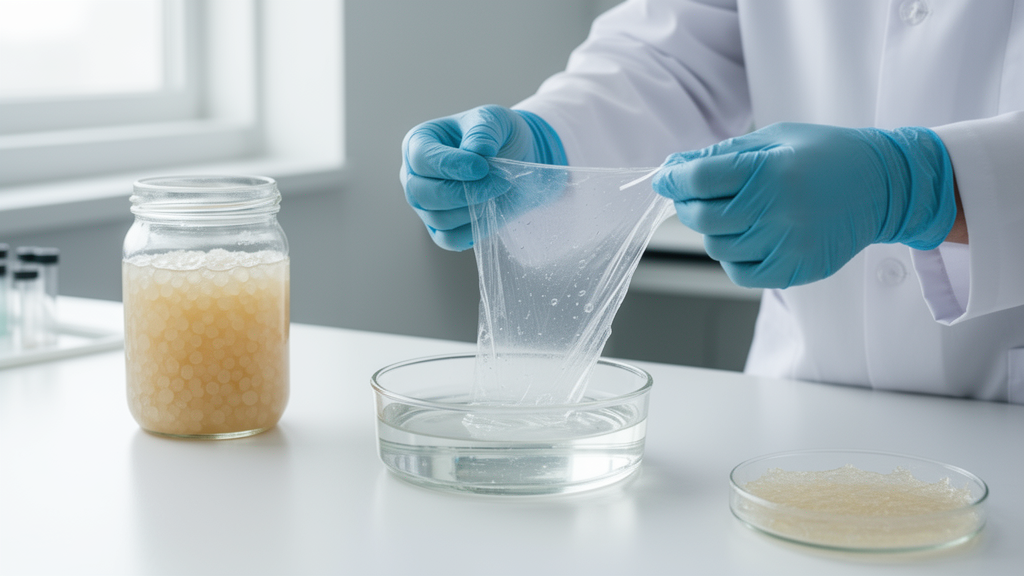
The immersion step is the heart of the new method. The dissolved polymer solution was poured into Petri dishes and immersed in a 50:50 ethanol–water bath for 24 hours. Because dextran is insoluble in this mixture, a highly elastic yet fragile white film formed in place. The ethanol bath was then replaced with aqueous glycerol solutions at 1.0, 1.5, or 2.0 wt% for another 24 hours, during which the plasticizer diffused from the medium into the polymer matrix. After the glycerol soak, the liquid was removed and the dishes were dried at 40 °C. The films produced with 0, 1.0, 1.5, and 2.0 wt% glycerol solutions were labeled I0, I1.0, I1.5, and I2.0 respectively.
Thermal analysis revealed how profoundly glycerol reshapes the material. Thermogravimetric measurements showed maximum degradation rate temperatures above 260 °C across all samples, with glycerol-containing films showing reduced onset temperatures and residual weights compared with glycerol-free controls. Modulated-temperature differential scanning calorimetry, used because standard DSC could not resolve the thermal events, showed a dramatic drop in glass transition temperature. In the homogenization series, the mid-point Tg fell from 113.8 ± 8.3 °C in unplasticized films to 5.6 ± 4.2 °C in films containing 25 wt% glycerol. In the immersion series, Tg dropped from 122.9 ± 2.8 °C to 10.4 ± 3.3 °C in films prepared with a 2.0 wt% glycerol solution. The authors interpret these shifts as evidence that plasticization through diffusion is as effective as direct incorporation.
Water sorption isotherms, measured gravimetrically at 20 °C across water activities from 0.10 to 0.90 and fitted to the Guggenheim–Anderson–de Boer model, showed similar behavior for both film types, with a sharp increase in water uptake above aw = 0.6, typical of hydrophilic biopolymer films. Glycerol significantly increased hydration at aw = 0.9 and raised the monolayer capacity parameter N while lowering the binding strength parameter c and the multilayer parameter k. The authors suggest that glycerol interacts with dextran chains through hydrogen bonding, disrupting interpolymer associations and increasing matrix free volume, which facilitates water uptake. Notably, the H films showed higher uptake than previously reported for never-dried water kefir grain films prepared without NaOH, suggesting that the alkaline treatment itself increases matrix hydrophilicity.
Mechanical testing delivered the most striking result. Uniaxial tensile tests, performed on specimens equilibrated at 53% relative humidity and following ASTM D882 guidelines, showed that elongation at break increased significantly with glycerol content in both series. Films from the homogenization method reached 98% elongation at break at 25 wt% glycerol, while films from the immersion method, plasticized by contact with a 2.0 wt% glycerol solution, reached 362.5 ± 68.8%. The authors attribute this exceptional ductility to complete dissolution of the polymer chains in the alkaline medium, which provides a continuous film matrix free of microcracks, as confirmed by scanning electron microscopy, and gives the chains sufficient mobility to align and reorganize under stress. The high elongation is further attributed to the degree of plasticization achieved through glycerol diffusion, evidenced by the decrease in Tg, the shift in onset temperature, and the changes in residual weight.
The authors conclude that the immersion method, requiring no specialized equipment beyond an overhead stirrer and a centrifuge, is a viable laboratory-scale alternative to ultrasonic homogenization for converting dried water kefir grains into high-ductility films. They caution, however, that managing large volumes of ethanol, glycerol, and alkaline solutions may present operational challenges at industrial scale, and that the long-term stability of processing water kefir in NaOH solutions, particularly regarding alkaline-induced chain scission, requires further study. As a by-product of a fermented beverage, dextran from water kefir grains offers an animal-free and non-food-competing source for biodegradable materials, and the sequence of alkaline dissolution, ethanol insolubilization, and glycerol diffusion establishes a new methodological framework for high-elongation film production from renewable biomass.
Subject of Research: Development of glycerol-plasticized dextran films from dried water kefir grains via a simplified immersion method
Article Title: Simplified immersion route for water-kefir dextran film development and the role of glycerol as a plasticizer
Article References: Delgado, J. F., Rodríguez, C., Maggi, N., Uhrig, M. L., Peltzer, M. A., & Salvay, A. G. (2026). Simplified immersion route for water-kefir dextran film development and the role of glycerol as a plasticizer. Discover Polymers, 3(1), Article 11. https://doi.org/10.1007/s44347-026-00050-y
Image Credits: AI Generated
DOI: 10.1007/s44347-026-00050-y
Keywords: water kefir, dextran, biopolymer films, glycerol plasticization, sodium hydroxide dissolution, immersion method, tensile properties, glass transition temperature, water sorption isotherms, thermogravimetric analysis, rheology, food by-product valorization
News Source: Bethany Barker. (October 30, 2026). Water Kefir Waste Becomes Stretchy Bioplastic Film With a Simple Glycerol Soak. Scienmag.