• HOME
  • NEWS
  • EXPLORE
    • CAREER
      • Companies
      • Jobs
    • EVENTS
    • iGEM
      • News
      • Team
    • PHOTOS
    • VIDEO
    • WIKI
  • BLOG
  • COMMUNITY
    • FACEBOOK
    • INSTAGRAM
    • TWITTER
Thursday, March 26, 2026
BIOENGINEER.ORG
No Result
View All Result
  • Login
  • HOME
  • NEWS
  • EXPLORE
    • CAREER
      • Companies
      • Jobs
        • Lecturer
        • PhD Studentship
        • Postdoc
        • Research Assistant
    • EVENTS
    • iGEM
      • News
      • Team
    • PHOTOS
    • VIDEO
    • WIKI
  • BLOG
  • COMMUNITY
    • FACEBOOK
    • INSTAGRAM
    • TWITTER
  • HOME
  • NEWS
  • EXPLORE
    • CAREER
      • Companies
      • Jobs
        • Lecturer
        • PhD Studentship
        • Postdoc
        • Research Assistant
    • EVENTS
    • iGEM
      • News
      • Team
    • PHOTOS
    • VIDEO
    • WIKI
  • BLOG
  • COMMUNITY
    • FACEBOOK
    • INSTAGRAM
    • TWITTER
No Result
View All Result
Bioengineer.org
No Result
View All Result
Home NEWS Science News Cancer

Vitamin E TPGS emulsified vinorelbine bitartrate loaded solid lipid nanoparticles (SLN)

Bioengineer by Bioengineer
December 16, 2018
in Cancer
Reading Time: 2 mins read
0
IMAGE
Share on FacebookShare on TwitterShare on LinkedinShare on RedditShare on Telegram

This article by Dr. Sanjay Singh et al. is published in Current Drug Delivery, Volume 15 , Issue 8 , 2018
IMAGE

Credit: Dr. Sanjay Singh, Bentham Science Publishers

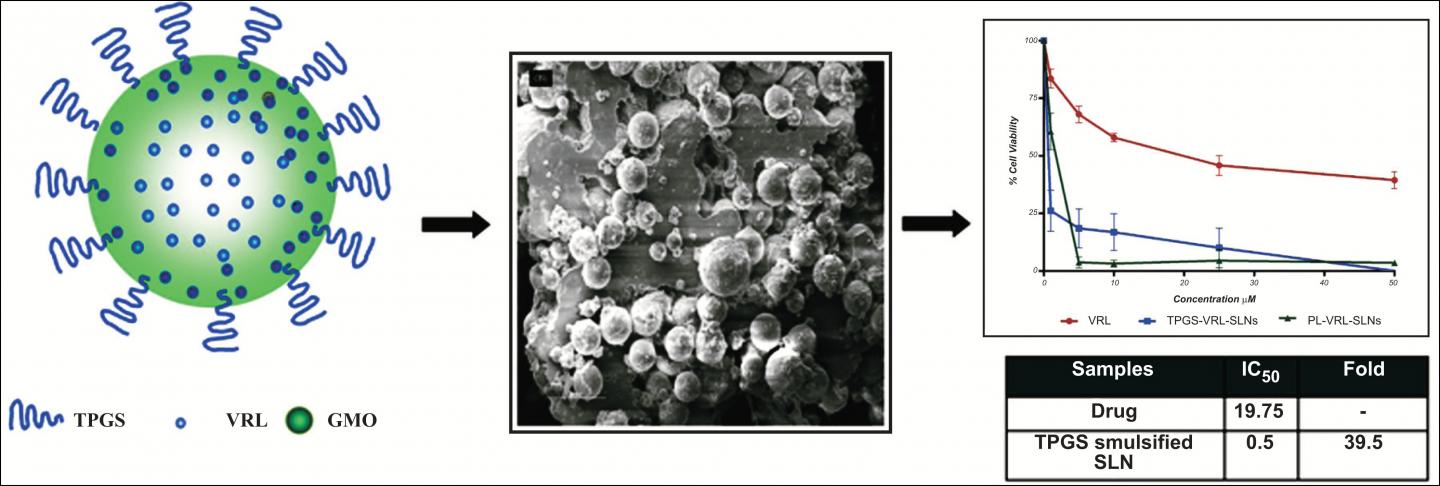
Vinorelbine Bitartrate (VRL), a semi-synthetic vinca alkaloid was approved by the FDA for breast cancer treatment, as it has been proven to be beneficial for first line of defense and subsequent therapies. But its hydrophilic and thermolabile structure causes hindrance to oral clinical translation. The main objective of this research is the development and optimization of a solid lipid nanoparticle (SLN) structure that can encapsulate hydrophilic and thermolabile Vinorelbine bitartrate to maximize the anticancer activity of the drug without compromising its efficacy and integrity. For this purpose, the study is mainly focused on the application of DOE, a modern statistical optimization tool for nanoparticle modification.

To prepare SLNs, a solvent diffusion technique was used employing Taguchi orthogonal array design with process variables and optimized formulation. Glyceryl mono-oleate (GMO) were used for its emulsifying nature and low melting point to enhance entrapment and reducing temperature associated degradation. To prevent infection, two types of surfactants, Vitamin E TPGS, and Poloxamer-188 were used to obtain TPGS-VRL-SLNs and PL-VRL-SLNs.

The results proved the method to be effective. The SLNs were produced spherical in shape with entrapment efficiency (EE) upto 58%. A biphasic release pattern was observed in in vitro release studies followed by the Korsemeyer peppas model with fickian release kinetics. MTT assay results revealed that TPGS-VRL-SLNs and PL-VRL-SLNs were 39.5 and 18.5 time more effective than VRL in its original nature. The DOE method was believed to be a successful approach for development of VRL-SLNs. Enhanced entrapment with anticancer efficacy of TPGS-VRL-SLN was the result of emulsifying nature of GMO and the cytotoxic nature of TPGS which influences VRL effects. Such properties of TPGS-VRL-SLNs may prove them to be a potentially useful carrier in cancer chemotherapeutics.

###

This article is Open Access. To obtain the article please visit: http://www.eurekaselect.com/161120

Media Contact
Faizan ul Haq
[email protected]

Related Journal Article

http://dx.doi.org/10.2174/1567201815666180409105410

Tags: BiochemistryBioinformaticsBreast CancercancerCarcinogensMedicine/HealthPharmaceutical SciencesPharmaceutical/Combinatorial ChemistryToxicology
Share12Tweet8Share2ShareShareShare2

Related Posts

Microtubules Found to Actively Ensure Accurate Chromosome Distribution During Cell Division

March 25, 2026

Alectinib Enhances CAR T-Cell Attack in ALK Neuroblastoma

March 23, 2026

Dr. Chun Li Honored with SNMMI Mars Shot Research Fund Award

March 20, 2026

Pre-Chemotherapy Exercise Demonstrates Potential to Alleviate Cancer-Related Fatigue

March 20, 2026
Please login to join discussion

POPULAR NEWS

  • blank

    Revolutionary AI Model Enhances Precision in Detecting Food Contamination

    96 shares
    Share 38 Tweet 24
  • Imagine a Social Media Feed That Challenges Your Views Instead of Reinforcing Them

    1003 shares
    Share 397 Tweet 248
  • Uncovering Functions of Cavernous Malformation Proteins in Organoids

    54 shares
    Share 22 Tweet 14
  • Promising Outcomes from First Clinical Trials of Gene Regulation in Epilepsy

    51 shares
    Share 20 Tweet 13

About

We bring you the latest biotechnology news from best research centers and universities around the world. Check our website.

Follow us

Recent News

In-Sensor Cryptography Links Physical Process to Digital Identity

Can Psychosocial Factors Influence Cancer Risk?

Depression Factors in Elderly: Pre vs. Post-COVID Analysis

Subscribe to Blog via Email

Success! An email was just sent to confirm your subscription. Please find the email now and click 'Confirm' to start subscribing.

Join 78 other subscribers
  • Contact Us

Bioengineer.org © Copyright 2023 All Rights Reserved.

Welcome Back!

Login to your account below

Forgotten Password?

Retrieve your password

Please enter your username or email address to reset your password.

Log In
No Result
View All Result
  • Homepages
    • Home Page 1
    • Home Page 2
  • News
  • National
  • Business
  • Health
  • Lifestyle
  • Science

Bioengineer.org © Copyright 2023 All Rights Reserved.