Hormonal changes caused by motorboat noise cause clownfish to hide, skip meals and attack their neighbors — putting damselfish in distress
Credit: Frederick Zuberer
Hormonal changes caused by motorboat noise cause clownfish to hide, skip meals and attack their neighbours – putting damselfish in distress.
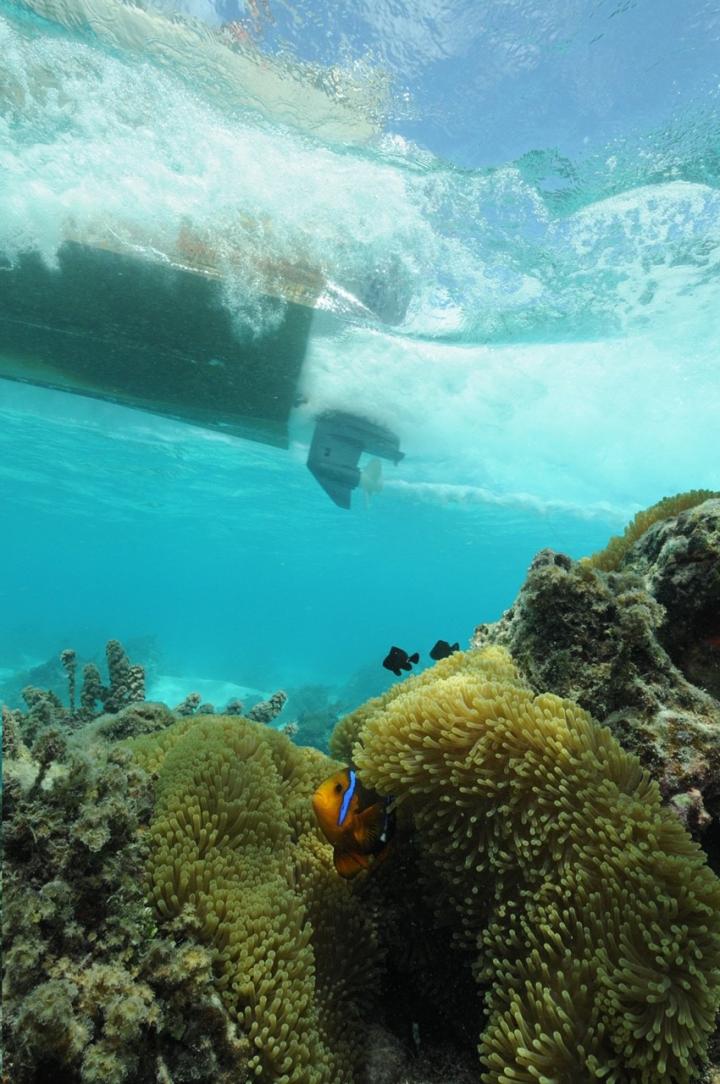
Working on the reefs around Moorea in French Polynesia, an international team of scientists exposed 40 pairs of clownfish to recordings of natural reef sounds or motorboat noise for up to two days. Motorboat noise caused clownfish to hide in the protective tentacles of their host anemone, move less into open water to feed and to be more aggressive towards domino damselfish that also reside in the anemone.
The researchers – from France, Chile and the UK – also found that noise-affected anemonefish were unable to respond appropriately to a second stressor, likely putting them at greater risk from threats such as predators and climate change.
The study, published in the journal Environmental Pollution, found noise-exposed fish had elevated levels of the stress hormone cortisol and the reproductive hormones testosterone and 11-ketotestosterone, which corresponded with observed behavioural changes. These measurable hormones offer a window into complex behaviours and could be used to develop new noise-mitigation tools.
Lead author, Associate Professor Suzanne Mills at the École Pratique des Hautes Études (EPHE) PSL Université Paris, CRIOBE, France, said, “The high cortisol levels after two days of exposure suggest that clownfish become chronically stressed by motorboat noise. This compromises the stress response system leaving clownfish unable to mount appropriate responses to further stressful events. If these stressful events include a predator, motorboat noise could have grave implications.”
Ricardo Beldade, Associate Professor at the Pontificia Universidad Católica de Chile, and previously with the Centre National de la Recherche Scientifique (CNRS) at CRIOBE, France said, “Clownfish defended their anemone territory aggressively during motorboat noise, which requires more energy. However, as the fish hid more and moved less to feed, even after the motorboat noise had passed, they may be unable to compensate through more foraging, with potentially detrimental impacts on growth and even survival.”
Andy Radford, Professor of Behavioural Ecology at the University of Bristol, said: “Experiments that consider behaviour of wild animals in natural conditions–as we have done in this study–are crucial if we are to understand fully the impact of anthropogenic noise. Our results highlight that behavioural changes caused by anthropogenic noise are likely underpinned by alterations in the stress response (cortisol) and certain steroid hormones.”
Dr Sophie Nedelec, University of Exeter, said, “Now we know that hormonal responses are the mechanisms driving behavioural changes to motorboat noise, they can be a useful tool in regulation. We might be able to predict the duration and/or interval times of motorboat noise exposure that allow individuals to return to normal behaviour.”
Steve Simpson, Professor of Marine Biology & Global Change at the University of Exeter, added, “Hormonal responses to different boat engines, propeller designs and spatial management of boating activities can be compared to reduce the impact of this globally prevalent pollutant. Hormonal responses are currently an underemployed tool for managing the noise of the 100,000s of motorboats used around the world.”
Mills summarised, “Our new findings highlight the need to control man-made noise in marine protected habitats.”
###
Paper:
‘Hormonal and behavioural effects of motorboat noise on wild coral reef fish’ by Mills, S.C., Beldade, R., Henry, L., Laverty, D., Nedelec, S.L., Simpson, S.D., & Radford, A.N. 2020 in Environmental Pollution.
Media Contact
Shona East
[email protected]
Related Journal Article
http://dx.