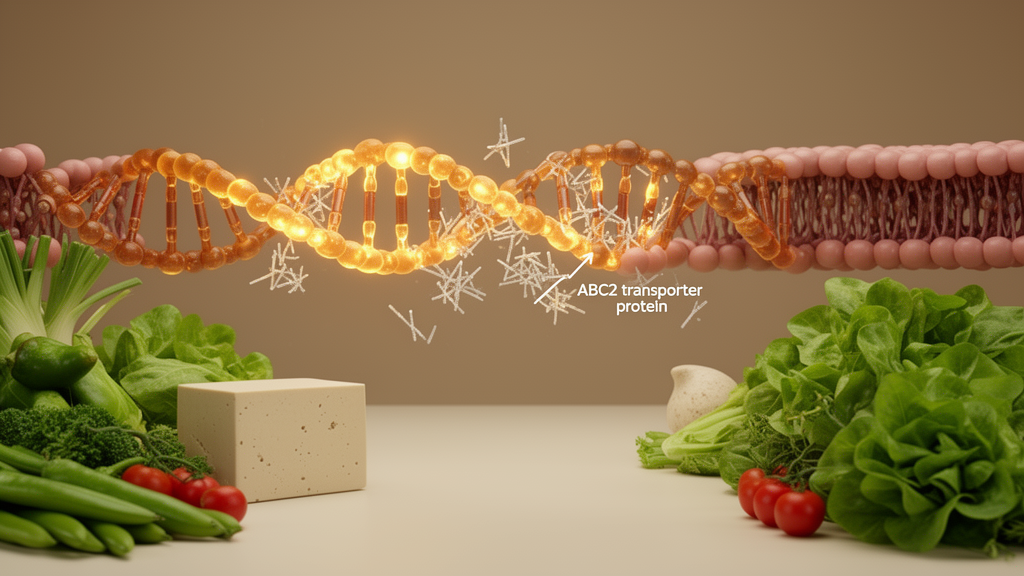
A large genetic study from Taiwan has found that a common uric-acid-raising gene variant raises the risk of hyperuricemia regardless of whether people eat a vegetarian diet, challenging the assumption that plant-based eating can buffer inherited metabolic risk. The research, published in Genes & Nutrition, analyzed more than eleven thousand participants from the Taiwan Biobank and found no meaningful interaction between the ABCG2 rs2231142 polymorphism and dietary pattern.
The study was designed as a population-based case-control analysis of 11,113 Taiwan Biobank participants. The researchers compared carriers of the high-risk GT and TT genotypes at rs2231142 with those carrying the reference GG genotype, and crossed this genetic classification with self-reported dietary habits, vegetarian versus non-vegetarian. Logistic regression models adjusted for a range of clinical confounders were used to estimate odds ratios for hyperuricemia and to test for gene–diet interaction.
The overall prevalence of hyperuricemia in the cohort was 11.1 percent. Participants carrying the GT or TT genotypes showed both a higher prevalence and a significantly elevated adjusted risk of hyperuricemia compared with GG carriers. Crucially, the formal interaction test between the polymorphism and dietary pattern was not statistically significant (P for interaction = 0.610), indicating that the genetic effect operated similarly in both dietary groups.
The numbers make this pattern concrete. Compared with vegetarian GG carriers, GT/TT carriers who were vegetarians had an adjusted odds ratio for hyperuricemia of 2.198 (95 percent confidence interval 1.369–3.528, p = 0.0011), while GT/TT non-vegetarians had an odds ratio of 2.171 (95 percent confidence interval 1.466–3.215, p < 0.001). The near-identical estimates across the two diets are the statistical core of the paper’s conclusion that vegetarianism does not attenuate the genetic risk.
Sex-stratified analyses sharpened the signal among women. Female GT/TT carriers had significantly higher odds of hyperuricemia whether they were vegetarians (odds ratio 3.560, 95 percent confidence interval 1.504–8.427) or non-vegetarians (odds ratio 3.405, 95 percent confidence interval 1.580–7.336).
Stratification by alcohol consumption and body mass index produced a consistent picture. Non-drinkers with the GT/TT genotype faced increased odds of hyperuricemia in both dietary categories, with odds ratios of 2.082 among vegetarians and 2.109 among non-vegetarians.
Body weight modified the magnitude but not the direction of the genetic effect. In participants with a body mass index of 24 kg/m² or above, GT/TT carriers had significantly increased odds of hyperuricemia whether vegetarian (odds ratio 1.854, 95 percent confidence interval 1.096–3.139) or non-vegetarian (odds ratio 1.794, 95 percent confidence interval 1.171–2.747). In the leaner subgroup below 24 kg/m², the odds ratios were substantially larger, at 4.861 for vegetarians and 3.282 for non-vegetarians, suggesting that in the absence of obesity-related metabolic load the genetic variant accounts for a proportionally greater share of hyperuricemia risk.
The authors frame their findings as a “genetics-over-diet” paradigm: the T allele at rs2231142 exerts a dominant influence on urate homeostasis that a vegetarian diet cannot offset. On this reading, dietary modification alone may be insufficient for people who carry the high-risk genotype, and the paper’s conclusion argues that clinical management should prioritize genetic screening and early pharmacological intervention to enhance urate excretion in the Taiwanese population.
Subject of Research: Gene–diet interaction between the ABCG2 rs2231142 polymorphism and vegetarian diet in hyperuricemia risk in a Taiwanese cohort
Article Title: The interaction between ABCG2 rs2231142 polymorphism and vegetarian diet on the prevalence of hyperuricemia in a large Taiwanese cohort
Article References: Ding, W.-Y., Lin, C.-H., Lin, J.-F., Cheng, Y.-M., Hsu, P.-S., & Lin, C.-S. (2026). The interaction between ABCG2 rs2231142 polymorphism and vegetarian diet on the prevalence of hyperuricemia in a large Taiwanese cohort. Genes & Nutrition. https://doi.org/10.1186/s12263-026-00816-w
Image Credits: AI Generated
DOI: 10.1186/s12263-026-00816-w
Keywords: hyperuricemia, ABCG2, rs2231142, vegetarian diet, Taiwan Biobank, gene–diet interaction, uric acid, gout, genetic risk, case-control study, urate transporter, interaction
News Source: Juliet Wilcox. (October 28, 2026). Vegetarian diet does not offset ABCG2 gene variant’s hyperuricemia risk in Taiwanese cohort. Scienmag.