Credit: UT Southwestern Medical Center
DALLAS – Oct. 6, 2016 – One particular protein is the final executioner of events that result in the death of brain cells during stroke, researchers from UT Southwestern Medical Center and their collaborators report. This finding could ultimately lead to new ways to protect against brain damage.
Researchers discovered that the protein, macrophage migration inhibitory factor (MIF), breaks the cell's DNA, resulting in brain cell death.
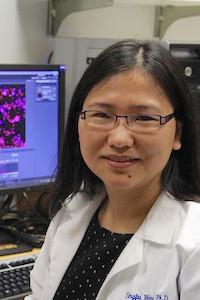
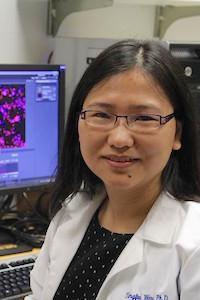
"Stroke is a major cause of death and serious long-term disability in the world. The Centers for Disease Control and Prevention (CDC) estimates that annually more than 795,000 U.S. residents have a stroke," said lead author Dr. Yingfei Wang, Assistant Professor of Pathology and of Neurology and Neurotherapeutics at UT Southwestern. The Department of Neurology and Neurotherapeutics is part of UT Southwestern's Peter O'Donnell Jr. Brain Institute, a comprehensive initiative dedicated to better understanding the basic molecular workings of the brain and applying these discoveries to the prevention and treatment of brain diseases and injuries.
The study, which appears online in Science, outlines three possible ways to manipulate MIF to protect brain tissue during a stroke – and possibly in other brain-damaging conditions such as Alzheimer's, Parkinson's, and Huntington's diseases, although this study examined only stroke.
Dr. Wang screened thousands of human proteins to find 160 that could be the culprits behind stroke-induced cell death. Eventually, the researchers were able to narrow the field to just one – MIF, a protein long known for its roles in immunity and inflammation.
"The MIF protein was identified in the 1960s, but the function we found related to DNA damage in the cell's nucleus after stroke is brand new," Dr. Wang said.
The MIF finding is the final piece in a puzzle that collaborating researchers at Johns Hopkins University have been carefully assembling for years to reveal the process by which brain cells die. This work was started in the labs of research partners Dr. Ted Dawson, Director of the Institute for Cell Engineering at the Johns Hopkins University School of Medicine, and Dr. Valina Dawson, Professor of Neurology at Johns Hopkins, where Dr. Wang began her work as a postdoctoral researcher and continued it as a collaboration between UT Southwestern and Johns Hopkins.
Despite their very different causes and symptoms, brain injury, stroke, and Alzheimer's, Parkinson's, and Huntington's diseases have a shared mechanism involving a distinct form of "programmed" brain cell death called parthanatos, researchers said. The name comes from the personification of death in Greek mythology, and PARP, an enzyme involved in the cell death process.
"I can't overemphasize what an important form of cell death it is; it plays a role in almost all forms of cellular injury," said Dr. Dawson, whose research group has spent years delineating each of the links in the parthanatos chain of events and the roles of the proteins involved.
The researchers are working to identify chemical compounds that could block MIF's actions and possibly protect brain cells from damage.
###
UT Southwestern authors include: postdoctoral researchers Dr. BongWoo Kim and Dr. Lei Bao and research assistant Jennifer Wang, all of Pathology at the time of the study. Dr. Kim is now in Physiology. The collaboration involved researchers from Johns Hopkins, Fudan University and Sun Yat-sen University in China, and the University of Alabama at Birmingham.
This research was supported by the National Institutes of Health, the National Institute of Neurological Disorders and Stroke, the American Heart Association, UT Southwestern Department of Pathology, a UT System Rising STARs award, and a grant from the National Institute on Drug Abuse.
About UT Southwestern Medical Center
UT Southwestern, one of the premier academic medical centers in the nation, integrates pioneering biomedical research with exceptional clinical care and education. The institution's faculty includes many distinguished members, including six who have been awarded Nobel Prizes since 1985. The faculty of almost 2,800 is responsible for groundbreaking medical advances and is committed to translating science-driven research quickly to new clinical treatments. UT Southwestern physicians provide medical care in about 80 specialties to more than 100,000 hospitalized patients and oversee approximately 2.2 million outpatient visits a year.
Media Contact
Deborah Wormser
[email protected]
214-648-3404
@UTSWNews
http://www.swmed.edu