• HOME
  • NEWS
  • EXPLORE
    • CAREER
      • Companies
      • Jobs
    • EVENTS
    • iGEM
      • News
      • Team
    • PHOTOS
    • VIDEO
    • WIKI
  • BLOG
  • COMMUNITY
    • FACEBOOK
    • INSTAGRAM
    • TWITTER
Sunday, May 24, 2026
BIOENGINEER.ORG
No Result
View All Result
  • Login
  • HOME
  • NEWS
  • EXPLORE
    • CAREER
      • Companies
      • Jobs
        • Lecturer
        • PhD Studentship
        • Postdoc
        • Research Assistant
    • EVENTS
    • iGEM
      • News
      • Team
    • PHOTOS
    • VIDEO
    • WIKI
  • BLOG
  • COMMUNITY
    • FACEBOOK
    • INSTAGRAM
    • TWITTER
  • HOME
  • NEWS
  • EXPLORE
    • CAREER
      • Companies
      • Jobs
        • Lecturer
        • PhD Studentship
        • Postdoc
        • Research Assistant
    • EVENTS
    • iGEM
      • News
      • Team
    • PHOTOS
    • VIDEO
    • WIKI
  • BLOG
  • COMMUNITY
    • FACEBOOK
    • INSTAGRAM
    • TWITTER
No Result
View All Result
Bioengineer.org
No Result
View All Result
Home NEWS Science News Chemistry

Using ultrasound localization microscopy to detect oxygen levels in tissues

Bioengineer by Bioengineer
March 4, 2020
in Chemistry
Reading Time: 3 mins read
0
IMAGE
Share on FacebookShare on TwitterShare on LinkedinShare on RedditShare on Telegram

IMAGE

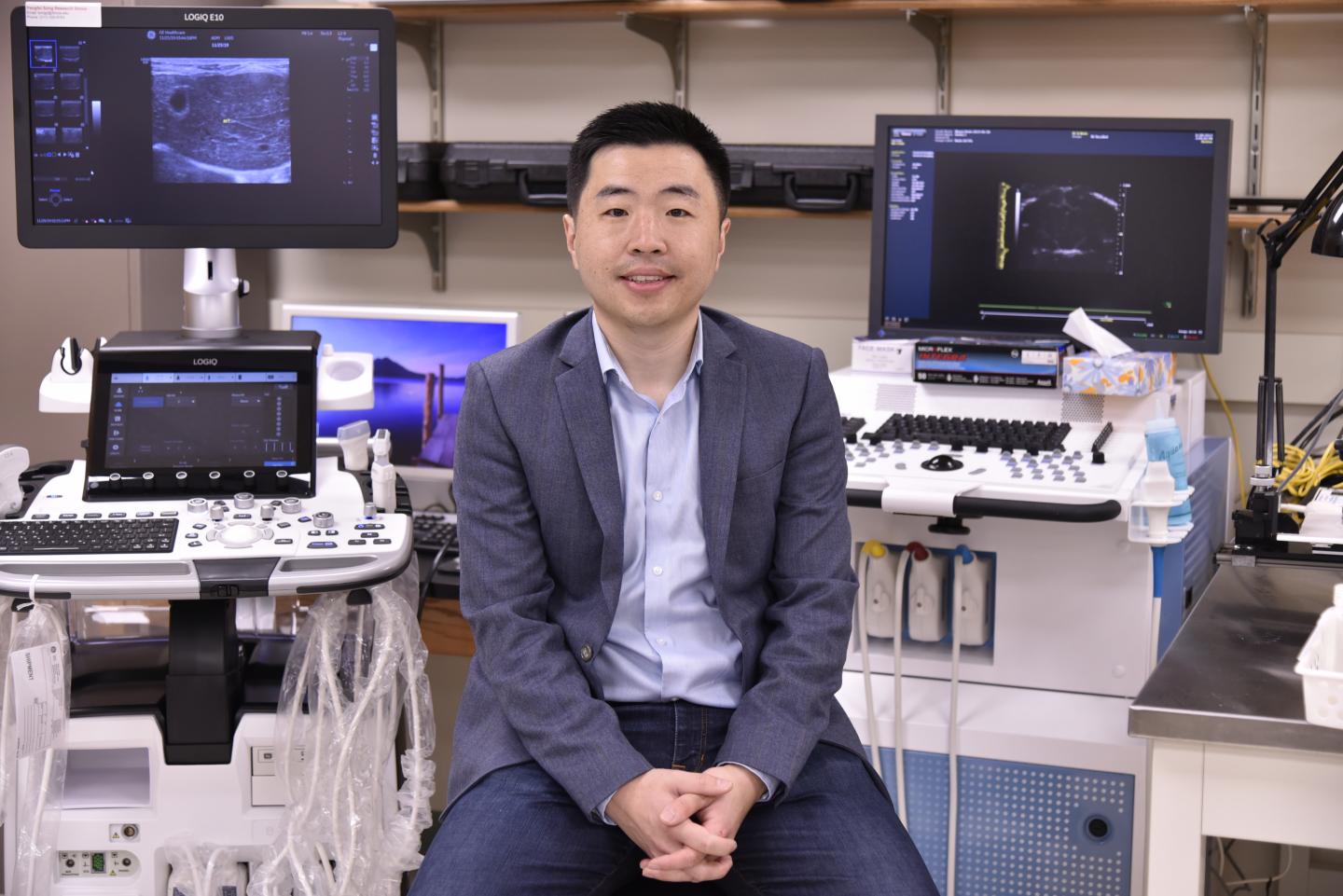
Credit: Doris Dahl, Beckman Institute for Advanced Science and Technology, University of Illinois at Urbana-Champaign


Researchers at the University of Illinois at Urbana-Champaign are using a new application of an existing imaging technique that may help detect tumors in humans.

The technique, super-resolution ultrasound localization microscopy, was used to visualize the distribution of blood vessels and measure oxygen levels in tumors. The study was carried out in chicken embryos, but the researchers hope to extend the studies in humans.

The paper “Ultrasound localization microscopy of renal tumor xenografts in chicken embryo is correlated to hypoxia” was published in Scientific Reports.

ULM uses microbubbles, which are the size of red blood cells, to image tissues.

“We track these bubbles as they flow through blood vessels to obtain a higher resolution image than traditional ultrasounds,” said Matthew Lowerison, a postdoctoral research associate in the Song Research Group at the Beckman Institute for Advanced Science and Technology.

Researchers have long known that tumors can be resistant to therapy because of their lower oxygen levels. “Red blood cells can flow through straight blood vessels quickly and efficiently. As a result, the delivery of oxygen and nutrients is efficient,” Lowerison said. “In contrast, the blood vessels in tumors are twisted onto each other. It is chaotic and disorganized, and the delivery of oxygen is inefficient.”

The members of the Song group have used ULM to demonstrate that oxygen levels are lower in tumors compared to healthy tissue.

“This study is unique because we can image tissue that is deeper inside humans without losing image resolution,” said Pengfei Song, an assistant professor of electrical and computer engineering and a full-time faculty member at the Beckman Institute. “Although this technique requires us to inject these microbubbles, they do not have toxicity problems as other imaging agents. Additionally, the microbubbles are approved by the Food and Drug Administration and are widely used in clinic around the world.”

Currently the main challenge posed by this technique is the acquisition time. “We need to have a large data set to process the images,” Lowerison said. “Although as engineers we are focused on getting the best possible images we can, this technique might work for doctors who want a better vascular image than the conventional imaging methods.”

“We are starting to see good results when we use artificial intelligence and machine learning with these technologies, which can help to make this process faster,” Song said. “Ultimately, we want to be able to use this technique in a clinical setting for cancer detection, diagnosis, and therapy evaluation.”

###

This work was supported by grants from the National Institutes of Health. Beckman Institute, Cancer Center at Illinois, and Carle Hospital have provided support for the Song Research Group to conduct human imaging studies at Carle Cancer Center.

Editor’s note: The study “Ultrasound localization microscopy of renal tumor xenografts in chicken embryo is correlated to hypoxia” can be found at https://doi.org/10.1038/s41598-020-59338-z

For more information, contact Pengfei Song, 217-300-9763, [email protected].

Media Contact
Doris Dahl
[email protected]
217-333-2895

Original Source

https://beckman.illinois.edu/about/news/article/2020/03/03/using-super-resolution-ultrasound-localization-microscopy-to-detect-oxygen-levels-in-tissues

Related Journal Article

http://dx.doi.org/10.1038/s41598-020-59338-z

Tags: BiochemistryBiologyBiomedical/Environmental/Chemical EngineeringBiotechnologycancerCell BiologyMedicine/Health
Share12Tweet8Share2ShareShareShare2

Related Posts

Study Reveals How Valproate Affects Early Brain Development: Insights into the Antiepileptic Drug’s Impact — Chemistry

Study Reveals How Valproate Affects Early Brain Development: Insights into the Antiepileptic Drug’s Impact

May 22, 2026
Sustainable Chemistry: Iron Replaces Noble Metals in Catalytic Reactions — Chemistry

Sustainable Chemistry: Iron Replaces Noble Metals in Catalytic Reactions

May 22, 2026

Advancing Thin-Film Device Manufacturing with Imaging Ellipsometry for Enhanced Process Control

May 22, 2026

Simple Adjustment in 3D Printing Enhances Fit of Dental Crowns

May 22, 2026
Please login to join discussion

POPULAR NEWS

  • ESMO 2025: mRNA COVID Vaccines Enhance Efficacy of Cancer Immunotherapy

    313 shares
    Share 125 Tweet 78
  • New Study Reveals Plants Can Detect the Sound of Rain

    734 shares
    Share 293 Tweet 183
  • Research Indicates Potential Connection Between Prenatal Medication Exposure and Elevated Autism Risk

    847 shares
    Share 339 Tweet 212
  • Common Food Preservatives Associated with Elevated Blood Pressure and Increased Heart Disease Risk

    55 shares
    Share 22 Tweet 14

About

We bring you the latest biotechnology news from best research centers and universities around the world. Check our website.

Follow us

Recent News

Deep Phenotyping Reveals Skin Remodeling in Sclerosis Treatment

Unveiling Treatment Timelines in Gliomas via AI

Chewing, Nutrition, and Frailty in Elderly Patients

Subscribe to Blog via Email

Success! An email was just sent to confirm your subscription. Please find the email now and click 'Confirm' to start subscribing.

Join 83 other subscribers
  • Contact Us

Bioengineer.org © Copyright 2023 All Rights Reserved.

Welcome Back!

Login to your account below

Forgotten Password?

Retrieve your password

Please enter your username or email address to reset your password.

Log In
No Result
View All Result
  • Homepages
    • Home Page 1
    • Home Page 2
  • News
  • National
  • Business
  • Health
  • Lifestyle
  • Science

Bioengineer.org © Copyright 2023 All Rights Reserved.