Every year, humanity flushes, dumps, and discards staggering quantities of organic waste. Global sewage sludge production reached 115 million tonnes of dry solids in 2020 and is projected to climb to 138 million tonnes by 2050, while roughly one billion tonnes of agricultural residues and 1.3 billion tonnes of food waste accumulate annually. Landfilling these streams alone accounts for about 18 percent of anthropogenic methane emissions, roughly 3.8 percent of total greenhouse gas emissions expressed as carbon dioxide equivalent. A new study published in Case Studies in Chemical and Environmental Engineering by researchers in Qatar now shows that two of these waste streams can be combined into a single, elegant solution: biochar made from banana peels and agricultural residues can act as a catalyst that significantly increases the amount of liquid fuel precursor extracted from sewage sludge during hydrothermal liquefaction.
The research team, led by Rim Ismail, Sabah Mariyam, Mohammad Alherbawi, and Tareq Al-Ansari, framed their work as a waste-to-waste valorization strategy. Rather than treating sludge, farm residues, and food waste as disposal problems, they converted each into functional materials and then used one to upgrade another. Three feedstocks were compared: dried sewage sludge pellets supplied by Qatar’s Public Works Authority, mixed dried agricultural residues from a local farm, and fresh banana peels from a single purchase batch. Each material was ground, homogenized, and sieved to particles below 120 micrometers to eliminate heat and mass transfer limitations, then characterized through proximate and ultimate analysis, calorimetry, electron microscopy, X-ray diffraction, and X-ray photoelectron spectroscopy.
The compositional differences among the feedstocks proved decisive. Banana peel stood out with the highest volatile matter content at 87.7 percent and the highest calorific value at 17.7 megajoules per kilogram, alongside a remarkably low ash fraction of just 7.52 percent. Sewage sludge, by contrast, contained 28.79 percent ash and only 31.10 percent carbon, yielding a modest heating value of 15.77 megajoules per kilogram. X-ray diffraction revealed that sludge was dominated by crystalline quartz, calcite, and calcium phosphate phases, while banana peel showed a broad amorphous hump typical of cellulose-rich biomass. Energy-dispersive spectroscopy also detected a notable potassium signal of 3.06 percent on the banana peel surface, a detail that would later prove central to the catalytic story.
Biochars were produced in a fixed-bed quartz reactor at 600 degrees Celsius under two atmospheres: inert nitrogen and reactive carbon dioxide. The carbon dioxide atmosphere enables in-situ activation through the Boudouard reaction, in which carbon reacts with carbon dioxide to form carbon monoxide, enlarging micropores and introducing oxygenated surface groups. Sewage sludge produced the highest biochar yields, reflecting its inorganic content, while agricultural residues produced the lowest, consistent with their readily decomposed cellulose and hemicellulose fractions. Thermogravimetric analysis showed that under carbon dioxide, the lignocellulosic feedstocks suffered sharp additional mass loss above roughly 700 degrees Celsius, whereas the mineral-rich sludge char resisted high-temperature conversion. All single-step biochars, however, exhibited disappointingly low surface areas below 4.2 square meters per gram, underscoring the limits of pyrolysis alone.
To unlock real porosity, the team applied a two-step chemical activation. Each biochar was impregnated with a one molar potassium carbonate solution at a one-to-three biochar-to-activator weight ratio, dried, and then heated to 700 degrees Celsius for two hours under nitrogen. Critically, the researchers skipped the acid-washing step commonly used to demineralize activated carbons, deliberately retaining potassium species within the carbon matrix. The result was a family of K-modified activated biochars rather than fully demineralized carbons. Scanning electron microscopy revealed dramatic transformations: the activated banana peel biochar developed a honeycomb-like network of thin walls and interconnected pores, while sludge-derived samples remained fragmented but mineral-dominated.
The headline result came from gas adsorption measurements. Potassium carbonate activation catapulted the surface area of carbon-dioxide-derived banana peel biochar from 3.17 to 311.9 square meters per gram, a hundredfold increase, with t-plot analysis confirming that micropores accounted for roughly 90.8 percent of that area. X-ray diffraction showed near-complete amorphization of the material, and X-ray photoelectron spectroscopy revealed an enhanced surface potassium signal. Yet the other feedstocks barely responded; sludge and agricultural residue biochars gained only a few square meters per gram, because their mineral contents hindered activator penetration and promoted side reactions. The banana peel material, BPBK-CO2, was selected for catalytic testing alongside its non-activated counterpart, BPB-CO2.
The proof-of-concept application targeted hydrothermal liquefaction of sewage sludge, a process that converts wet biomass into biocrude at 250 to 370 degrees Celsius and elevated pressures without the energy penalty of drying. In a 500-milliliter batch reactor, 30 grams of sludge were processed with 170 milliliters of water at 310 degrees Celsius for 45 minutes, reaching autogenous pressures near 100 bar in subcritical water. Biochar catalysts were added at 5 weight percent of the dry feedstock. The catalyst-free baseline produced a biocrude yield of 25.75 percent. Adding the non-activated banana peel biochar raised this to 37.88 percent, while the activated, high-surface-area version yielded 31.35 percent, a striking inversion that challenged the assumption that porosity governs catalytic performance.
The explanation lay in potassium. Inductively coupled plasma analysis showed the non-activated biochar contained 189.3 milligrams of potassium per gram, more than double the 79.6 milligrams per gram in the activated material. During liquefaction, aqueous-phase potassium rose 3.56-fold over baseline with the non-activated char and 2.03-fold with the activated one, and biocrude yield tracked the aqueous potassium concentration almost perfectly. The researchers propose that dissolved alkali species promote hydrolysis, depolymerization, and decarboxylation of sludge macromolecules while suppressing the repolymerization of reactive intermediates into solids, with surface-associated potassium providing complementary basic sites. Consistent with this mechanism, carbon dioxide in the aqueous phase increased dramatically, from 17.47 percent of the headspace profile at baseline to over 56 percent with either biochar, signaling enhanced decarboxylation.
Biocrude quality improved across the board. The higher heating value rose from 30.15 megajoules per kilogram at baseline to 31.13 with the non-activated char and 31.86 with the activated char, both within the typical range for liquefaction biocrudes. Oxygenated compounds in the oil decreased from 43.18 percent to roughly 36 percent with both catalysts, a shift that could reduce hydrogen demand during downstream hydrodeoxygenation and improve storage stability. Gas chromatography-mass spectrometry also revealed a strong shift toward lighter compounds: the fraction below C8 grew from 41.75 percent at baseline to 57.75 to 64.15 percent with the biochars. Notably, the activated biochar retained a larger share of the biocrude in the C8 to C16 range, the hydrocarbon window most relevant to jet fuel, suggesting activation moderated over-cracking by limiting potassium release.
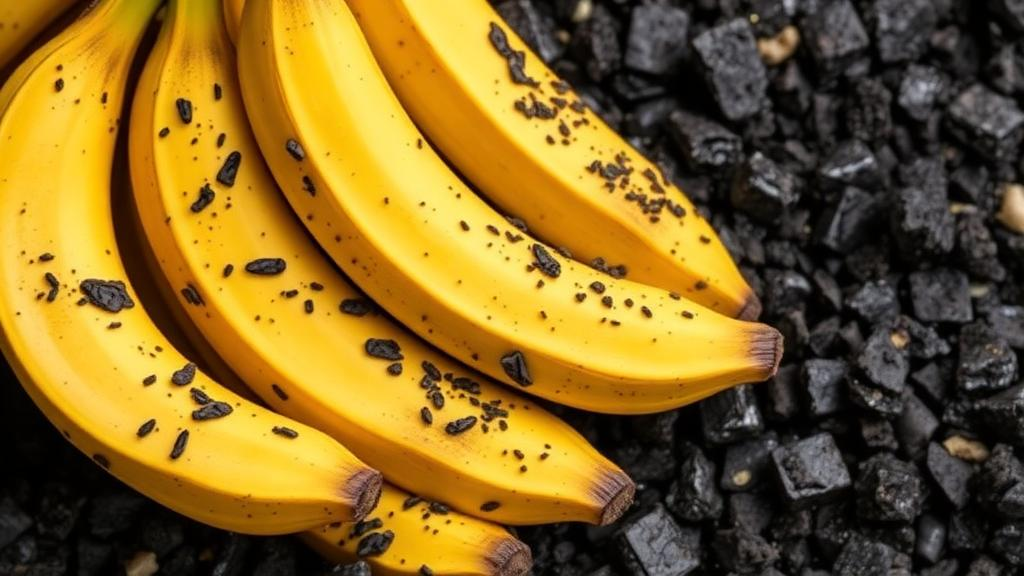
The study’s authors are careful to frame these results as a paired proof of concept rather than a comprehensive screening, and they acknowledge open questions, including the need for soluble-potassium and potassium-free controls, quantification of potassium leaching, catalyst reuse trials, and full elemental mass balances. Nevertheless, the implications are compelling. The best catalyst for maximizing biocrude yield was not the most porous one but the one richest in a naturally occurring alkali metal, meaning that the cheapest, least-processed waste char may outperform its engineered counterpart depending on the process objective. For a world drowning in sludge and food waste, the idea that banana peels discarded after breakfast could help transform a city’s sewage into liquid fuel is a vivid demonstration of circular bioenergy, where the byproducts of one waste stream become the key that unlocks the value of another.
Subject of Research: Waste-derived potassium-modified activated biochars as catalysts for sewage-sludge hydrothermal liquefaction
Article Title: Comparative preparation of waste-derived K-modified activated biochars and proof-of-concept application in sewage-sludge hydrothermal liquefaction
Article References: Ismail, R., Mariyam, S., Alherbawi, M., & Al-Ansari, T. (2026). Comparative preparation of waste-derived K-modified activated biochars and proof-of-concept application in sewage-sludge hydrothermal liquefaction. Case Studies in Chemical and Environmental Engineering, 14, Article 101493. https://doi.org/10.1016/j.cscee.2026.101493
Image Credits: AI Generated
DOI: 10.1016/j.cscee.2026.101493
Keywords: biochar, hydrothermal liquefaction, sewage sludge, banana peel, potassium carbonate activation, biocrude, pyrolysis, waste valorization, catalysis, renewable energy, BET surface area, circular economy
Bethany Barker. (October 4, 2026). Banana Peels Turn Into Catalysts That Boost Bio-Oil From Sewage Sludge. Scienmag.