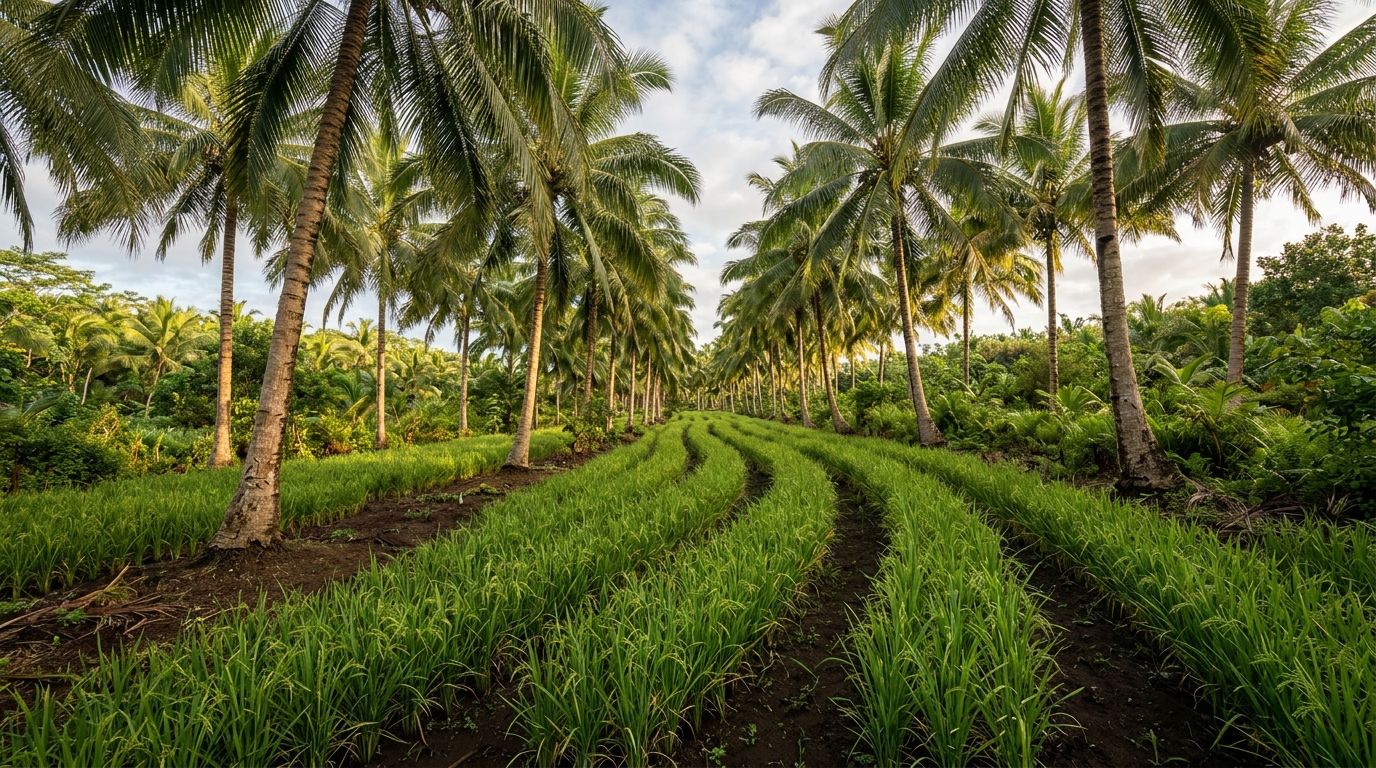
Upland rice lines bred for Indonesia’s drylands do not all respond the same way to a single dose of fertilizer, according to a field study conducted inside a mature coconut plantation in North Halmahera, Indonesia. Ten advanced Gamagora rice lines and the check variety Inpago 12 were grown under two different NPK application timings, and the results revealed significant genotype-by-timing interactions for every panicle and grain-component trait the researchers measured. Under the early application timing, Gamagora 7 and Gamagora 9 stood out with grain productivities of 1.41 and 1.40 tonnes per hectare, respectively, while the check variety Inpago 12 produced 0.83 tonnes per hectare. The study, published in Frontiers in Agronomy, was designed as a site- and season-specific agronomic evaluation rather than a test of an optimum fertilizer schedule.
The experiment took place from January to June 2022 in Beringin Agung Village, West Kao Subdistrict, in North Halmahera Regency, North Maluku Province. The site sits within a dryland coconut plantation of mature trees aged roughly 32 to 47 years, planted between 1975 and 1990 at a spacing of 10 by 10 meters. Rather than placing plots directly beneath the coconut canopy, the researchers established the rice in an open area within the plantation complex where no coconut trunks were present inside the experimental plots. This distinction matters for interpretation, because the study did not measure within-canopy photosynthetically active radiation, canopy cover, coconut leaf area index, root competition, or plot-level soil moisture, so it cannot speak directly to tree-crop interaction processes.
Environmental conditions at the site reflected a humid tropical climate. Data from the Gamar Malamo Meteorological Station in Kao Subdistrict indicated a mean monthly temperature of 26.2 to 27.0 degrees Celsius, relative humidity of 88.9 to 92.4 percent, an average meteorological sunshine percentage of 54.92 percent, and total annual rainfall in 2022 of 2,780.1 millimeters. The authors caution that the sunshine figure is a station-level meteorological variable and should not be read as a measurement of light availability within the plantation itself. The soil at the site, characterized in previous work, had a pH of 6.5, potential P2O5 and K2O contents of 78.00 and 60.33 milligrams per 100 grams, a cation exchange capacity of 11.59 centimoles of charge per kilogram, and total nitrogen of 0.27 percent. The area is predominantly covered by volcanic-derived Latosols according to the regional soil map.
The plant materials consisted of ten Gamagora lines, developed through hybridization or mutation breeding at the Center for Agrotechnology Innovation at Universitas Gadjah Mada in Yogyakarta, alongside the upland variety Inpago 12 as a check. The lines carry diverse pedigrees, including crosses such as Aek Sibundang/M11, Fatmawati/IR64//Memberamo/Ciherang, and Sintanur//IR64//Memberamo/Ciherang, as well as mutation-bred lines derived from Lampung Kuning, Rojolele Klaten, Mayangsari, and Lakatesan. M11 and M12, referenced in the pedigrees, are mutant-derived lines developed from the local varieties Anak Daro and Dusel. This genetic diversity set the stage for testing whether the lines would diverge in their agronomic responses to fertilizer timing.
The experimental design was a factorial randomized complete block design with three blocks. The first factor was the 11 rice genotypes, and the second was fertilizer application timing at either 14 or 35 days after sowing. That produced 22 genotype-by-timing combinations per block and 66 plots in total, with treatments randomized within each block along the field slope to account for spatial heterogeneity. Every treatment received a single complete application of 100 kilograms per hectare of compound NPK 15:15:15 fertilizer, described as an experimental low-input rate equivalent to 15 kilograms each of N, P2O5, and K2O per hectare. Crucially, the experiment included no unfertilized control, no full-rate treatment, no split application, and no standard farmer-practice schedule, which means the design permits comparison of the two tested single-application timings at one rate but cannot estimate rate effects or determine an optimum fertilizer programme.
Crop management followed low-input dryland practice. Rice was established by direct seeding using the dibbling method, with 3 to 5 seeds per planting hole at a spacing of 20 by 40 centimeters. Weeds were controlled with herbicide at 28 days after sowing, and pest management targeted rice stink bugs, stem borers, and rice-eating birds, with protective nets installed around the experimental area to reduce bird damage during grain filling and maturation. Harvesting occurred at physiological maturity, when approximately 85 to 90 percent of the panicles had turned yellow. The researchers measured plant height and effective tillers at the booting stage, and panicle and grain-component traits at harvest, sampling two representative panicles from two sample hills in each plot.
The statistical analysis, conducted in SAS using the General Linear Model procedure, revealed significant genotype-by-fertilizer-timing interactions for all six panicle and grain-component traits evaluated: number of grains per panicle, number of unfilled grains per panicle, unfilled-grain percentage, number of non-detached grains per panicle, grain detachment percentage, and thousand-grain weight. These interactions indicate that the response of each trait to fertilizer timing differed among genotypes. For instance, the highest number of grains per panicle was recorded by Gamagora 7 under the 35-day application at 318.67 grains per panicle, while Gamagora 5 showed a numerically higher value under 14 days, though the difference between timings was not significant for that line. Gamagora 3 maintained a high number of grains per panicle under both timings, with a numerically higher value at 35 days that was not statistically significant.
Unfilled grains and grain detachment told a more nuanced story. The highest number of unfilled grains per panicle was recorded by Gamagora 5 under the 14-day application at 145.3 grains, and the highest unfilled-grain percentage was also Gamagora 5 under 14 days at 58.86 percent. Gamagora 1, 5, 7, and 9 all showed significantly higher numbers of unfilled grains under 14 days than under 35 days. For non-detached grains, assessed by manually pressing individual panicles and counting what remained attached, Gamagora 5 under 14 days again recorded the highest value at 158.0 grains per panicle, significantly different from all other treatment combinations. Lines G1, G5, G6, G7, G8, and G9 showed significant differences in this trait between timings, with higher values under 14 days, while G2, G3, G4, G10, and the check showed no significant differences. The highest grain detachment percentages appeared for Gamagora 9 under 35 days at 94.97 percent, the check under 14 days at 94.50 percent, and several other lines under 35 days, though most genotypes showed no significant difference in detachment between timings except Gamagora 6 and Gamagora 8.
Thousand-grain weight also varied significantly among genotype-by-timing combinations. The highest value was recorded by Gamagora 4 under the 35-day application at 30.65 grams, which did not differ significantly from Gamagora 4 under 14 days at 30.00 grams. Several genotypes, including G1, G2, G3, G4, G5, G6, G7, G10, and the check, showed significant differences in thousand-grain weight between timings, whereas G8 and G9 did not. Correlation analysis added further texture: the number of grains per panicle was positively correlated with unfilled grains and non-detached grains but negatively correlated with thousand-grain weight, and the percentage of unfilled grains was strongly correlated with the number of unfilled grains at a coefficient of 0.960. Principal component analysis on the 14-day data, covering 33 observations from 11 genotypes across three blocks, showed that the first two components explained 69.5 percent of total variation, with grain productivity closely aligned with grains per panicle and non-detached grains in multivariate space.
The authors are careful to frame what these results do and do not establish. Because harvest-plot grain yield was measured only under the 14-day application, the data cannot be used to compare grain productivity between the two timings or to infer a timing effect on yield. The study also did not measure nutrient uptake, nutrient-use efficiency, canopy light environment, soil moisture, plant physiological responses, contemporary plot-soil conditions, or economic performance, and it evaluated only two single-application timings at one reduced NPK rate without unfertilized, full-rate, split-application, or farmer-practice controls. What the work does show is genotype-specific agronomic response under the specific conditions of one site and one season, with Gamagora 7 and Gamagora 9 warranting further evaluation across seasons and locations to assess consistency. Further studies with additional timings, rates, and appropriate controls, the authors conclude, are needed before broader agronomic recommendations can be made.
Subject of Research: Agronomic responses of upland rice genotypes to two NPK fertilizer application timings in a coconut-based dryland agroforestry system in North Halmahera, Indonesia
Article Title: Agronomic responses of upland rice lines to two NPK application timings in a coconut-based dryland agroforestry system
Article References: Sulistiono, W., Sakiroh, Aji, H. B., Saefudin, Wibawa, W., Qodarrohman, M., La Kamisi, H., Hannan, M. F. I., Anshori, A., Syafi, S., Taryono, Alam, T., Li’aini, A. S., & Apriyana, Y. (2026). Agronomic responses of upland rice lines to two NPK application timings in a coconut-based dryland agroforestry system. Frontiers in Agronomy, 8, Article 1916751. https://doi.org/10.3389/fagro.2026.1916751
Image Credits: AI Generated
DOI: 10.3389/fagro.2026.1916751
Keywords: upland rice, NPK application timing, coconut agroforestry, genotype-by-management interaction, grain productivity, North Halmahera, Gamagora lines, Inpago 12, dryland cropping, fertilizer management, agronomic traits, Indonesia
News Source: Alan Morgan. (November 5, 2026). Upland Rice Lines Show Genotype-Specific Responses to NPK Timing in Coconut Agroforestry. Scienmag.