• HOME
  • NEWS
  • EXPLORE
    • CAREER
      • Companies
      • Jobs
    • EVENTS
    • iGEM
      • News
      • Team
    • PHOTOS
    • VIDEO
    • WIKI
  • BLOG
  • COMMUNITY
    • FACEBOOK
    • INSTAGRAM
    • TWITTER
Saturday, May 23, 2026
BIOENGINEER.ORG
No Result
View All Result
  • Login
  • HOME
  • NEWS
  • EXPLORE
    • CAREER
      • Companies
      • Jobs
        • Lecturer
        • PhD Studentship
        • Postdoc
        • Research Assistant
    • EVENTS
    • iGEM
      • News
      • Team
    • PHOTOS
    • VIDEO
    • WIKI
  • BLOG
  • COMMUNITY
    • FACEBOOK
    • INSTAGRAM
    • TWITTER
  • HOME
  • NEWS
  • EXPLORE
    • CAREER
      • Companies
      • Jobs
        • Lecturer
        • PhD Studentship
        • Postdoc
        • Research Assistant
    • EVENTS
    • iGEM
      • News
      • Team
    • PHOTOS
    • VIDEO
    • WIKI
  • BLOG
  • COMMUNITY
    • FACEBOOK
    • INSTAGRAM
    • TWITTER
No Result
View All Result
Bioengineer.org
No Result
View All Result
Home NEWS Science News Chemistry

Unusual electron sharing found in cool crystal

Bioengineer by Bioengineer
July 31, 2020
in Chemistry
Reading Time: 3 mins read
0
IMAGE
Share on FacebookShare on TwitterShare on LinkedinShare on RedditShare on Telegram

IMAGE

Credit: Yoshihiko Okamoto

A team of scientists led by Nagoya University in Japan has detected a highly unusual atomic configuration in a tungsten-based material. Until now, the atomic configuration had only been seen in trihydrogen, an ion that exists in between star systems in space. The findings, published in the journal Nature Communications, suggest further studies could reveal compounds with interesting electronic properties.

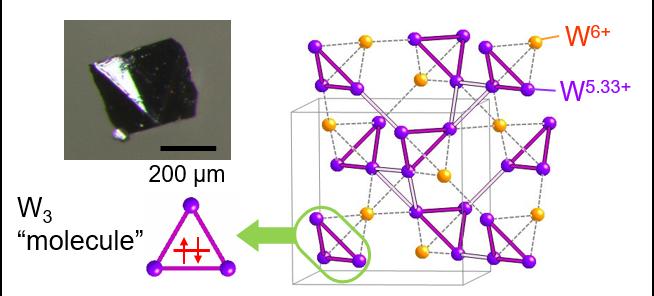
Atoms that make up humans and trees and kitchen tables generally bond together by sharing electrons – think of electrons as the atomic glue of life. Nagoya University applied physicist Yoshihiko Okamoto and colleagues have found a highly unusual version of this glue: a regular triangular molecule was formed of three atoms bonded together by two electrons.

“This type of bond had only previously been seen in the trihydrogen ions found in interstellar material,” says Okamoto. “We were excited to see this configuration in a cooled tungsten-based crystal.”

The so-called tritungsten molecules were discovered in single crystals of caesium tungsten oxide (CsW2O6) cooled below -58°C. CsW2O6 conducts electricity at room temperature but changes into an insulating material when it is cooled below -58°C. It has been a challenge to study how the atomic structure of this type of material changes in response to temperature. To overcome this, Okamoto and his colleagues in Japan synthesized very pure single crystals of CsW2O6 and bombarded them with X-ray beams at room temperature and -58°C.

The tungsten molecules in the conducting crystal form three-dimensional networks of tetrahedral pyramids connected at their corners, known as a pyrochlore structure. The bonds between the molecules form due to a symmetrical sharing of electrons between them.

However, when the compound is cooled, the electrons re-arrange and two types of tungsten atoms emerge within the tetrahedra, each with a different ‘valence’, or bonding power with other atoms. This, in turn, distorts the lengths of tungsten bonds with oxygen atoms in the compound, leading to a more compressed shape. Importantly, the tungsten atoms with lower valence form small and large triangles on the sides of the tungsten tetrahedra, with the highly unusual tritungsten molecules forming on the small triangles. The three tungsten atoms forming the points of these triangles share only two electrons between them to keep them bonded together.

“To our knowledge, CsW2O6 is the only example where this type of bond formation, where several atoms share only a few electrons, appears as a phase transition,” says Okamoto.

The team aims to further investigate compounds with pyrochlore structures, with the ultimate goal of discovering materials with new and interesting properties.

###

The paper, “Regular-triangle trimer and charge order preserving the Anderson condition in the pyrochlore structure of CsW2O6,” has been published in the journal Nature Communications at DOI: 10.1038/s41467-020-16873-7.

Contact: Yoshihiko Okamoto

Graduate School of Engineering, Nagoya University

Email: [email protected]

Media Contact
Yoshihiko Okamoto
[email protected]

Original Source

http://en.nagoya-u.ac.jp/research/activities/news/2020/07/unusual-electron-sharing-found-in-cool-crystal.html

Related Journal Article

http://dx.doi.org/10.1038/s41467-020-16873-7

Tags: Chemistry/Physics/Materials SciencesMaterials
Share12Tweet8Share2ShareShareShare2

Related Posts

Study Reveals How Valproate Affects Early Brain Development: Insights into the Antiepileptic Drug’s Impact — Chemistry

Study Reveals How Valproate Affects Early Brain Development: Insights into the Antiepileptic Drug’s Impact

May 22, 2026
Sustainable Chemistry: Iron Replaces Noble Metals in Catalytic Reactions — Chemistry

Sustainable Chemistry: Iron Replaces Noble Metals in Catalytic Reactions

May 22, 2026

Advancing Thin-Film Device Manufacturing with Imaging Ellipsometry for Enhanced Process Control

May 22, 2026

Simple Adjustment in 3D Printing Enhances Fit of Dental Crowns

May 22, 2026
Please login to join discussion

POPULAR NEWS

  • blank

    New Study Reveals Plants Can Detect the Sound of Rain

    734 shares
    Share 293 Tweet 183
  • ESMO 2025: mRNA COVID Vaccines Enhance Efficacy of Cancer Immunotherapy

    311 shares
    Share 124 Tweet 78
  • Research Indicates Potential Connection Between Prenatal Medication Exposure and Elevated Autism Risk

    847 shares
    Share 339 Tweet 212
  • Common Food Preservatives Associated with Elevated Blood Pressure and Increased Heart Disease Risk

    55 shares
    Share 22 Tweet 14

About

We bring you the latest biotechnology news from best research centers and universities around the world. Check our website.

Follow us

Recent News

Assessing Osteoporotic Pelvis Fracture Score Feasibility

Eco-Friendly Pomegranate Peel Carbon Removes Amoxicillin

CD5L Protein Shields Kidneys by Reducing Oxidative Stress

Subscribe to Blog via Email

Enter your email address to subscribe to this blog and receive notifications of new posts by email.

Join 83 other subscribers
  • Contact Us

Bioengineer.org © Copyright 2023 All Rights Reserved.

Welcome Back!

Login to your account below

Forgotten Password?

Retrieve your password

Please enter your username or email address to reset your password.

Log In
No Result
View All Result
  • Homepages
    • Home Page 1
    • Home Page 2
  • News
  • National
  • Business
  • Health
  • Lifestyle
  • Science

Bioengineer.org © Copyright 2023 All Rights Reserved.