A ribosome-associated quality-control system in unstressed yeast preferentially tracks messenger RNAs encoding proteins predicted to be disordered. Researchers compared wild-type Saccharomyces cerevisiae with cells lacking the chaperone Zuo1 and found that 1,461 transcripts accumulated when Zuo1 was absent. Proteins encoded by these so-called Zuo1 targets had greater predicted disorder, were enriched in positively charged amino acids, were depleted in proline and were generally shorter than proteins encoded by other transcripts. Ribosome profiling also showed that more than 95% of the targets carried more ribosomes when Zuo1 was present. Together, the observations support a model in which Zuo1 responds to the structural state of a protein as it emerges from the ribosome, slowing translation when compact folding is difficult and thereby promoting recognition of the transcript by co-translational decay machinery.
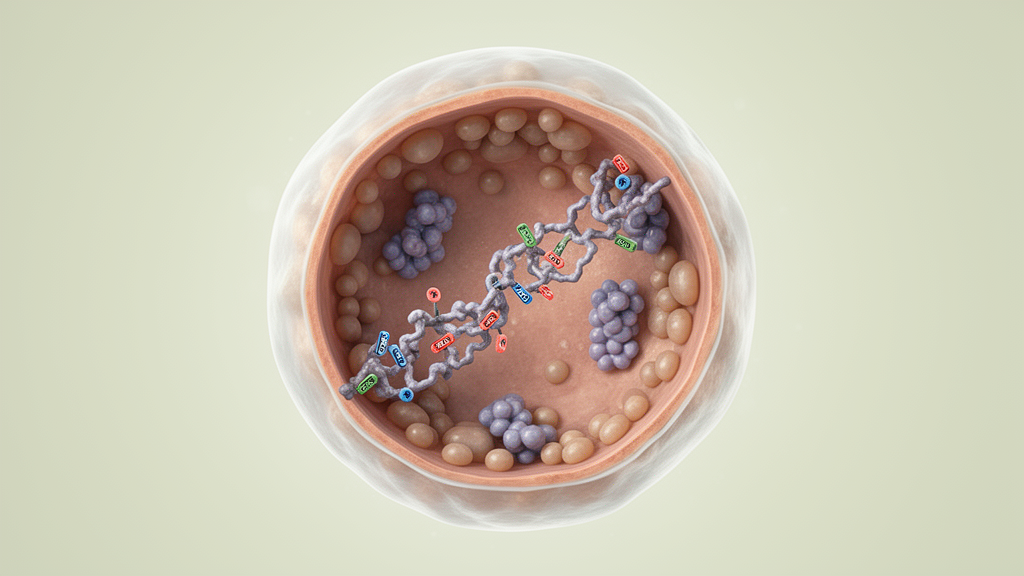
Zuo1, also called Zuotin, is an HSP40 chaperone associated with the ribosome and its exit tunnel, where newly synthesized proteins emerge. It operates with the non-canonical HSP70 cofactor Ssz1 in the ribosome-associated chaperone complex. Zuo1 simultaneously interacts with the nascent peptide and 18S ribosomal RNA helix 44, which extends toward the ribosomal A site, where codons are decoded. This arrangement provides a potential connection between the physical state of the emerging chain and ribosome movement. Earlier experiments showed that Zuo1 slows elongating ribosomes when nascent chains misfold. The slowed or abnormally moving ribosomes can then be recognized by co-translational mRNA-decay pathways, including nonstop decay, no-go decay and codon optimality-mediated decay. The study examined which naturally occurring transcripts engage this system when yeast cells are not exposed to experimental folding stress.
To avoid the broad secondary effects associated with heat, oxidative stress or the folding inhibitor L-azetidine-2-carboxylic acid, the investigators analyzed unstressed yeast cells. They used bulk RNA sequencing to measure steady-state transcript abundance and ribosome profiling to sequence ribosome-protected mRNA fragments and quantify ribosome binding. The comparison was restricted to 5,133 verified and uncharacterized open reading frames annotated in the Saccharomyces Genome Database. Dubious open reading frames, genes within ribosomal DNA repeats and subtelomeric Y′ elements were excluded to reduce annotation and ribosomal RNA-derived artifacts; this filtering had minimal effects on the composition of the differentially expressed gene sets. A transcript with increased abundance in the zuo1Δ strain was classified as a Zuo1 target because its accumulation implied that Zuo1 normally limits its abundance. The analysis identified 1,461 such upregulated transcripts, along with 1,600 transcripts whose abundance decreased after Zuo1 deletion, while 3,672 other transcripts formed the non-upregulated reference group.
The proteins encoded by Zuo1 targets showed a notable difference in predicted structural order. AlphaFold’s per-residue local distance difference test score, or pLDDT, measures confidence in a predicted local structure. Low scores are strongly associated with disorder, whereas high scores indicate well-ordered regions. Proteins encoded by Zuo1 targets had a median mean pLDDT of 77.0, compared with 85.8 for proteins encoded by transcripts that decreased in abundance in zuo1Δ cells. The targets also had a greater fraction of residues with pLDDT below 50, the threshold used to classify disordered residues, and a smaller fraction with pLDDT above 90, the threshold used to identify highly ordered residues. Across the transcriptome, lower mean pLDDT was associated with a larger increase in transcript abundance following Zuo1 deletion. This was an association between a predicted protein property and a steady-state RNA measurement, not a direct observation of protein folding or transcript decay in individual cells.
Because pLDDT can be influenced by the depth of the multiple sequence alignment available for a protein, the researchers also tested whether the association could be an artifact of the prediction method. They applied five alignment-free, sequence-based disorder predictors: IUPred in its short-disorder configuration, ESpritz in its X-ray and NMR configurations, MobiDB-lite and DisEMBL. All five indicated greater disorder among proteins encoded by Zuo1 targets than among proteins encoded by transcripts that were not upregulated after Zuo1 deletion. The difference was larger when the targets were compared with the 1,600 transcripts whose abundance fell in zuo1Δ cells. Agreement among these methods supports the interpretation that the association reflects sequence-encoded disorder rather than a peculiarity of AlphaFold confidence scores. The absence of Zuo1 alone also did not induce the canonical proteotoxic responses associated with loss of proteostasis, suggesting that the identified cohort represented physiological targets rather than transcripts affected by an induced stress response.
Amino-acid composition supplied additional characteristics of the target cohort. Relative to non-upregulated genes, Zuo1 targets encoded proteins enriched in lysine and arginine, the two positively charged residues, and depleted in proline. Their proteins were also shorter. Each feature tracked with the magnitude of transcript accumulation in zuo1Δ cells: positively charged residue fraction correlated positively with accumulation, while proline frequency and protein length correlated negatively with it. Positively charged amino acids can slow ribosomes through electrostatic interactions with the negatively charged surface of the ribosomal exit tunnel. The present data, however, cannot distinguish whether Zuo1 responds directly to the charge of the nascent chain or indirectly to structural consequences of highly charged sequences. The positive-charge enrichment was only modestly correlated with predicted disorder, while proline frequency was positively correlated with disorder. The depletion of proline also distinguishes these targets from the substrate class associated with proline-induced elongation stalling.
Ribosome profiling provided a translation-level counterpart to the steady-state RNA measurements. Ribosome density for each transcript was calculated by normalizing ribosome-protected fragment counts to the corresponding steady-state mRNA level. More than 95% of Zuo1 target transcripts showed higher ribosome occupancy in wild-type cells than in zuo1Δ cells, with a Wilcoxon signed-rank test yielding p = 9 × 10⁻²²⁹. The same directional pattern was not observed across the genome as a whole, arguing against a nonspecific global effect of Zuo1 deletion on translation. Instead, the occupancy increase was concentrated on a defined set of transcripts. Transcripts encoding more disordered proteins also showed a larger ratio of wild-type to deletion-strain ribosome occupancy, both when disorder was measured with IUPred and when it was inferred from mean AlphaFold pLDDT. The relationship remained nearly unchanged after adjustment for wild-type expression level and open reading frame length, with an adjusted disorder slope of 0.146. The trend was nevertheless shallow, and the investigators described it as consistent with, rather than direct proof of, preferential ribosome slowing.
These findings refine the interpretation of Zuo1-mediated surveillance. An intrinsically disordered protein does not misfold in the conventional sense because it never adopts a stable folded structure. Zuo1 may therefore respond to the absence of a compact structure appearing at the ribosomal exit channel rather than to the presence of one particular misfolded species. This interpretation is consistent with earlier reporter experiments in which differently shuffled HIS3 open reading frames with no capacity to fold efficiently triggered Zuo1-dependent slowing and decay. Those constructs produced decay intermediates of different sizes, indicating that the response depended on how the nascent chain folded rather than on an exact ribosome position within the RNA. The endogenous cohort examined here exhibits the same general property, although the current experiments do not directly reveal the conformational events sensed by the chaperone or localize the precise sites of ribosome slowing within individual transcripts.
The identification of transcripts encoding disordered proteins as potential surveillance substrates raises an unresolved question about how those transcripts remain expressed. Disordered proteins are abundant, functional and in many cases essential. One possibility is that Zuo1 surveillance imposes a tolerated cost on this class of transcripts, keeping their steady-state abundance below the level their transcription rate might otherwise produce. Alternatively, particular disordered transcripts could escape decay through co-translational binding partners or other ribosome-associated factors acting downstream of Zuo1. Steady-state abundance cannot distinguish these possibilities. Direct measurements of individual transcript decay rates, such as transcription-shutoff experiments, would be needed to establish whether accumulation in zuo1Δ cells specifically reflects stabilization rather than altered transcription. The present data therefore define a broad endogenous cohort and its associations, but do not assign decay rates or exemption mechanisms to individual Zuo1 targets.
Several limitations constrain the conclusions. RNA sequencing measures steady-state abundance rather than transcript stability, and deleting Zuo1 can produce effects beyond the surveillance pathway under study. The disorder association persisted across different gene-set comparisons and prediction methods, and the ribosome-occupancy trend remained after adjustment for expression level and open reading frame length, but the latter relationship was modest. Positional analysis of ribosome density within individual target open reading frames, together with examination of cells deficient in co-translational decay factors, would be needed to strengthen the causal connection between Zuo1-dependent slowing and transcript degradation. Even with those limitations, the study provides the first broad characterization of endogenous Zuo1 substrates in yeast. By combining RNA sequencing, ribosome profiling and multiple disorder predictors, it links a ribosome-associated chaperone to the predicted structural state of emerging proteins under normal, unstressed conditions.
Subject of Research: Zuo1-mediated mRNA surveillance of nascent protein disorder in unstressed yeast
Article Title: Endogenous targets of Zuo1-mediated mRNA surveillance encode proteins with higher predicted disorder
Article References: Chang, S., & Coller, J. (2026). Endogenous targets of Zuo1-mediated mRNA surveillance encode proteins with higher predicted disorder. iScience, 29(11), Article 117945. https://doi.org/10.1016/j.isci.2026.117945
Image Credits: AI Generated
DOI: 10.1016/j.isci.2026.117945
Keywords: Zuo1, mRNA surveillance, protein disorder, ribosome profiling, co-translational decay, yeast, nascent protein folding, ribosome-associated chaperone, RNA sequencing, proteostasis, Endogenous, targets
News Source: Denise Maddox. (October 21, 2026). Unstressed yeast study links Zuo1 surveillance to predicted protein disorder. Scienmag.