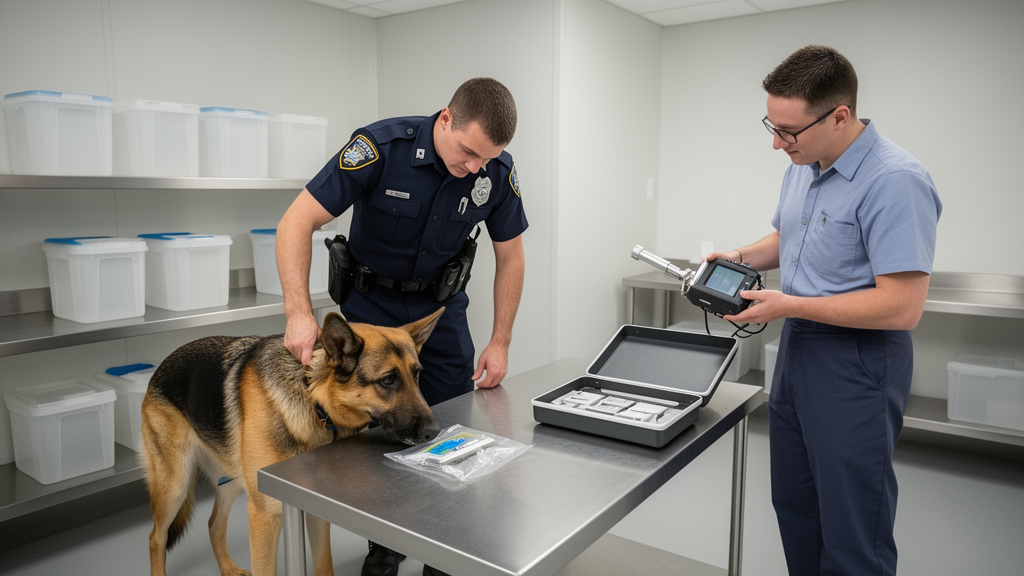
An electronic nose sampled odours around a clandestine grave in a pilot observational study that compared chemical detection with the independent searches of police cadaver detection dogs. The University of Technology Sydney research, published in PLOS One, tested NOS.E at a site where human remains had been buried for more than three months, assessing whether the instrument could identify buried remains and help validate dogs’ alerts. NOS.E collected samples from the burial site and surrounding control areas while the dogs searched separately, allowing researchers to compare a machine-readable chemical signal with canine behaviour without either system directly guiding the other.
Lead author Dr Amber O. Brown said cadaver detection dogs are among the best tools for locating buried human remains, although the specific odours they detect are not fully understood. The study asked whether an electronic nose could detect human remains and provide an objective means of evaluating whether dog training is working. The instrument was developed through collaboration between forensic science and engineering researchers at UTS and moves technology developed in the laboratory into field conditions. Rather than replacing dogs, the researchers describe NOS.E as a complementary tool: dogs can search an area rapidly, while the electronic nose measures chemical signals that humans can analyse and interpret.
One reason training is difficult is that decomposition is not associated with one stable scent. Human remains pass through five distinct decomposition stages, each producing different odours at different concentrations. Dogs therefore face a more complex target than a substance with a relatively consistent chemical profile. Brown said tracking those changes in real time may help trainers identify whether dogs need additional exposure to earlier or later stages. The electronic nose may also reveal whether a dog is responding to decomposition odours or to some other cue, a concern particularly relevant for younger dogs. Associate Professor Maiken Ueland, Director of the Australian Facility for Taphonomic Experimental Research, said this could give trainers greater certainty by showing whether decomposition odours are present in an area, including at locations where a dog does not alert.
The result is a single-site case study rather than a general performance test. NOS.E sampled the burial site and surrounding control locations, and police dogs worked independently at the site, but the evidence does not establish how well either method would perform across different environments, decomposition stages, handlers, dogs or burial conditions. The authors have proposed a larger, longer-term study involving multiple donors, more dogs and repeated site visits. They also identify a major methodological challenge: maintaining rigorous controls so dogs and handlers do not become familiar with a site or pick up unintended clues. The pilot therefore supports the further evaluation of electronic-nose technology as a training aid, but does not establish that it can independently locate human remains or outperform trained detection dogs.
Ueland said the project demonstrates the value of direct collaboration between researchers and police, who identified dog training as a potential application that the engineering team had not originally considered. The chemical measurements may also help bridge the gap between the complex scent information available to a dog and the signals that can be documented by an instrument. In mass disasters or other hazardous settings, she said an electronic nose could offer an additional way to search without exposing people or dogs to danger, although that possible use was not evaluated in this pilot. Overall, the study positions NOS.E as an objective complement to cadaver detection dogs: canine searches provide rapid behavioural alerts, while electronic-nose sampling can measure the presence and chemical characteristics of decomposition odours and test whether an alert is consistent with the site conditions.
Subject of Research: Pilot comparison of an electronic nose and cadaver detection dogs for identifying buried human remains and validating canine alerts.
Article Title: Electronic nose puts police detection dogs to the test
Article References: Electronic nose puts police detection dogs to the test. Original publication (Bibliographic details unavailable.)
Image Credits: AI Generated
DOI: Not provided
Keywords: electronic nose, cadaver detection dogs, human remains, decomposition odours, forensic science, dog training, buried remains, chemical sensing, UTS, PLOS One, Electronic, nose
News Source: William Thompson. (October 21, 2026). Pilot test compares electronic nose and police detection dogs. Scienmag.