In a single-patient case report, a 77-year-old man with severe heart failure underwent percutaneous coronary intervention on the only functioning coronary conduit remaining after years of graft failure and chronic total occlusion. The procedure combined a mechanical heart pump called Impella CP with a drug-coated balloon used as a bailout when a second stent could not be delivered. The intervention restored full coronary flow, and the patient was discharged two days later without angina at three-month follow-up. The outcome demonstrates the feasibility of a carefully staged “protected PCI” strategy in exceptionally difficult anatomy, although a case report cannot establish that the same approach will produce similar results in other patients.
The patient had undergone triple-vessel coronary artery bypass grafting 22 years earlier, receiving a left internal mammary artery graft to the left anterior descending artery and saphenous vein grafts to the right coronary artery and an obtuse marginal branch. By the time of his current admission, both vein grafts and all three native epicardial coronary arteries were chronically totally occluded. His left ventricular ejection fraction was only 25–30%, with diffuse hypokinesia and severe functional mitral regurgitation, while chronic obstructive pulmonary disease and an 80-pack-year smoking history added substantial comorbidity. He reported increasing exertional angina and heart-failure symptoms classified as Canadian Cardiovascular Society class III and New York Heart Association class III.
An angiogram performed six months earlier had shown that the LIMA-to-LAD graft was the sole functional conduit. It supplied the LAD territory directly and provided collateral perfusion to the right coronary and circumflex territories through septal and epicardial connections. Two severe, sequential stenoses obstructed the graft system: one at the distal LIMA-to-LAD anastomosis and another farther down the native LAD near its bifurcation with the second diagonal branch. A Heart Team considered the anatomy and operative risk, but two independent cardiothoracic surgeons declined redo bypass surgery. With medical therapy unable to control his symptoms, the clinicians treated complex, high-risk indicated PCI as the feasible revascularization option.
The team planned the intervention with percutaneous mechanical circulatory support in place before manipulating the coronary artery, reasoning that temporary loss of flow in the graft could interrupt perfusion to the entire left ventricle. Computed tomography indicated that the common femoral and iliac arteries were large enough for the planned access, despite mild-to-moderate iliac stenosis. Operators inserted an Impella CP with SmartAssist through a 14-F sheath in the left femoral artery and used a 6-F internal mammary artery guiding catheter from the ipsilateral radial artery. The pump ran for two hours at performance level P9, reaching a peak supported flow of 3.8 litres per minute, while unfractionated heparin was administered according to activated clotting time targets.
Crossing the lesions proved difficult because of severe angulation and the bifurcation geometry. After several guidewire approaches failed, the operators used a Sion wire supported by a Corsair Pro XS microcatheter. During this maneuver, the wire entered the second diagonal branch, where selective contrast injection confirmed its position and excluded wire-induced dissection. Repositioning the microcatheter redirected the wire toward the distal LAD, and the lesion was ultimately crossed. Immediately afterward, contrast opacification disappeared from the distal anastomosis and beyond. The clinicians considered a graft pseudolesion, spasm, or an iatrogenic dissection, but intracoronary nitroglycerin, additional vasodilator therapy, and gentle wire pullback failed to restore flow.
Because there was no clearly defined landing zone for a stent, the operators performed balloon angioplasty with two semi-compliant balloons and then a non-compliant balloon inflated at 18 atmospheres. This restored only partial flow, classified as TIMI grade 2, without a flow-limiting dissection, suggesting that device-induced vessel deformation might have contributed to the earlier interruption. Stent delivery then became the central problem. The operators advanced a 6-F Guidezilla extension catheter deep into the distal LIMA through an “inchworming” maneuver, using a balloon to help move the extension forward. They implanted a 2.5-by-16-mm Firehawk Liberty drug-eluting stent at the distal anastomosis at 20 atmospheres, creating a scaffold that supported further catheter advancement.
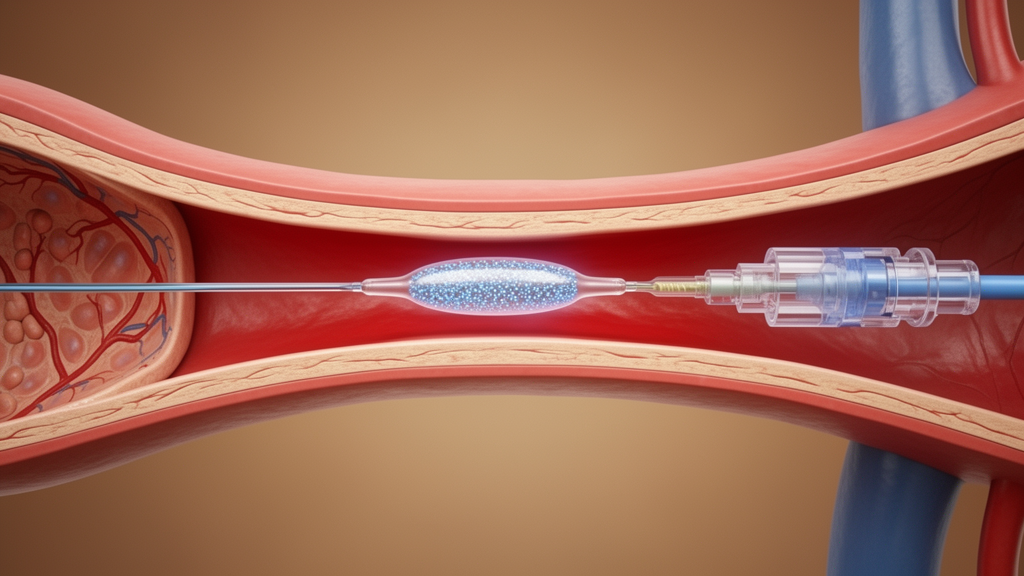
A second drug-eluting stent could not reach the more distant native LAD lesion despite multiple buddy wires and supportive catheter configurations. Angiography then showed renewed loss of antegrade flow beyond the first stent, with appearances consistent with an advanced iatrogenic dissection. A second stent would ordinarily be the preferred treatment for such a complication, but the long, tortuous graft and marked deliverability limitations made further stenting impractical. The clinicians therefore selected a lower-profile paclitaxel-coated balloon as a bailout. After non-compliant balloon preparation, they inflated a 2.5-by-15-mm drug-coated balloon at 12 atmospheres for 60 seconds. Final angiography showed no residual stenosis and TIMI grade 3 flow, leaving only a minor, non-flow-limiting type B dissection that was managed conservatively.
The mechanical support was not without cost. About 20 minutes before completion, the patient developed pain and clinical evidence of left lower-limb ischemia, attributed to the large 14-F femoral sheath in the setting of peripheral arterial disease. Because he remained hemodynamically stable, the team promptly stopped and removed Impella, then closed the access site with two suture-mediated devices. A local hematoma extended across the inguinal ligament, but no major vascular complication occurred and the limb symptoms resolved. The patient stayed in hospital for another two days without major complications and was discharged ambulatory on guideline-directed heart-failure therapy and dual antiplatelet therapy with aspirin and clopogrel, planned for at least 12 months.
At one- and three-month follow-up, the patient remained free of angina and had improved to NYHA functional class II. An implantable cardioverter-defibrillator was inserted at three months for primary prevention of sudden cardiac death, following the team’s earlier plan to reassess arrhythmic risk after revascularization. Follow-up invasive coronary angiography is planned at 12 months to assess the angiographic durability of the hybrid drug-eluting-stent and drug-coated-balloon strategy and help guide decisions about antiplatelet duration. The case is chiefly instructional: Impella maintained systemic perfusion during a prolonged period of compromised coronary flow, deep guide-extension support enabled the first stent implantation, and drug-coated balloon angioplasty restored full flow when another stent could not be delivered. Its value lies in documenting those rescue steps in one patient, not in demonstrating a general clinical benefit of bailout drug-coated balloons or prophylactic mechanical support across the broader population of high-risk PCI.
Subject of Research: Protected PCI of a last remaining LIMA-to-LAD graft using Impella and bailout drug-coated balloon angioplasty
Article Title: Case Report: Impella CP-protected percutaneous coronary intervention of the last remaining vessel—a LIMA-to-LAD graft—complicated by no-reflow and rescued with a drug-coated balloon
Article References: Toulgaridis, F., Tzortzis, S., Tsiamis, N., Sassalos, K., Karanikolas, N., Mavrogenis, I., Kitsiou, A., & Triantis, G. (2026). Case Report: Impella CP-protected percutaneous coronary intervention of the last remaining vessel—a LIMA-to-LAD graft—complicated by no-reflow and rescued with a drug-coated balloon. Frontiers in Cardiovascular Medicine, 13, Article 1951936. https://doi.org/10.3389/fcvm.2026.1951936
Image Credits: AI Generated
DOI: 10.3389/fcvm.2026.1951936
Keywords: Impella CP, drug-coated balloon, percutaneous coronary intervention, LIMA-to-LAD graft, last remaining coronary vessel, mechanical circulatory support, coronary no-reflow, high-risk PCI, coronary dissection, Case, Report, Impella
News Source: Ophelia Keating. (October 21, 2026). Drug-Coated Balloon Rescues Last Remaining Coronary Graft in Protected PCI. Scienmag.