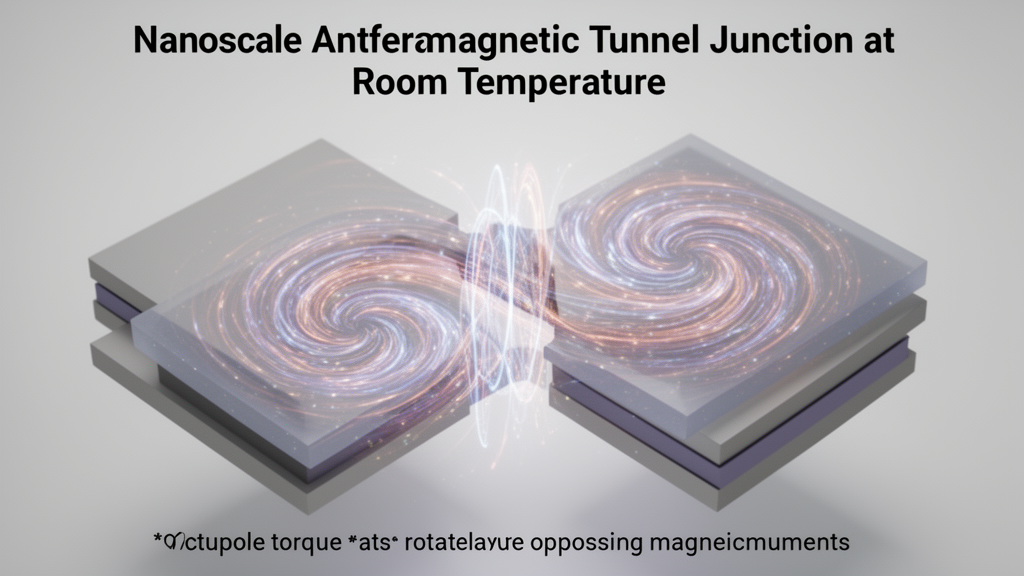
Researchers have demonstrated current-induced switching in an all-antiferromagnetic tunnel junction, identifying the mechanism as octupole-driven spin-transfer torque. Nanoscale devices made from two antiferromagnetic PtMn3 layers separated by an MgO tunnel barrier switched at room temperature, exhibited a tunnelling magnetoresistance of 363% and required switching current densities of the order of 10 MA cm−2. The study reports the antiferromagnetic counterpart of spin-transfer torque in a junction whose total electric current is spin-neutral.
Magnetic tunnel junctions based on ferromagnets are established elements of spintronics because they combine electrical detection of magnetic order with electrical control of that order. The two relevant effects are tunnelling magnetoresistance and spin-transfer torque. All-antiferromagnetic tunnel junctions, or AATJs, use magnetic materials with no net magnetization.
Previous work had shown that AATJs based on chiral antiferromagnets can exhibit tunnelling magnetoresistance. According to the study, that response is associated with non-relativistic, momentum-dependent spin polarization and a cluster magnetic octupole moment, both of which are manifestations of a spin-split band structure. The new result addresses the reciprocal effect: rather than merely using a magnetic state to produce an electrical signal, the researchers used electrical current to switch the antiferromagnetic configuration.
The devices had a PtMn3|MgO|PtMn3 structure and were tested at the nanoscale. The reported tunnelling magnetoresistance reached 363% at room temperature, while the current densities needed to induce switching were of the order of 10 million amperes per square centimetre. The device structure and the two-terminal nature of the switching experiment are consistent with an electrically written and electrically read magnetic state.
What makes the observed torque different from its ferromagnetic counterpart is the condition of the total current. In an all-antiferromagnetic junction, the net electric current is spin-neutral, yet the current can still act on the magnetic order. The team’s theoretical modelling attributes this effect to an imbalance between intra- and inter-sublattice spin currents across the AATJ.
Equivalently, the model relates the torque to the non-zero net cluster octupole polarization of each PtMn3 layer. These are two descriptions of the same modelled mechanism, rather than separate experimental outcomes. The modelling also examines the sublattice-projected conduction channels of PtMn3 as a function of the parallel component of the wave vector, written as k|| in the reported figure.
This analysis links the electronic structure of the chiral antiferromagnet to the current imbalance that drives the switching. The result is a microscopic account of why a spin-neutral total current can produce a torque: the currents associated with the antiferromagnetic sublattices do not contribute in a completely interchangeable way to the device response. Calling the effect octupole-driven spin-transfer torque identifies the relevant magnetic degree of freedom and distinguishes it from the conventional ferromagnetic mechanism.
In the reported PtMn3 system, the measured effect is linked to the cluster octupole polarization that accompanies the material’s spin-split band structure. The experiments establish that this antiferromagnetic response can support both switching and a substantial tunnelling magnetoresistance in the same class of device, addressing an assumption that the two effects could not coexist at sizeable levels in an AATJ. The authors present the work as a new materials platform for antiferromagnetic spintronics and a potential pathway toward deeply scaled magnetic memory and room-temperature terahertz technologies.
Those are proposed directions for further development rather than demonstrated applications. The reported evidence is confined to nanoscale PtMn3|MgO|PtMn3 junctions, their observed room-temperature switching and 363% tunnelling magnetoresistance, and a theoretical model of the torque. It shows that electrical control need not rely on a net magnetization carried by the entire magnetic system.
Instead, the researchers demonstrate that a spin-neutral current, resolved into unequal intra- and inter-sublattice spin currents, can switch a chiral antiferromagnetic junction and that the same material platform can provide a large room-temperature tunnelling magnetoresistance. The central achievement is therefore both electrical and conceptual: a reciprocal, octupole-associated form of spin-transfer torque has been observed and explained in an all-antiferromagnetic tunnel junction.
Subject of Research: Room-temperature current-induced switching of PtMn3 all-antiferromagnetic tunnel junctions
Article Title: Octupole-driven spin torque switching of antiferromagnetic tunnel junctions
Article References: Kang, J., Hamdi, M., Cheung, S. K., Yuan, L.-D., Elekhtiar, M., Matt, E., Rogers, W., Meo, A., Lim, P. G., Tey, M. S. N., D’Addario, A., Konakanchi, S. T., Athas, J., Arpaci, S., Devincenti, A., Wan, L., Mehta, S. C., Zogbi, N., Sangwan, V. K., … Khalili Amiri, P. (2026). Octupole-driven spin torque switching of antiferromagnetic tunnel junctions. Nature. https://doi.org/10.1038/s41586-026-11172-5
Image Credits: AI Generated
DOI: 10.1038/s41586-026-11172-5
Keywords: antiferromagnetic spintronics, spin-transfer torque, tunnelling magnetoresistance, PtMn3, magnetic octupole, magnetic tunnel junctions, room-temperature switching, chiral antiferromagnets, spin-split bands, Octupole-driven, spin, torque
News Source: Denise Maddox. (October 21, 2026). Octupole torque switches antiferromagnetic tunnel junctions at room temperature. Scienmag.