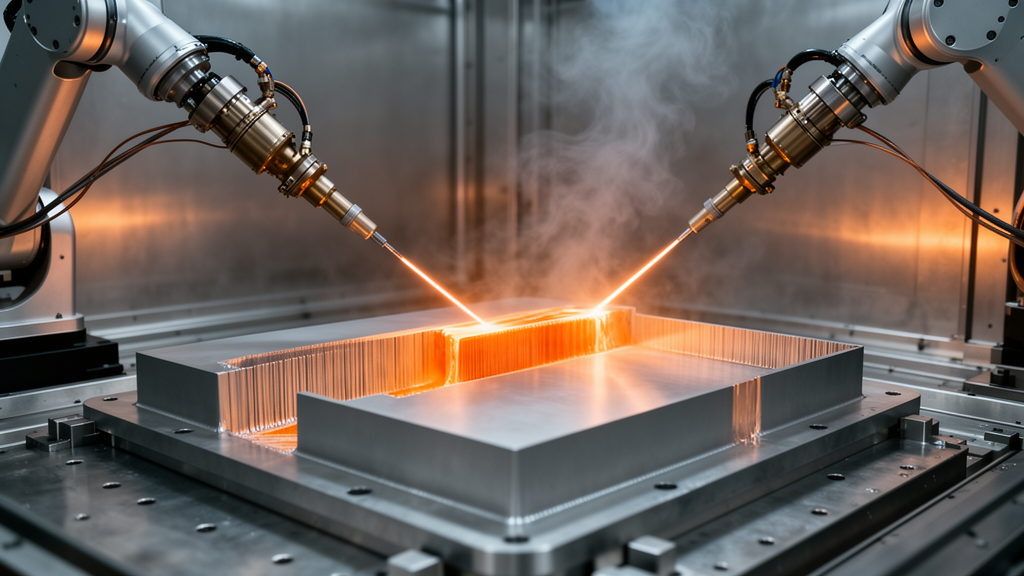
A comprehensive review of wire arc additive manufacturing (WAAM) of Ti-6Al-4V finds that the process can build large titanium components rapidly, but performance depends on controlling heat accumulation, grain structure, residual stresses and defects. The review, published in the Journal of Materials Science: Metallurgy, synthesizes how arc power sources, deposition paths, thermal management, atmospheric protection and post-processing affect the alloy from molten metal to final component. WAAM, also called arc-based directed energy deposition, melts titanium wire with an electric arc and deposits it layer by layer.
The approach offers high deposition rates and a large build envelope, making it attractive for aerospace, automotive and marine applications, while surface finish, dimensional accuracy, anisotropy and fatigue performance remain important limitations. The central finding is that WAAM Ti-6Al-4V cannot be treated as a uniform material. Repeated heating changes the alloy as each new layer is deposited, producing spatial gradients in phase morphology, grain orientation, hardness, residual stress and mechanical behavior.
The alloy contains 6 wt% aluminum and 4 wt% vanadium, which stabilize its alpha and beta phases. Its columnar prior-beta grains often grow epitaxially from the substrate through successive layers, while the alpha laths within them vary with local cooling and reheating. Reported prior-beta grain sizes range from about 0.2 to 4 millimeters.
The review identifies the moving heat source, deposited geometry and later thermal cycles as central mechanisms linking process settings to structure and properties. Three main arc configurations provide different compromises. Gas tungsten arc welding uses a non-consumable tungsten electrode and typically deposits 1 to 2 kilograms per hour.
It is clean and relatively spatter-free, can handle one or two wires, and can be pulsed to alter the thermal profile and reduce porosity. Plasma arc welding constricts the arc inside a nozzle, raising current density and enabling deposition rates of 2 to 4 kilograms per hour. The concentrated arc improves stability and can remove surface oxide through cathode atomization, but greater heat accumulation can increase distortion, grain coarsening and tensile residual stress.
Gas metal arc welding uses consumable wire and reaches 3 to 4 kilograms per hour, or about 9.5 kilograms per hour with a tandem arrangement, but conventional operation is prone to unstable arcs and spatter. Cold metal transfer offers a lower-heat GMAW variant by retracting the wire during short-circuit periods. The review reports that it can reduce heat input by roughly 30 to 50% and dilution from the typical GMAW range of 20 to 30% to below 10%, while producing less spatter.
Its behavior can be adjusted through short-circuit, globular, spray, synergic and pulse-advanced transfer modes. In one comparison, CMT-WAAM Ti-6Al-4V thin walls had a finer, more uniform alpha-lamellar distribution, an average microhardness of 328.9 HV, a tensile strength of 1,045 megapascals and 30.15% elongation compared with a conventional GMA-arc counterpart. These results apply to the tested material and conditions; they do not establish universal performance for every WAAM configuration.
Because Ti-6Al-4V conducts heat at only about 6.7 watts per meter-kelvin, layer-by-layer deposition can create a hot, distorted build with pronounced thermal gradients. The review describes several ways researchers have attempted to dissipate heat, including electric preheating of wire, interlayer dwell periods, forced-air or liquid-carbon-dioxide cooling, progressively reducing heat input as the build rises, fractal-like scanning paths and toolpaths optimized through thermal simulation. A comparison found dwell time more influential than cooling-gas flow under the conditions examined, showing that equipment settings cannot be generalized without considering geometry and build height.
Torch weaving at 1 hertz combined with a low-heat “coldArc” regime also disrupted epitaxial columnar growth and produced a lower-aspect-ratio prior-beta structure and more uniform transformation products. Hybrid processing offers a route to reduce anisotropy, the tendency for strength and ductility to vary with loading direction. Hot forging can create a fully equiaxed microstructure, and one study reported an ultimate tensile strength rising from 961 to 1,137 megapascals and elongation from 8.8% to 15.2%.
In-situ interpass rolling is especially effective because reheating during the next deposition can generate annealing twins and recrystallized grains. Post-process rolling and ultrasonic peening can also introduce compressive residual stress. In a large-scale comparison, hot isostatic pressing achieved full densification and the best overall performance among the treatments examined, while solution treatment and aging improved strength but produced comparatively small gains in fatigue-relevant properties.
These studies also show that strengthening and ductility do not always rise together. Atmospheric control is equally important because hot titanium readily absorbs oxygen, nitrogen and hydrogen. Local argon shielding can restrict oxygen pickup to tens or a few hundred parts per million, although lower regions of large builds may remain exposed as heat accumulates.
A sealed GTAW-WAAM chamber that maintained oxygen below 10 parts per million produced 99.98% near-theoretical density, a refined Widmanstatten microstructure, an ultimate tensile strength of 964 plus or minus 29 megapascals and a dry-sliding wear rate about 40% below conventionally manufactured Ti-6Al-4V. Another controlled study found that increasing oxygen from 1 to 1,000 parts per million raised hardness and tensile strength but reduced elongation from 11.5% to 9.5%. The review notes that direct comparison of local shielding and full enclosure under otherwise identical conditions is still needed.
Fatigue performance remains a demanding test because microscopic defects can override improvements in the bulk microstructure. The review specifically identifies gas pores and surface roughness as important factors in fatigue initiation and crack growth. Tomography of WAAM Ti-6Al-4V made with contaminated wire showed near-surface cracks growing around pores; pore growth accelerated late in life, between 20,000 and 28,000 cycles, equivalent to 65 to 85% of fatigue life.
Samples containing critical pores larger than 100 micrometers had substantially lower fatigue life than nominally defect-free specimens, even though their as-built microstructures and tensile strengths were similar. Clustering of gas porosity also governed fatigue life across process-varied and heat-treated conditions in a large-scale study, reinforcing that microstructural refinement alone cannot guarantee durability. The review’s outlook points toward integrated process design rather than a single universal recipe.
Fractal scanning, pulsed sources, interpass cooling, heat treatment and in-situ deformation are presented as complementary approaches whose effects must be assessed together. Important unanswered questions include how to optimize scanning for residual stress, which grain-refining strategy best balances strength and ductility, and how residual stress affects fatigue-crack growth. Direct evidence linking these variables remains sparse, and the review excludes comprehensive treatment of process monitoring, closed-loop control, digital twins, qualification, certification and high-temperature creep.
Its conclusion is nevertheless clear: WAAM can deliver large Ti-6Al-4V components at high deposition rates, but structural performance emerges from the combined physics of the arc, melt pool, thermal cycling and post-processing, not from deposition speed alone.
Subject of Research: Review of WAAM Ti-6Al-4V process, microstructure, residual stress and mechanical performance
Article Title: Wire arc additive manufacturing of Ti-6Al-4 V alloy: a review
Article References: Mendiratta, M., Chakkravarthy, V., Satish Idury, K. S. N., Singh, N. K., Smirnov, S. A., Tsai, J.-T., Evlashin, S., Chen, K., Zhang, L., Gushchina, M., Klimova-Korsmik, O., & Narayan, R. L. (2026). Wire arc additive manufacturing of Ti-6Al-4 V alloy: a review. Journal of Materials Science: Metallurgy, 1(1), Article 24. https://doi.org/10.1007/s44492-026-00025-x
Image Credits: AI Generated
DOI: 10.1007/s44492-026-00025-x
Keywords: wire arc additive manufacturing, Ti-6Al-4V, directed energy deposition, titanium alloys, microstructure, residual stress, tensile properties, fatigue life, thermal management, Wire, additive, manufacturing
News Source: Denise Maddox. (October 21, 2026). Research report: Wire arc additive manufacturing of Ti-6Al-4 V alloy: a review. Scienmag.