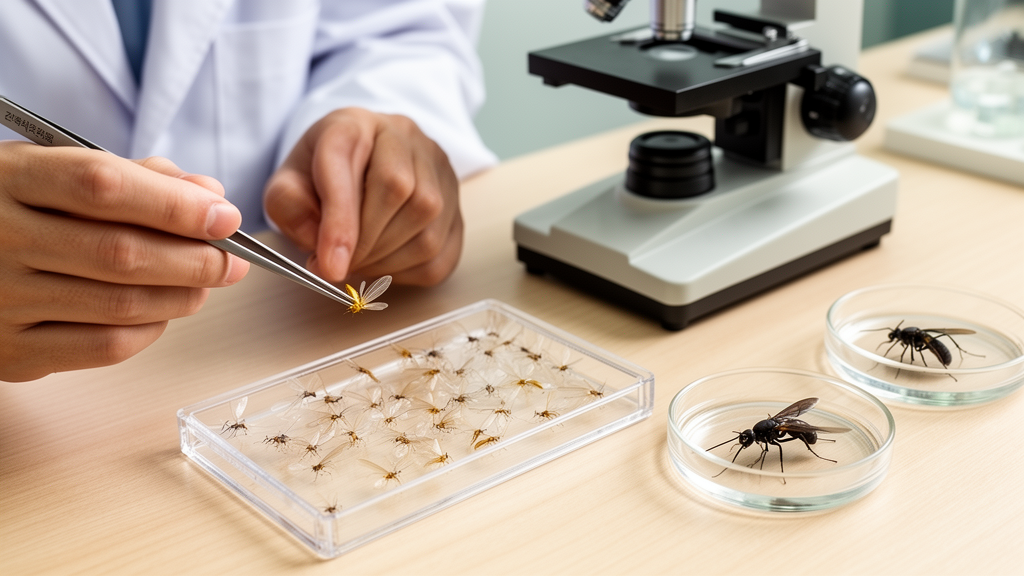
A country-wide inventory of Korean fairyflies has raised the documented South Korean fauna to 15 genera and 36 species, while describing two new species in the parasitoid wasp genus Zeyanus. One species, Zeyanus knuz, was identified from South Korea and Japan, and the other, Zeyanus sunayez, was described from South Korea with a male paratype from Japan. The taxonomic study also documents South Korean records for three species of Mymar and the first Taiwan record of Dicopomorpha koreana.
They examined material from the Korea National Insect Collection, the Korea National Arboretum in Pocheon, the Department of Entomology at Kyungpook National University, the R.M. Bohart Museum of Entomology at the University of California, Davis, and the Entomology Research Museum at the University of California, Riverside. Japanese Zeyanus specimens were borrowed from the Laboratory of Entomology at Meijo University in Nagoya. Most specimens deposited in the Korea National Arboretum and Kyungpook National University collections had been collected with Malaise traps, while Anagrus atomus was collected by sweeping.
The study used specimen morphology, diagnostic images and DNA sequences for selected females. The checklist reveals that knowledge of Korean fairyflies developed through scattered revisions and rearing studies rather than a sustained national survey. Jong Cheol Paik’s first 1974 report listed five genera, but the authors could not locate the voucher specimens.
Paik’s 1978 list included three identified and three unidentified species, and many records from the 1980s and 1990s concerned fairyflies reared from rice-feeding leafhoppers or planthoppers. Voucher material associated with the 1984 examination of Anagrus and Gonatocerus collected in the 1970s and early 1980s is also missing. These gaps matter because an observation cannot be reassessed securely when its physical basis is unavailable, and several historical identifications were later shown to conflict with the known distributions of the named species.
One South Korean record of Anagrus nigriventris was treated as a misidentification because the species is restricted to the New World, and another record of A. flaveolus was also excluded for the same biogeographic reason. The specimens formerly identified as A. nigriventris most likely belonged to A. incarnatus, although that replacement was not certain. The Korean identification of Anaphes gauthieri requires confirmation, and a later taxonomic review raised concerns about South Korean specimens identified as A. regulus, including a possible confusion with A. flavipes.
Elsewhere in the checklist, some Anaphes regulus distribution records may also require confirmation or represent misidentifications. The authors note that the true identity of that nominal species cannot be settled conclusively without molecular analysis of the dry-mounted lectotype, if DNA can be recovered from it at all. The study adds South Korean records for Mymar ermak, M. maritimum and M. pulchellum, all members of a genus that had previously been recorded in the country through the species Mymar taprobanicum.
DNA was extracted non-destructively from females of the three Mymar species, and mitochondrial cytochrome c oxidase subunit I, or COI, sequences were generated. The reported GenBank accessions were PZ377445, PZ377446 and PZ377447 for M. ermak, PZ377448 for M. pulchellum and PZ377449 for M. maritimum. The authors also cautioned that records of M. pulchellum outside the Palearctic region need confirmation through molecular methods.
A female of Dicopomorpha koreana collected in Xitou Forest, Nantou County, Taiwan, in 2017 constitutes a new record for Taiwan and for the genus Dicopomorpha. The species was described from South Korea in 2003 and had also been reported from India. The Taiwanese specimen was deposited in the National Museum of Natural Science in Taichung.
This range extension was based on a single female, so it adds a confirmed locality rather than a comprehensive account of the species’ distribution in Taiwan. Together with the three Mymar records, the finding expands the country-level checklist from the 31 species previously recognized to 36 species in 15 genera. The slide-mounted holotype came from a deciduous forest at Yawata, Asahi, Aichi Prefecture, on Honshu Island, Japan, where it was collected in 1998.
A Japanese paratype was collected at Katabira, Kani, Gifu Prefecture, in 2004, and two South Korean paratypes came from Gwangneung Forest in Gyeonggi-do. The species is distinguished by body coloration, antenna proportions, the number and arrangement of multiporous plate sensilla on the antennal segments, forewing microtrichia and the proportions of the ovipositor and metatibia. The dry-mounted holotype measured 1,750 micrometres in body length and 2,005 micrometres after slide mounting, while the dry-mounted paratypes ranged from 1,340 to 1,420 micrometres.
The male remains unknown. Zeyanus sunayez had the larger specimen series. Its South Korean holotype was collected at Gwangneung Forest in 2015 and is deposited at the National Institute of Biological Resources in Incheon.
Additional female specimens were collected in Gangwon-do, Gyeonggi-do, Gyeongsangbuk-do and Gyeongsangnam-do, while a male paratype came from Mount Yui on Amami Oshima in the Ryukyu Islands of Japan. Dry-mounted females measured 1,540 to 1,907 micrometres in body length, and ethanol-preserved females measured 1,683 to 1,997 micrometres. The holotype measured 1,866 micrometres before slide mounting and 2,091 micrometres afterward.
A COI sequence from a female paratype was deposited as PZ653912, and the species name is a reversed spelling of the genus name. Triapitsyn and colleagues updated their identification key for female Zeyanus to include all recognized species and both newly described taxa. Z. knuz was separated from Z. kweishuilini, a species known from southern Taiwan, partly through antennal sensilla, the dimensions of the antennal club and the number and position of forewing microtrichia.
Z. sunayez was distinguished from the Oriental species Z. asulcifrons by relatively longer funicular segments, different numbers of multiporous plate sensilla, a complete cubital row of forewing microtrichia and differences in body coloration. The molecular work was limited to a female paratype of Z. sunayez, and no COI data were reported for Z. knuz. Host information was unavailable for both new species, and the authors did not establish their hosts or ecological effects in South Korea or Japan.
Zeyanus is known from the Afrotropical, Oriental and eastern Palearctic regions, but its documented biology remains sparse. The only host association reported for the genus involved an unidentified Zeyanus species reared in Chonburi Province, Thailand, from an unidentified Ledra leafhopper attacking chili. The large body size observed in many Zeyanus species has been associated with the comparatively large leafhoppers of Ledrinae, but the authors explicitly describe this as a correlation and note that further rearings from Ledrinae would be needed to confirm the relationship.
Because the two new species were not recovered from hosts, the study provides no evidence that either is an effective biological control agent.
Subject of Research: Taxonomic inventory of South Korean fairyflies and descriptions of two new Zeyanus species
Article Title: Checklist of Korean Mymaridae ( Hymenoptera , Chalcidoidea ) with new records and descriptions of two new species of Zeyanus from South Korea and Japan
Article References: Triapitsyn, S. V., Kim, S., & Kang, I. (2026). Checklist of Korean Mymaridae (Hymenoptera, Chalcidoidea) with new records and descriptions of two new species of Zeyanus from South Korea and Japan. ZooKeys, 1295, 129-159. https://doi.org/10.3897/zookeys.1295.200780
Image Credits: AI Generated
DOI: 10.3897/zookeys.1295.200780
Keywords: fairyflies, Mymaridae, Zeyanus knuz, Zeyanus sunayez, South Korea, Japan, taxonomy, biodiversity, COI sequencing, parasitoid wasps, Checklist, Korean
News Source: Drew Townsend. (October 21, 2026). Korean fairyfly inventory documents 36 species and two new Zeyanus wasps. Scienmag.