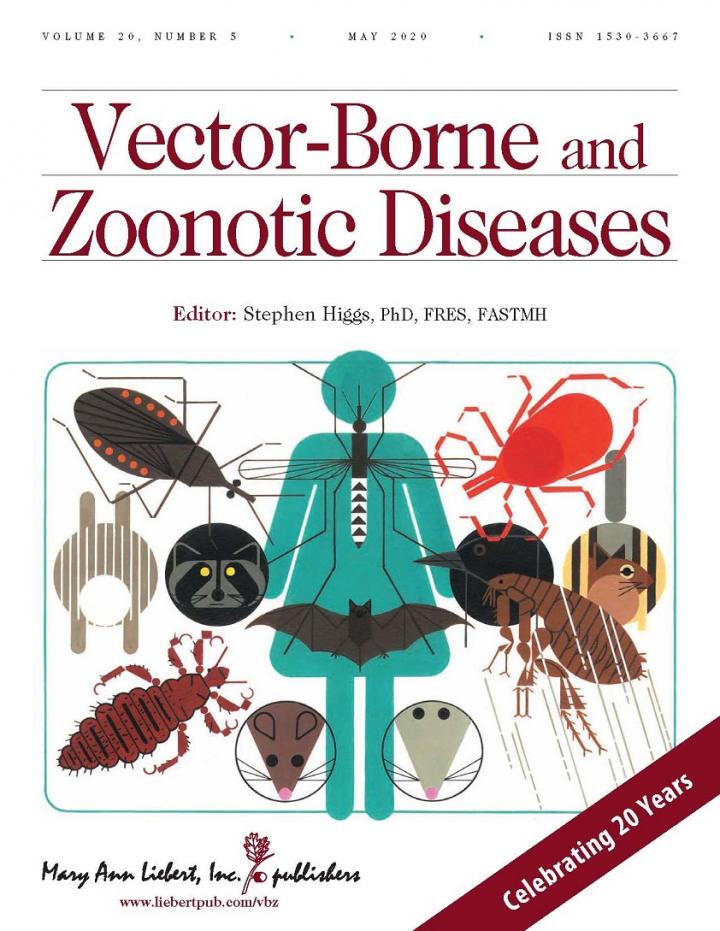
Credit: Mary Ann Liebert, Inc., publishers
New Rochelle, NY, May 7, 2020–A new paper identifies the critical need for ) on the ability of the COVID-19 virus to infect certain animal species, the transmissibility of infection between humans and those animals, and the impact infection could have on food security and the economy. The article, which focuses on companion animals, livestock and poultry, working animals such as military service dogs, and zoo species, is published in Vector-Borne and Zoonotic Disease, a peer-reviewed publication from Mary Ann Liebert, Inc., publishers. Click here to read the full-text article free on the Vector-Borne and Zoonotic Disease website.
The authors identify three urgent issues to consider: the potential for domesticated animals to transmit infection to humans and to contribute to community spread of disease; the impact on food security, economy, and trade if livestock and poultry are affected by coronavirus; and the effect on national security if the virus infects military service dogs and impairs their sense of smell, often used for tracking and to detect explosives and narcotics.
Tracey McNamara, DVM, DACVP, NAPf, Western University of Health Sciences (Pomona, CA), Juergen Richt, DVM PhD, Kansas State University (Manhattan, Kansas) and Larry Glickman, VMD, DrPH, Purdue University (West Lafayette, IN) coauthored the article entitled “A Critical Needs Assessment for Research in Companion Animals and Livestock Following the Pandemic of COVID-19 in Humans.”
Stringent studies are needed, with robust data collection, and not just anecdotal evidence. Dogs, cats, lions, and tigers have all already tested positive for the COVID-19 virus. Studies are needed on the transmissibility of the virus between animal species and between animals and humans, on the best diagnostic tests available for companion animals and livestock, and on how COVID-19 is expressed in animals.
“The potential for zoonotic SARS-CoV-2 to infect companion animals has been a topic of much discussion,” says Stephen Higgs, PhD, Editor-in-Chief of Vector-Borne and Zoonotic Diseases and Director, Biosecurity Research Institute, Kansas State University, Manhattan, KS. “With over 3 million cases of COVID-19 and over a quarter of a million deaths worldwide so far since January, it is vital that we understand the risks posed by domestic animals as a possible source for human infection. This review, brings all of what we know about SARS-CoV-2, pets, and other animals to our readership.”
###
About the Journal
Vector-Borne and Zoonotic Diseases is an authoritative peer-reviewed journal published monthly online with open access options and in print dedicated to diseases transmitted to humans by insects or animals. Led by says Stephen Higgs, Ph.D, Editor-in-Chief of Vector-Borne and Zoonotic Diseases and Director, Biosecurity Research Institute, Kansas State University, Manhattan, KS, the Journal covers a widespread group of vector and zoonotic-borne diseases including bacterial, chlamydial, rickettsial, viral, and parasitic zoonoses and provides a unique platform for basic and applied disease research. The Journal also examines geographic, seasonal, and other risk factors that influence the transmission, diagnosis, management, and prevention of zoonotic diseases that pose a threat to public health worldwide. Vector-Borne and Zoonotic Diseases is the official journal of SocZEE, the Society for Zoonotic Ecology and Epidemiology. Complete tables of content and a sample issue may be viewed on the Vector-Borne and Zoonotic Diseases website.
About the Publisher
Mary Ann Liebert, Inc., publishers is a privately held, fully integrated media company known for establishing authoritative peer-reviewed journals in many promising areas of science and biomedical research, including Viral Immunology, Health Securityand Foodborne Pathogens and Disease Its biotechnology trade magazine, GEN (Genetic Engineering & Biotechnology News), was the first in its field and is today the industry’s most widely read publication worldwide. A complete list of the firm’s 90 journals, books, and newsmagazines is available on the Mary Ann Liebert, Inc., publishers website.
Media Contact
Kathryn Ryan
[email protected]
Original Source
https:/
Related Journal Article
http://dx.