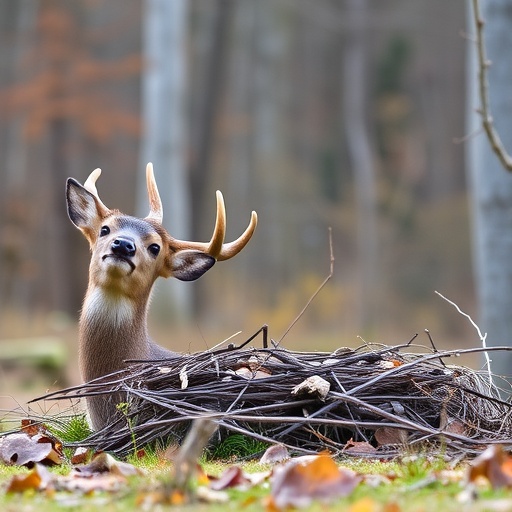
In a surprising turn of behavioral ecology, recent observations have unveiled an aggressive defense mechanism employed by the American woodcock (Scolopax minor), a ground-nesting shorebird known primarily for its cryptic plumage and elusive behaviors. Traditionally, these birds have been recognized for their distinctive bobbing gait and unique, nasal “peent” calls, yet rarely for confrontational behaviors. However, a compelling video captured by University of Maine researchers may represent the first documented evidence of these birds actively repelling white-tailed deer (Odocoileus virginianus) from their nesting grounds, challenging the long-held assumptions about the passive vulnerability of ground nests to large herbivores.
The prevailing wisdom in avian ecology posits that large herbivores like deer pose minimal threat to nesting birds, largely due to the inconspicuous nature of these mammals’ foraging habits and dietary preferences. Ground-nesting birds such as the American woodcock typically rely heavily on crypsis; their mottled plumage provides remarkable camouflage, enabling them to blend seamlessly into forest floors and leaf litter. When threatened by predators, woodcock have also been known to employ deceptive “broken wing” displays designed to divert attention away from their vulnerable eggs or chicks. Yet these strategies seem limited when confronted with the sheer size and persistence of a deer inadvertently invading their nesting territory.
Over the course of April 2024, researchers studying woodcock nesting behavior through strategically placed motion-activated cameras in West Virginia documented a series of rather extraordinary encounters. Of 73 recorded instances where deer approached nesting sites, six involved active defense behaviors exhibited by five individual hen woodcocks. These responses ranged from vocalizations and threatening postures to direct physical charges and even flight maneuvers towards the large intruders. Remarkably, these aggressive actions prompted the deer either to retreat leisurely or to flee outright, an outcome previously undocumented in avian-deer interactions.
Detailed analysis of the video footage reveals that the defense exhibited by woodcock hens is not a monolithic behavior but rather a spectrum of responses tailored to specific situational cues. Some hens maintained complete stillness, relying solely on their cryptic coloration to avoid detection. Others, arguably more desperate or secure in their defensive capabilities, opted for overt aggression – emitting characteristic calls and performing threat displays intended to dissuade the deer from further intrusion. This behavioral plasticity suggests a nuanced survival strategy that had not been comprehensively recognized in prior field studies.
The temporal aspect of woodcock incubation appears significant in modulating these defensive responses. Woodcock eggs require an incubation period of approximately three weeks, which is notably prolonged relative to similarly sized birds. This extended incubation likely increases the hen’s investment in the nest, enhancing her motivation to adopt aggressive nest defense tactics when potential threats are perceived. As Amber Roth, an associate professor collaborating on the project, emphasized, “The longer a hen sits, the more resolved she becomes to protect her nesting investment, employing anything from motionless camouflage to direct confrontation.”
Importantly, despite frequent deer presence—detected at nearly 68% of the monitored nesting sites—there was no evidence of eggs being consumed or nests being destroyed by these large herbivores. This finding challenges assumptions that deer are nest predators and instead portrays them as potential inadvertent threats due to their sheer physical presence and rooting behavior. The varying responses of woodcock hens underscore their ecological resilience and capacity to adapt behaviors according to perceived risk and environmental context.
From a broader ecological perspective, this research adds an intriguing layer of complexity to our understanding of interspecific interactions in forest ecosystems. Deer populations have been steadily increasing in many parts of eastern North America, sometimes reaching levels deemed overabundant. These population surges inevitably ripple through local ecosystems, impacting vegetation, competing wildlife, and predator-prey dynamics. The demonstration that woodcock hens actively defend nests from a vertebrate herbivore complicates the simplistic narrative of herbivore-nest predator dichotomies and calls for more integrative approaches to wildlife management.
The study represents a remarkable collaboration embedded within the Eastern Woodcock Migration Research Cooperative, a multinational initiative aimed at tracking and conserving this iconic migratory species. Co-founded by Erik Blomberg and Amber Roth, the cooperative leverages a network of researchers, government agencies, and conservation groups spanning 32 U.S. states and seven Canadian provinces. Through the deployment of over 700 GPS-tracked woodcock individuals, alongside ground-based observational methodologies, the team has aggregated an unprecedented dataset illuminating the species’ migratory patterns, habitat use, and behavioral ecology—including this new insight into nest defense against deer.
Lead researcher Kylie Brunette, a Ph.D. student in wildlife ecology at UMaine, articulated the significance of these findings: “Documenting woodcock aggression towards something as large as a deer reveals a hidden dimension of avian behavioral ecology. It raises compelling questions about how such defense strategies evolved and how they influence broader ecological interactions within forest communities.” This work not only expands basic scientific understanding but may also have practical implications for managing deer populations in regions critical for woodcock survival and reproduction.
The researchers utilized advanced videography equipment as part of their ongoing research efforts during the 2024 and 2025 nesting seasons. The footage provides rare visual confirmation that these small birds assess threats dynamically, employing both passive and active defensive measures. The behaviors observed suggest a refined risk-assessment mechanism, where hens weigh the potential danger posed by an approaching mammal and respond accordingly, balancing energy expenditure and nest survival probability.
This revelation holds considerable significance for conservation biologists and wildlife managers, emphasizing that ground-nesting birds can exhibit previously unnoticed behavioral flexibility when confronted by large, non-predatory mammals. It also underscores the importance of comprehensive monitoring techniques, such as video surveillance, in capturing subtle yet ecologically meaningful interactions among species.
As deer continue to expand their ranges and multiply in density—exacerbated in some locales by reduced predation and habitat changes—understanding how nesting songbirds and shorebirds coexist with these giants becomes increasingly urgent. The findings from this study advocate for a nuanced view that acknowledges the potential for conflict but also the adaptive responses that mitigate nest predation risks, which may be crucial for sustaining woodcock populations in the face of evolving ecological pressures.
The researchers have published their observations and conclusions in the journal Ecology, providing a rigorous review and placing these behaviors within the broader context of avian defense strategies and multi-species interactions. This peer-reviewed contribution invites additional inquiry and interdisciplinary collaboration to further elucidate the ecological roles and evolutionary pathways shaping such remarkable behaviors.
In sum, the American woodcock’s assertive responses to white-tailed deer presence reveal a compelling narrative of survival, adaptation, and interspecies dynamics that redefine long-standing assumptions in avian ecology. This discovery not only enriches our understanding of woodcock behavior but also highlights the subtle complexities embedded within natural ecosystems, where even small birds can stand resilient against the odds in defending their most precious assets—nests and progeny.
Subject of Research: Animals
Article Title: Oh deer! Videography reveals a range of defensive behaviors against a cervid by a ground-nesting bird
News Publication Date: 20-Jun-2026
Web References:
DOI Link: 10.1002/ecy.70448
Eastern Woodcock Migration Research Cooperative: https://umaine.edu/news/2024/11/umaine-leads-international-team-to-study-conserve-woodcock/
References:
Brunette K, Roth AM, Blomberg EJ, et al. Oh deer! Videography reveals a range of defensive behaviors against a cervid by a ground-nesting bird. Ecology. 2026; DOI:10.1002/ecy.70448.
Image Credits: University of Maine
Keywords: Migratory birds, Modern birds, Wild birds, Wildlife, Animals
Tags: American woodcock nest defenseavian behavioral ecologybird-deer conflict ecologydeer impact on bird nestsground nest vulnerabilityground-nesting bird protectionlarge herbivore threat to birdsUniversity of Maine wildlife researchwhite-tailed deer interactionwoodcock aggressive behaviorwoodcock camouflage strategieswoodcock deceptive displays